About Penstemon glaber Pursh
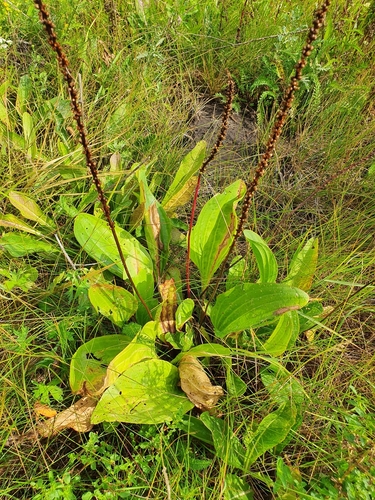
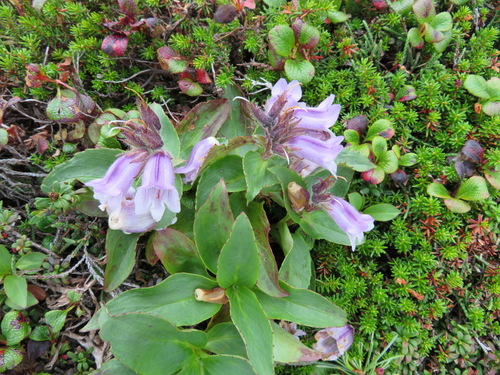
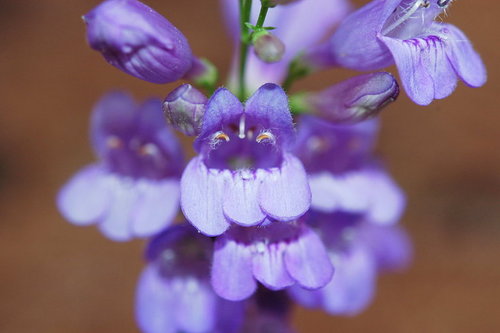
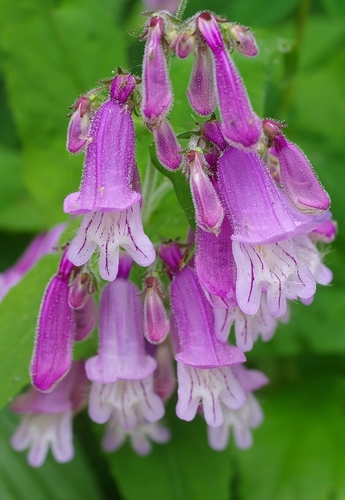
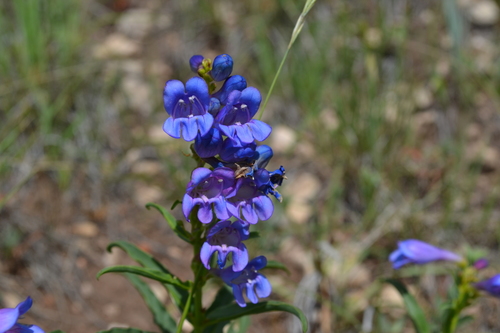
Penstemon glaber Pursh, also commonly called sawsepal penstemon, is a herbaceous plant. Its stems typically grow 50 to 65 centimeters (20 to 26 inches) tall, ranging from 10 to 80 centimeters (4 to 31 inches) overall. Stems and leaves are hairless, or covered in fine short usually erect hairs (puberulent) or fully covered in hairs (pubescent), and they are not glaucous. The plant has woody, fibrous roots. Leaves grow both at the plant base and along the stems, though basal leaves may sometimes be absent, greatly reduced in number, or smaller. All leaves have smooth edges. Lower stem (cauline) and basal leaves taper at their base to a leaf stem (petiole), measure 2 to 15.5 centimeters long by 0.5 to 4.5 centimeters wide (most often less than 8 cm long and 2 cm wide), and are shaped obovate, oblanceolate, or lanceolate (reversed teardrop, reversed spear-head with the wider portion past the midpoint, or spear-head with the widest part nearer the base respectively). The leaf tip may be blunt or pointed, and occasionally ends in a mucronate tip where the central leaf vein extends past the leaf blade. Leaves higher on the stems attach directly to the main stem without a petiole (sessile), with two to eight pairs of leaves growing on opposite sides of each stem. Upper leaves are 2.7 to 15 cm long, lanceolate in shape, with either a wide rounded tip or a narrow sharp tip. Their bases may be cordate, with heart-shaped lobes or ear-like projections that wrap around the stem, or simply have a squared base. The upper portion of each stem forms an inflorescence 3 to 30 centimeters long that is secund, meaning all flowers face the same direction. Flowers grow in three to twelve clusters from stem nodes, with egg-shaped to lanceolate bracts located just below each cluster. Each node has two branched flower stalks (cymes), each holding two to four flowers. The flower sepals are fused, with five lobes surrounding the base of the floral tube that have erose edges, meaning they look uneven as if nibbled. Flower color varies between individual plants, ranging from purple and blue-purple to rich turquoise blue; some plants have pink-blushed flower buds. The inside of the flower tube is paler, marked with dark red-purple nectar guides. Each flower is moderately two-lipped (bilabiate), with two lobes on the upper lip and three on the lower lip. Flowers are 24 to 48 millimeters long, with a diameter of 8 to 18 mm. The longer pair of stamens just reaches the flower opening, but all stamens are usually contained entirely within the floral tube. The sterile modified stamen (staminode) is sparsely covered in pale-yellow woolly hairs up to 1.5 mm long. The staminode is 15 to 22 mm long, so it may extend slightly past the flower mouth or be entirely contained inside the tube like the fertile stamens. The fruit is a capsule 10 to 17 mm long and 5 to 8 mm wide. Sawsepal penstemon grows across many North American states, ranging from northern Mexico northward through the United States along the Rocky Mountains. In Mexico, it only grows in the state of Chihuahua. In New Mexico it grows in the northern part of the state, from Union County to McKinley County. In Colorado it primarily grows east of the Continental Divide, in the mountains and the counties at the foot of the mountains. In Wyoming it grows throughout the state except for the southwestern corner, while it is only found in the western panhandle of Nebraska. It is primarily found in western South Dakota, and only occurs in a small number of scattered counties in North Dakota and Montana. The pollen wasp Pseudomasaris vespoides, which is thought to specialize in collecting pollen from Penstemon species, has been collected from sawsepal penstemon plants. Sawsepal penstemon is one of the more popular Penstemon species grown in gardens, both within and outside its native range. The varieties alpinus and brandegeei are specifically noted for being long-lived. Plants growing at high elevations are quite small and dainty, and seeds collected from populations at or above timberline produce small plants when grown, though not as small as the wild plants. The species tends to grow larger in gardens, and the variety brandegeei is particularly noted for its larger, basket-like form with many stems, in contrast to wild plants which only produce one to three stems. Excess watering or high rainfall can result in sprawling plants with pale flower color. Plants are hardy to temperatures as low as −20 °C (−4 °F), and can survive even lower temperatures when kept drier.