About Plantago hookeriana Fisch. & C.A.Mey.
Nomenclature and Classification
Plantago hookeriana, commonly known as Hooker's plantain, is a flowering plant species in the plantain family, Plantaginaceae.
Native Distribution
It is native to Texas and Louisiana in the United States, where it typically grows in disturbed sandy areas.
Growth Form
This species is an annual herb that grows from a taproot.
Leaf Characteristics
Its leaves are linear or lance-shaped; they may grow up to 30 centimeters (12 inches) long, though they are usually smaller.
Inflorescence Traits
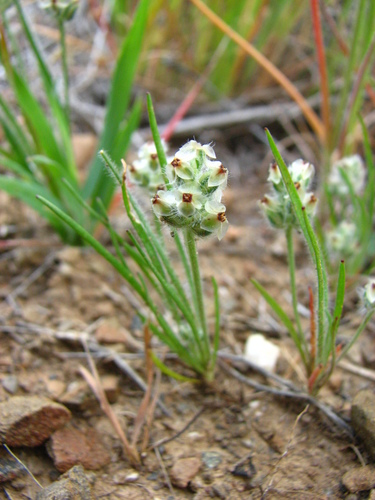
The inflorescence is a narrow spike that reaches up to 12 centimeters (4.7 inches) long.
Flower Appearance
Each small flower has whitish corolla lobes marked with brown spots or stripes.
Flowering Period
This species flowers in spring.
Cultivation Uses
It is planted to provide forage and to revegetate wildlife habitat and rangeland.
Wildlife Value
Its seeds feed many types of game birds, and its foliage is eaten by several types of animals including deer.
Etymology
The Latin specific epithet hookeriana honors William Jackson Hooker.