About Penstemon floridus Brandegee
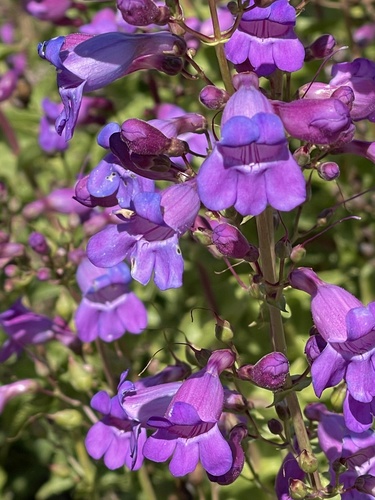
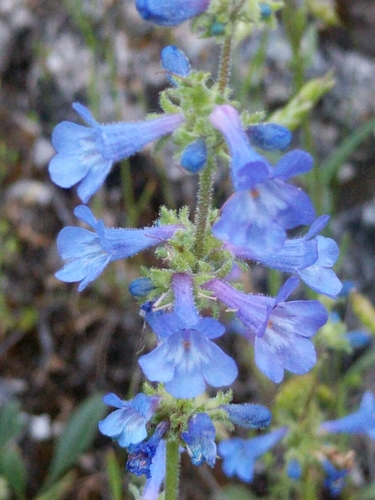
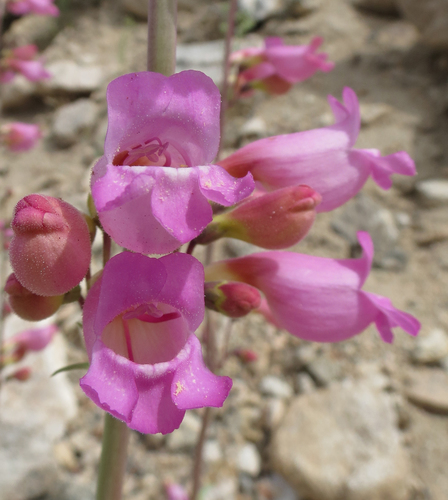
Penstemon floridus Brandegee is a herbaceous plant that reaches 50 to 120 centimeters (1.6 to 3.9 ft) in height at maturity. Its stems are either erect, or grow outward a short distance before curving upward. The stems are hairless and glaucous, covered in natural waxes that give them a pale gray or blue tint. This species produces both basal leaves (growing directly from the plant base) and cauline leaves (attached to the stems). The leaves are thick and typically dentate, with large teeth along their margins. Basal leaves and the lowest stem leaves have short petioles, measure 5 to 10 centimeters (2.0 to 3.9 in) long, and are usually 2 to 4.5 cm (0.79 to 1.77 in) wide, occasionally as narrow as 8 millimeters. These leaves occur in a range of shapes: obovate to ovate, oblanceolate, or lanceolate. Stems bear six to nine pairs of leaves. Upper stem leaves attach directly to the main stem by their bases, and may clasp the stem. The inflorescence, located at the tip of each stem, is hairy and glandular, 30 to 80 cm (1.0 to 2.6 ft) long, and holds nine to nineteen flower clusters. All flowers in the inflorescence face the same direction. The showy flowers are 2.1 to 3.2 cm long, with a wide throat that is narrower at the mouth; this trait is especially prominent in var. floridus, giving the flower a shape resembling an inflated pink pufferfish. The fused petals range in color from lavender to light pink, rose pink, or light yellow, and always have darker red nectar guide lines. Penstemon floridus is restricted to the deserts of Nevada and southern California. It grows in desert sagebrush and pinyon-juniper woodland communities, most often in gravelly soil in arroyos and canyons.