About Penstemon canescens (Britton) Britton
Scientific name: Penstemon canescens (Britton) Britton
Penstemon canescens is an herbaceous plant that produces one or more unbranched stems, which grow 20 to 80 centimeters (8 to 31 inches) tall, and are usually taller than 35 cm (14 inches). Stems are either erect (growing straight upward) or ascending (growing outward first before curving upward). Stems are always at least glandular-pubescent (covered in sticky glandular hairs) toward their tips, and very often covered entirely with backward-pointing hairs. This species produces both basal rosette leaves and cauline (stem-growing) leaves. Rosette leaves and the lowest cauline leaves measure 2.8–17 centimeters (1–6.5 inches) long and 1.1–4.2 centimeters (0.4–1.7 inches) wide. Their shape ranges from round (orbicular) to inverted egg-shaped (obovate) to elliptical, with tapered bases and irregularly serrated or wavy edges. Each stem bears 3 to 7 pairs of oppositely arranged leaves. Upper leaves are sessile (attached directly to the stem) or attached via very short petioles; they share the same length range as lower leaves but are narrower, at 0.9 to 4 centimeters wide, and are shaped from oblanceolate to lanceolate.
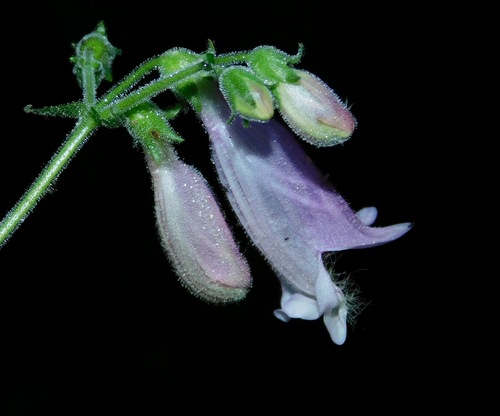
Flowers are pinkish-purple, pale purple, or violet, and grow in a terminal panicle. The corolla is tubular and two-lipped: the upper lip has two lobes, and the lower lip has three lobes. The throat of the corolla is white with purple stripes, and a yellow, hairy staminode extends out from the throat. Flowering typically occurs from May through July, but can start as early as April or end as late as September.
Penstemon canescens is native to the eastern United States, ranging north to Pennsylvania, south to Alabama, and west to Illinois. In Pennsylvania, it grows in south central mountain counties including Snyder, Huntingdon, and Bedford. It grows across much of Virginia, most commonly in western mountain counties; in West Virginia, it is mainly found in the eastern and southern parts of the state. It grows in the far western portions of North Carolina, and three counties at the western tip of South Carolina. It is almost entirely restricted to northern counties in Georgia, with one outlying population in Rockdale County. In Alabama, it is found in six widely scattered counties; in Tennessee, it grows mostly in the eastern half of the state with a few scattered locations in the west. Its populations are widely scattered across Kentucky, and it is found mostly in southern counties of Indiana. It has only been recorded in Franklin County, Illinois and Lawrence County, Ohio; occurrence records for Maryland are not available. This species requires well-drained soils to prevent root rot, and grows in forests, thickets, on cliffs, and in pine barrens.