About Penstemon angustifolius Nutt. ex Pursh
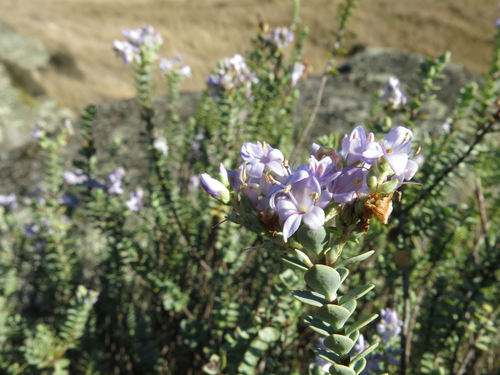
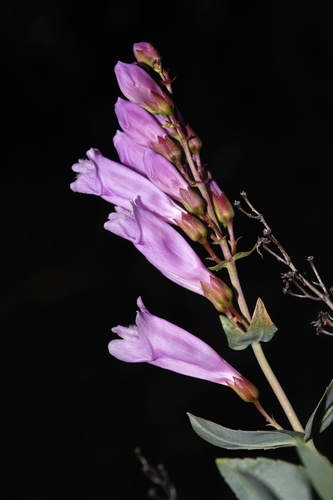
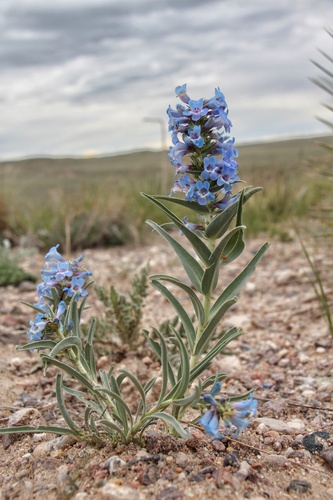
Penstemon angustifolius Nutt. ex Pursh is a herbaceous plant. Its height ranges from 6 to 65 centimeters (2 to 26 inches), and more commonly falls between 15 to 45 cm (6 to 18 in). It has thick, waxy, gray-green stems with somewhat woody bases. Basal leaves, which grow directly from the plant's base, are 25 to 90 millimeters long and 2 to 18 mm wide, and are usually longer than 40 mm. These leaves are leathery with a smooth, hairless surface, though they may occasionally have a rough texture. Leaf shapes vary between spatulate (spoon-shaped), oblanceolate (spear-head shaped with a tapered base and end), or linear (narrow like a grass blade). The lowest cauline leaves, which attach to the stems, are similar in appearance to the basal leaves. Its flowers come in a range of colors from pink and blue to lavender, and bloom from April to June. This species is distributed across west-central United States, ranging from Montana and North Dakota in the north to Arizona, New Mexico, and Kansas in the south, growing in the Great Plains and the Rocky Mountains. It is drought tolerant and grows in well-drained sandy soil, growing in dense groups at elevations between 1200 and 2200 meters. In its native environment, this plant is effective at preventing wind erosion. Deer and various insects feed on parts of this plant, and it is particularly favored by native bees. Its seeds are consumed by birds, rodents, ants, and bees, and Penstemon weevils are a recorded herbivore that feeds on this species. Penstemon angustifolius has been cultivated since as early as the 1800s. Records note that Native Americans used the plant's roots for medicinal purposes. The Lakota also used pigment from the plant's petals to paint moccasins. It can be used as a landscaping plant and as a garden plant for xeriscaping.