About Pelecanus occidentalis Linnaeus, 1766
Taxonomy and Basic Classification
The brown pelican (Pelecanus occidentalis Linnaeus, 1766) is the smallest of the eight currently living pelican species, yet it is often one of the larger seabirds within its range.
Size: Length and Wingspan
Adult individuals measure 1 to 1.52 m (3 ft 3 in to 5 ft 0 in) in total length, with a wingspan ranging from 2.03 to 2.28 m (6 ft 8 in to 7 ft 6 in).
Size: Weight
Adult weights fall between 2 and 5 kg (4.4 to 11.0 lb), which is roughly half the weight of the other two pelican species native to the Americas: the American white pelican and the Peruvian pelican.
Sexual Size Dimorphism (Weight)
Average weight measurements from Florida recorded 3.17 kg (7.0 lb) across 47 females, and 3.7 kg (8.2 lb) across 56 males.
Bill Morphology
Like all pelicans, it has a very long bill, which measures 280 to 348 mm (11.0 to 13.7 in) in length.
Breeding Plumage: Head and Neck
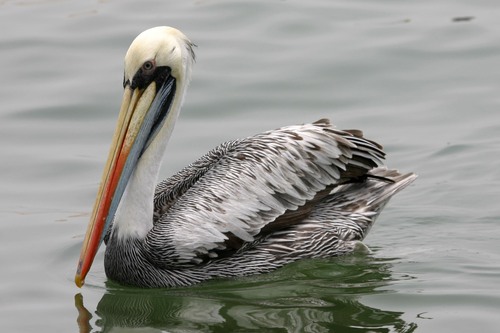
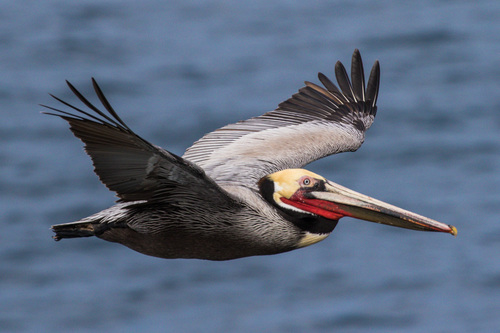
For the nominate subspecies in breeding plumage, the head is white with a pale yellow tint on the crown, while the nape and neck are a dark maroon-brown.
White lines run along the base of the gular pouch on the upper sides of the neck, and the lower foreneck has a pale yellowish patch.
Breeding Plumage: Nape Crest
Elongated feathers at the center of the nape form a short, deep chestnut crest.
Breeding Plumage: Upperwing Coverts
The mantle, scapulars, and upperwing coverts (feathers on the upper surface of the wings) are silvery gray with a brownish tinge.
The lesser coverts have dark bases, which creates a streaked appearance along the wing's leading edge.
Breeding Plumage: Uppertail Coverts
The uppertail coverts (feathers above the tail) are silvery white at their center, forming pale streaks.
Breeding Plumage: Wing Feathers
The median (between the greater and lesser coverts), primary (attached to the distal forelimb), secondary (attached to the ulna), and greater coverts (the outermost, largest row of upperwing coverts) are blackish; primary feathers have white shafts, while secondary feathers have variable silver-gray fringes.
Tertials (feathers growing from the brachial region) are silver-gray with a brownish tinge.
Breeding Plumage: Underwing
The underwing has grayish-brown flight feathers with white shafts on the outer primary feathers.
The axillaries and covert feathers are dark, with a broad, silver-gray central area.
Breeding Plumage: Tail and Pouch
The tail is dark gray with a variable silvery tint.
The lower mandible is blackish, with a greenish-black gular pouch at the bottom that drains water after the bird scoops up prey.
Breeding Plumage: Body and Limbs
The breast and belly are dark, and the legs and feet are black.
The bill is grayish-white tinged with brown, mixed with pale carmine spots.
Breeding Plumage: Additional Details
The short crest is pale reddish-brown.
The back, rump, and tail are streaked with gray and dark brown, sometimes with a rusty hue.
Plumage and Size: Sexual Similarities
Males and females have similar plumage, but females are slightly smaller.
Buoyancy Adaptation
The species is exceptionally buoyant thanks to internal air sacs located beneath its skin and within its bones.
Locomotion
It is graceful in flight, but clumsy when moving on land.
Nonbreeding Plumage: Head and Neck
Nonbreeding adults have a white head and neck, while pre-breeding adults have a creamy yellow head.
Nonbreeding Plumage: Facial and Pouch Features
The pink skin surrounding the eyes fades to a dull gray during the nonbreeding season, and nonbreeding individuals have no red coloring; their gular pouch has a strong olivaceous ochre tint, and their legs are olivaceous gray to blackish-gray.
Iris Color Change
Their irises range from pale blue to yellowish white, and turn brown during the breeding season.
Courtship Bill and Pouch Coloration
During courtship, the bill shifts from pinkish red to pale orange, becoming more red at the tip, and the gular pouch turns blackish.
Late Breeding Season Bill Coloration
Later in the breeding season, most of the upper jaw and the basal third of the mandible turn pale ash-gray.
Juvenile Plumage: Overall Appearance
Juvenile brown pelicans are similar in overall shape to adults, but are grayish-brown overall with paler underparts.
The head, neck, and thighs are dusky-brown, and the abdomen is dull white.
Juvenile Plumage: Male Comparison
A juvenile male's plumage resembles that of a full-grown adult female, though the male's head feathers are rather rigid.
Juvenile Plumage: Tail and Flight Feathers
A juvenile's tail and flight feathers are browner than those of an adult.
Juvenile Plumage: Wing Coverts
Juveniles have short, brown upperwing coverts that are often darker on the greater coverts, and dull brownish-gray underwing coverts with a whitish band at the center.
Juvenile Soft Part Features
Juvenile irises are dark brown, facial skin is bluish, the bill is gray with a horn-yellow to orange tint near the tip, and the gular pouch is dark gray to pinkish-gray.
Juvenile Plumage Maturation
Juveniles do not develop full adult plumage until they are over 3 years old; when the plumage matures, the neck feathers become paler, the upperparts become striped, the greater upperwing and median coverts become grayer, and the belly develops dark spots.
Distinction from American White Pelican
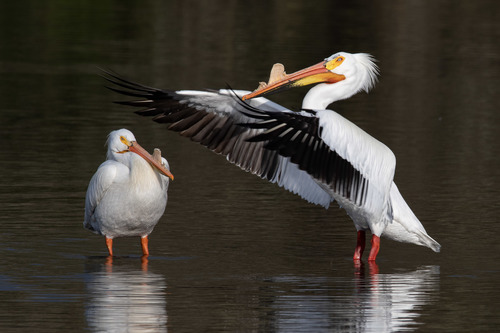
The brown pelican is easily told apart from the American white pelican by its non-white plumage, smaller size, and habit of diving for fish from the air, while American white pelicans practice cooperative surface fishing.
Marine Pelican Status
The brown pelican and Peruvian pelican are the only fully marine pelican species.
Vocalizations
Brown pelicans produce a wide range of harsh grunting calls, such as the low-pitched hrrraa-hrra, during displays.
Adults rarely make low croaking sounds, while young pelicans frequently squeal.
Global Geographic Range
The brown pelican inhabits the Atlantic, Gulf, and Pacific Coasts of the Americas.
Atlantic Coast Range
On the Atlantic Coast, its range extends from the coast of New Jersey to the mouth of the Amazon River.
Pacific Coast Range
Along the Pacific Coast, it occurs from British Columbia to northern Peru, including the Galapagos Islands.
Post-Nesting Movement (North America)
After finishing nesting, North American brown pelicans travel in flocks further north along the coasts, then return to warmer waters for the winter.
Nonbreeding Northern Range Limit
During the non-breeding season, the species can be found as far north as Canada.
Southern Peruvian Occurrence
It is a rare, irregular visitor south of Piura in Peru, where it is generally replaced by the Peruvian pelican, but it can occur as a non-breeding visitor at least as far south as Ica during El Niño years.
Chilean Occurrence Records
Small numbers of brown pelicans have also been recorded at Arica in far northern Chile.
Common Distribution Areas
The species is fairly common along the coasts of California, North Carolina, South Carolina, Georgia, the West Indies, and many Caribbean islands stretching south to Guyana.
Gulf Coast Distribution
Along the Gulf Coast, it lives in Alabama, Texas, Florida, Mississippi, Louisiana, and Mexico.
Primary Habitat Types
The brown pelican is a strictly marine species, primarily inhabiting marine subtidal areas, warm estuaries, and marine pelagic waters.
It is also found in mangrove swamps, and prefers shallow waters, particularly near salty bays and beaches.
Open Sea Avoidance
It avoids the open sea, and rarely travels more than 20 miles from the coast.
Inland Occurrence
Some immature individuals may stray to inland freshwater lakes.
Range Overlap with Peruvian Pelican
Its range can overlap with the Peruvian pelican in some areas along the Pacific coast of South America.
Roosting Sites
It roosts on rocks, open water, rocky cliffs, piers, jetties, sand beaches, and mudflats.