About Pelecanus conspicillatus Temminck, 1824
Common Name & Wingspan
Pelecanus conspicillatus, commonly called the Australian pelican, is medium-sized for a pelican, with a wingspan of 2.3 to 2.6 m (7.5 to 8.5 ft).
Weight Range
Its weight ranges from 4 to 13 kg (8.8 to 28.7 lb), though most individuals weigh between 4.54 and 7.7 kg (10.0 and 17.0 lb).
Average Weight
The average weight of four unsexed Australian pelicans was measured at 5.5 kg (12 lb), which makes it the second heaviest average flying bird species in Australia, after the brolga.
Comparative Weight
Males of the more sexually dimorphic Australian bustard have slightly higher average and maximum weights than this species; both the Australian pelican and Australian bustard are much smaller than Australia's cassowary and emu.
Bill Size
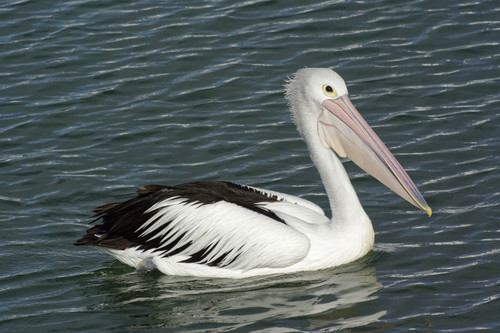
The Australian pelican's pale, pinkish bill is enormous even by pelican standards, and is the largest bill found among any living bird. The longest recorded bill from this species is 50 cm (20 in) long.
Sexual Dimorphism
Females are slightly smaller than males, and have a notably smaller bill that can measure as little as 34.6 cm (13.6 in) when mature.
Total Length
The bird's total length, counting the bill, is 152–188 cm (60–74 in), which places it alongside the Dalmatian pelican as one of the longest pelican species.
Plumage Base Color
Overall, the Australian pelican is predominantly white.
Plumage Markings
It has a white panel on the upper wing and a white V-shape on the rump, set against black primary flight feathers.
Breeding Coloration
During the courtship breeding period, the orbital skin and distal quarter of the bill turn orange, while the pouch may shift to dark blue, pink, or scarlet.
Non-breeding Appearance
Non-breeding adults have pale yellow bills and eye-rings, and a pale pinkish pouch.
Juvenile Appearance
Juvenile birds resemble adults, but their black markings are replaced with brown, and the white patch on the upper wing is smaller.
Distributional Separation
While the Australian pelican's general appearance is similar to several other pelican species, it is allopatric from those related species.
Native Range
This species is found across large areas of mainland Australia and Tasmania.
Core Habitat Requirement
It primarily lives in large expanses of open water that do not have dense aquatic vegetation.
Suitable Habitat Types
Habitats that can support Australian pelicans include large lakes, reservoirs, billabongs, rivers, estuaries, swamps, temporarily flooded areas in arid zones, agricultural drainage channels, salt evaporation ponds, and coastal lagoons.
Surrounding Environment Tolerance
The surrounding terrestrial environment does not matter to this species: it can be forest, grassland, desert, estuarine mudflats, an ornamental city park, or industrial wasteland, as long as there is open water that provides enough food.
Breeding Habitat Preference
However, Australian pelicans do tend to prefer areas with relatively low levels of human disturbance when breeding.
Roosting Sites
They may also roost on mudflats, sandbars, beaches, reefs, jetties, and pilings.
First New Zealand Records
The first recorded occurrence of this species in New Zealand came from a specimen shot at Jerusalem in 1890, alongside small numbers of subfossil bones, the first of which were found at Lake Grassmere in 1947.
Subsequent New Zealand Sightings
Additional records of stray individual Australian pelicans in New Zealand have followed.
Initial New Zealand Subspecies Classification
The recovered bones were initially described as a new subspecies, Pelecanus (conspicillatus) novaezealandiae, the so-called "New Zealand pelican", because they appeared to come from larger birds. This classification was published by Scarlett in 1966.
Taxonomic Revision of New Zealand Bones
However, when Worthy reviewed new fossil material in 1998, he determined that these bones could not be distinguished from the Australian population. The first of these New Zealand fossils was found in 1930.
Movement Drivers
Australian pelicans do not follow a fixed regular movement schedule, instead moving to follow the availability of food supplies. Drought often triggers movements of the species.
Lake Eyre Movement Example
For example, when the normally barren Lake Eyre filled between 1974 and 1976, only a small number of pelicans remained around coastal Australian cities; when the large inland lakes dried again, the population dispersed once more, with flocks of thousands appearing on northern Australian coasts.
Wind Dispersal
In some cases, pelicans are blown to new locations by wind.
Regular Non-Australian Range
The species is a fairly regular visitor to the southern coast of New Guinea, as well as the Bismarck Islands and Solomon Islands.
Vagrant Records
It occurs as a vagrant on Christmas Island, in Vanuatu, Fiji, Palau, and New Zealand.
1978 Indonesia Irruption
A large population irruption into Indonesia happened in 1978, when Australian pelicans reached Sulawesi, Java, and possibly also Sumatra.