About Pedicularis groenlandica Retz.
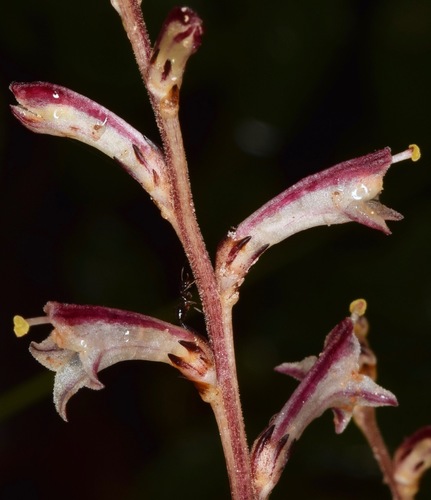
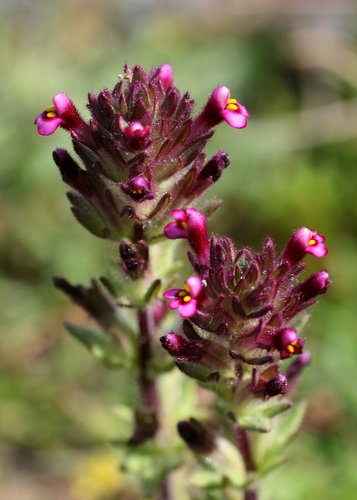
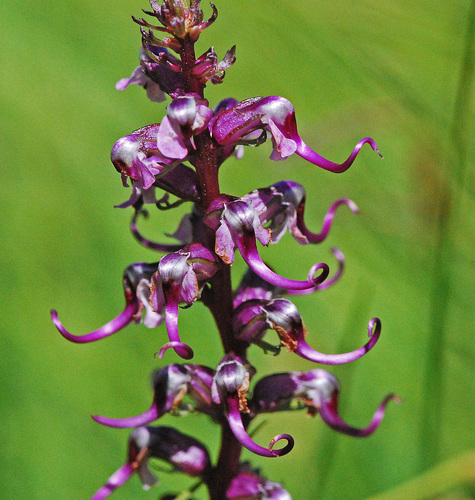
Pedicularis groenlandica Retz. is an erect plant that grows between 10 centimeters (3.9 inches) and 60 centimeters (24 inches) tall. It generally produces 5–20 large basal leaves that sprout directly from the base of the plant. These leaves are lanceolate, meaning they are narrow in outline with the widest part at the middle, ending in a pointed tip, and measure 20–150 millimeters long by 5–250 millimeters wide. They strongly resemble fern leaves, as they are divided all the way to the central leaf vein, and sometimes leaf segments are slightly divided again, giving a 1-pinnatifid or slightly 2-pinnatifid structure, with toothed or double-toothed (serrate or doubly serrate) edges. Leaf surfaces are smooth (glabrous). When new leaves first emerge in spring they are distinctly red, but as days lengthen, increasing production of green chlorophyll masks most of the red pigment. Besides basal leaves, Pedicularis groenlandica has between 3 and 31 leaves attached to its flowering stem (cauline leaves). These share the same lanceolate blade shape as basal leaves, but are often much smaller, ranging from 10–150 millimeters in length, and much narrower at 1–25 millimeters in width. They also have the same feathery, fern-like shape with serrated leaflet edges. Pedicularis groenlandica is the most widely distributed member of the genus Pedicularis in North America. It is found in the high mountain ranges of western North America, including the Cascades, High Sierra, Rocky Mountains, western Canada, and Alaska. Its range extends east through Canada and into Greenland. In Greenland, it occurs only at a single location, the same site it was originally discovered near Nuuk, in the Eqaluit commune's Paarliit Kuussuat (Paarliit Valley) at 64°01'N. This species grows at elevations from 600–3500 meters, and requires a cold montane, alpine tundra, boreal, or arctic tundra climate. Within these environments, it strongly prefers moist habitats such as bogs, fens, marshes, forested swamps, springs, stream banks, and floodplains. Specific observed occurrences follow this preference: in Greenland it grows among Carex bigelowii near a river bank; in the Elk Mountains of central Colorado, it grows right next to six glacially-derived ponds and in wet meadows; in Labrador's Mealy Mountains east of Goose Bay, plants grow along a lake shore and in marshy areas; in Yukon Territory, it is only found in the southern part of the territory, in the boggy habitat of the Watson Lake area. Unlike Pedicularis bracteosa, Pedicularis procera, or Pedicularis sudetica, Pedicularis groenlandica does not produce a nectar reward for pollinators. Bees visit its flowers to collect pollen, and rely on other plants for nectar rewards. Bumblebees (genus Bombus) vibrate their flight muscles while holding the flower to release the concealed pollen. In Colorado, workers of three bumblebee species—Bombus bifarius, Bombus melanopygus, and Bombus sylvicola—were observed visiting P. groenlandica most often. Queens or workers of five other bumblebee species—Bombus appositus, Bombus centralis, Bombus flavifrons, Bombus mixtus, and Bombus occidentalis—were recorded visiting at lower frequencies. Pollinator exclusion experiments confirm that P. groenlandica flowers are not self-fertile: no fruit forms on plants that do not have access to pollinators. Pedicularis groenlandica has relatively non-specific host requirements. It is a parasitic plant documented to parasitize various Carex (sedge) and Poa (grass) species, specifically Carex helleri, Carex fissuricola, Carex nigricans, and also the grass Deschampsia cespitosa. When P. groenlandica roots come into contact with a host plant's roots, this contact stimulates the production of haustoria to tap into the host plant. The butterfly Euphydryas gillettii has been observed laying eggs on Pedicularis groenlandica colonies in Idaho. Captive experiments show there is no significant difference in survivorship for caterpillars feeding on P. groenlandica leaves compared to caterpillars feeding on the butterfly's more common host plant, Lonicera involucrata. Pedicularis groenlandica and other species in its genus are rarely cultivated. Live plants are not offered for commercial sale, due to the difficulties of growing host-dependent parasitic plants. Most, but not all, Pedicularis species are completely dependent on host species. Seeds are available commercially, as P. groenlandica is sometimes propagated for wetland restoration projects in its native range. A 2002 report described the seeds as non-dormant, able to sprout at 22 °C (72 °F). Later work by Jeff Evans and Dale Wick found that while a host plant is not required for seeds to sprout, seedlings will decline in health and eventually die without a host. Evans and Wick recorded that the seeds have physiological dormancy, and use gibberellic acid to enhance germination. In the wild, dormancy may be broken by warm-cool-warm temperature cycles. Gardens with very wet, nearly boggy areas may be able to grow P. groenlandica, particularly when grown alongside black alpine sedge (Carex nigricans), one of its most frequent natural host plants.