About Aphyllon californicum (Cham. & Schltdl.) A.Gray
Taxonomic Classification
Aphyllon californicum (Cham. & Schltdl.) A.Gray, previously classified as Orobanche californica, grows from a thick root.
Growth Form & Size
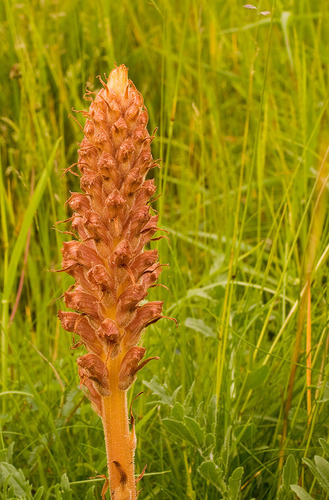
It grows erect, reaching a maximum height of around 35 centimetres (14 inches), and may produce one stem or a cluster of several stems.
Nutrient Acquisition Strategy
As a parasite that obtains all its nutrients from a host plant, it has no leaves and produces no chlorophyll.
Stem Color & Pubescence
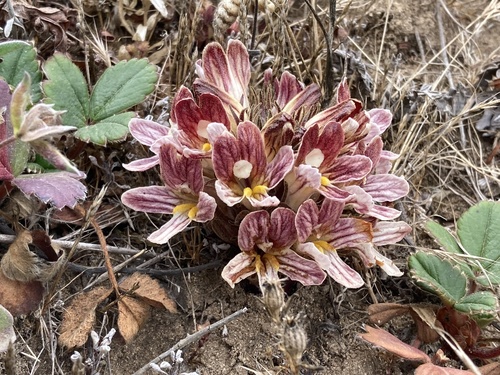
This plant ranges in color from light to dark purple, and its surface is covered in glandular hairs.
Inflorescence Structure
Its inflorescence is an elongated or branched cluster that holds several flowers.
Flower Morphology
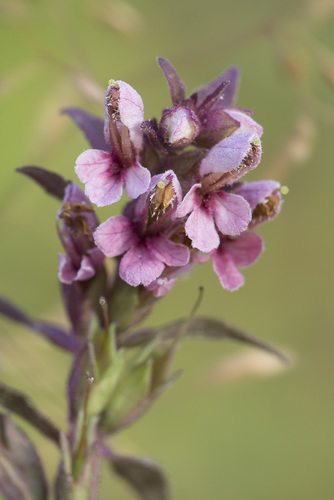
Each flower is tubular, can grow up to 5 centimeters long, and is colored pale pink, yellowish, or purple, sometimes with distinct visible veining.
Fruit & Seed Characteristics
After flowering, it produces a capsule fruit that contains very small seeds.
Native Range
This species is native to western North America, where its range extends from British Columbia and Idaho through California and Nevada down to Baja California.
Habitat & Host Associations
It grows in many different types of habitats, and has been recorded growing in association with California goldenrod (Solidago californica) and sagebrush (Artemisia tridentata).
Traditional Uses
The Paiute people of eastern California and the Great Basin used a decoction of this plant as a remedy for colds and as a pulmonary aid.