About Paraquilegia microphylla (Royle) J.Drumm. & Hutch.
Taxonomic Classification
Paraquilegia microphylla (Royle) J.Drumm. & Hutch. is a species of perennial herb in the genus Paraquilegia, family Ranunculaceae.
Morphological Variability
This species shows high morphological variability, especially in leaf traits and flower color. It is overall similar to Paraquilegia anemonoides and Paraquilegia caespitosa, but can be distinguished by its generally smaller, glabrous biternate leaves.
Leaf Structure
Its biternate leaves grow on petioles 2.5 to 11 cm (0.98 to 4.3 in) long.
Mature Plant Size
As a cushion plant, mature individuals can reach or occasionally exceed 40 cm (16 in) in total width.
Stem Features
Over multiple growing seasons, the densely packed stems become covered by the remains of old petioles. Stem arrangement is one of the variable traits of the species: some plants are tightly tufted with short, densely packed stems, while others, even within the same population, have thinner, more loosely arranged stems.
Flowering Period
Flowering occurs from May to August.
Flower Dimensions
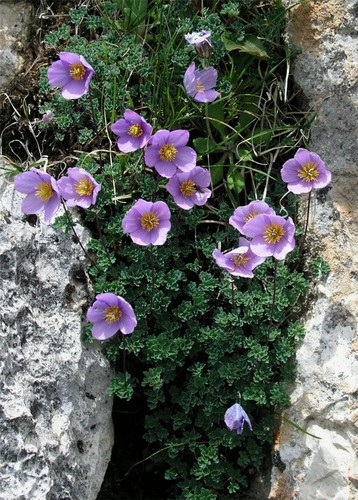
Flowering stems grow 30 mm (1.2 in) to 150 mm (5.9 in) tall, and open flowers are 2.8 cm (1.1 in) to 5 cm (2.0 in) in diameter.
Genus Flower Traits
All species in the genus Paraquilegia have five sepals and five shorter yellow petals.
Sepal Color Variation
For P. microphylla, sepals are usually purple to purplish red, with rare white individuals. Flower color varies across the species' range: western Himalayan populations have small white flowers, while eastern Himalayan populations produce larger lilac flowers.
Fruiting Period
Fruiting takes place in August and September.
Fruit Development
The fruits of P. microphylla are occasionally partially developed before sepals are shed, but this happens less often than in P. caespitosa.
Seed Morphology
Seeds of P. microphylla are smooth, hairless, brown, narrowly ovoid, and narrowly winged, measuring 1.3 mm (0.051 in) to 1.8 mm (0.071 in) long.
Germination Traits
Seeds typically require at least two years to germinate. American botanist and gardener Robert Nold described the resulting seedlings as "incredibly small and look[ing] exactly like columbines dancing on the head of a pin".
Native Range
Paraquilegia microphylla is native to an extensive range covering Siberian Russia, Central Asia, the Himalayas, and eastwards to Japan. It grows throughout most of the Himalayas, only absent from the westernmost parts of the range.
Distribution in China
In China, it occurs in mountainous western regions, including Tibet (Xizang), Sichuan, and Xinjiang.
Additional Distribution Records
The Flora of China also records its presence in Kazakhstan, Nepal, northern Pakistan, Sikkim (Bhutan), and Tajikistan.
Climate Preference
This species favors alpine and subarctic climates.
Habitat Characteristics
It grows mainly on cliffs and in rock fissures at altitudes from 2,700 m (8,900 ft) to 4,300 m (14,100 ft), and rarely grows on sloping rocky meadows.
Soil Preference
It prefers limestone soil.
Genus Cultivation Notes
Members of the genus Paraquilegia are cultivated by rock gardeners, and Nold noted that the genus is generally considered to only be grown successfully by "the most experienced growers".
Cultivation Status
P. microphylla is the most common Paraquilegia species in cultivation, though it remains relatively rare. When exhibited, it is often misidentified as P. anemonoides.
Cultivation History
During the 20th century, multiple seed-collecting expeditions to western China and the Himalayas brought seeds of this species back to the United Kingdom and the United States.