About Palmaria palmata (L.) F.Weber & D.Mohr
Common Name and Classification
Palmaria palmata, commonly known as dulse, is a red alga.
Holdfast and Stipe Characteristics
Its erect frond grows attached via a discoid holdfast and a short, inconspicuous stipe, growing epiphytically on Laminaria stipes or directly on rocks.
Frond Appearance Basics
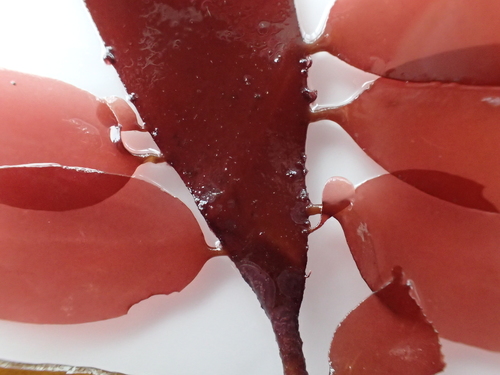
Fronds vary in shape, and range in color from deep rose to reddish purple, with a rather leathery texture.
Blade Structure and Size
The flat, leaf-like blade gradually expands and divides into broad segments that can reach up to 50 centimeters (20 inches) long and 3–8 cm (1–3 in) wide; these segments can bear flat, wedge-shaped new growths called proliferations along their edges.
Internal Blade Anatomy
Structurally, the blade has an outer cortex made of small cells, which encloses a medulla of larger cells up to 0.35 units thick.
Taxonomic Synonym Clarification
The reference to Rhodymenia palmata var. mollis in Abbott and Hollenberg (1976) is now considered to refer to a different accepted species, Palmaria mollis (Setchel et Gardner) van der Meer et Bird.
Similar Species Distinction
Dulse is similar to another seaweed, Dilsea carnosa, but Dilsea has a more leathery texture.
Dilsea carnosa Morphology
Its blades grow up to 30 cm (12 in) long and 20 cm (8 in) wide, and unlike P. palmata, Dilsea carnosa is not branched and does not develop proliferations or branches from the frond edge, though older blades may split naturally.
Atlantic Europe Distribution
In terms of distribution, P. palmata is the only species of the genus Palmaria found on the coast of Atlantic Europe.
European Range Extension
It occurs from Portugal to the Baltic coasts, and also grows on the coasts of Iceland and the Faroe Islands.
Global Distribution Range
It is also found on the shores of Arctic Russia, Arctic Canada, Atlantic Canada, Alaska, Japan, and Korea.
California Record Correction
Previous records of P. palmata from California actually refer to the related species Palmaria mollis.
Habitat and Depth Range
Ecologically, P. palmata grows from the mid-tide area of the intertidal zone (the region between high and low tide) down to depths of 20 meters or more, and can grow on both sheltered and exposed shorelines.
Traditional Uses
Dulse is commonly used as food and traditional medicine in Ireland, Iceland, and Atlantic Canada.
Commercial Availability
It is sold in many health food stores and fish markets, and can also be ordered directly from local distributors.
Animal Fodder Use
In some countries, it is also used as animal fodder.
Nutritional Content
Compared to other vegetables, dulse is a good source of minerals and vitamins, contains all trace elements required by humans, and has a high protein content.
Iodine Content Benefit
It naturally contains iodine, which prevents goitre.
Harvest Season
Dulse is typically available for harvest from June to September.
Harvest Method
It can be picked by hand when the tide goes out.
Post-Harvest Processing Steps
After harvest, small snails, shell fragments, and other small debris can be washed or shaken off the plant, which is then spread out to dry.
Drying and Packaging Process
Some harvesters turn it once during drying, then roll it into large bales for later packaging.
Fresh Consumption Method
Fresh dulse can be eaten directly off rocks before sun-drying.
Dried Consumption Forms
Sun-dried dulse can be eaten as-is, or ground into flakes or a powder.
Culinary Flavor Function
When used in cooking, dulse acts similarly to a flavor enhancer.
Icelandic Traditional Preparation
In Iceland, traditional preparation calls for eating it with butter.
Cooked Preparation Varieties
It can be pan-fried quickly to make chips, baked in the oven covered with cheese, served with salsa, or simply microwaved briefly.
Common Culinary Applications
It can be added to soups, chowders, sandwiches, and salads, or mixed into bread or pizza dough.
MSG Substitute Use
When finely diced, it can be used as a flavor enhancer in meat dishes such as chili, in place of monosodium glutamate.
Irish Culinary Use
In Ireland, dulse is used to make "White Soda Bread".
Northern Ireland Traditional Sales
In Ballycastle, Northern Ireland, it is traditionally sold at the Ould Lammas Fair, and it is particularly popular along the Causeway Coast.
Harvest Tradition Status
Although gathering dulse by hand is a fading tradition, many people still collect their own.
Ulster Coast Snack Consumption
Along the Ulster coastline from County Down to County Donegal, dried uncooked dulse is eaten as a snack.
West Ireland Common Name and Sales
On the west coast of Ireland, it is commonly known as dillisk, and dried dillisk is usually sold as a snack food from stalls in seaside towns by periwinkle sellers.
Cultivated Strain Development
Researchers at Oregon State University's Hatfield Marine Science Center have selected a fast-growing strain of Pacific dulse (P. mollis).
Cultivated Strain Flavor Characteristic
Originally developed as a feed for abalone farming, the researchers note that this strain of seaweed tastes like bacon when fried.