About Halosaccion glandiforme (S.G.Gmelin) Ruprecht
Thallus Shape
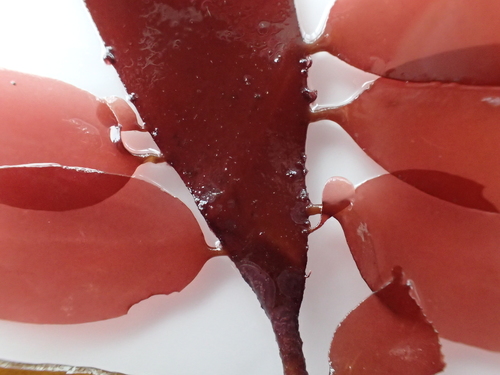
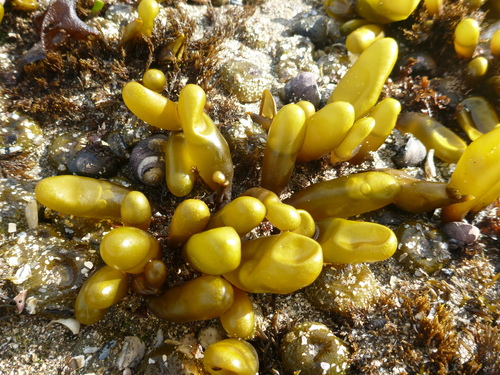
The body (called a thallus) of Halosaccion glandiforme, also known as sea sac, is a hollow, torpedo-shaped, ellipsoid sac. This shape creates low water drag, letting the algae live in areas with strong waves and currents.
Coloration
The sac ranges in color from reddish-purple to yellowish-brown.
Size Dimensions
It can reach up to 15 centimetres (5.9 in) long, though most individuals are shorter, and grows to a maximum diameter of 4 centimetres (1.6 in). The sac wall is up to 400 micrometres (0.016 in) thick.
Thallus Pores
The thallus has 5 to 15 small pores, between 10 micrometres (0.00039 in) and 100 micrometres (0.0039 in) in diameter, that allow seawater to move into and out of the sac.
Water Intake Mechanism
When the algae is submerged, elastic sac walls pull water into the thallus through the pores.
Photosynthesis Buoyancy
Rapid photosynthesis produces a small oxygen bubble inside the sac, which keeps the algae positioned near the surface to access sunlight.
Anchoring Structure
The sac tapers into a short stipe (stem), which connects to a small, disc-shaped holdfast that anchors the algae to the seabed. The stipe is relatively weak, but its low drag means this is enough to anchor the algae.
Emersion Response
When the tide goes out, the algae dries out in open air. Water leaks out of the sac through the pores, which keeps the thallus cool and moist.
Deflation Physiology
As water leaves, the sac deflates and may look flattened. Deflated sacs die in sunlight within three hours, but water-filled sacs stay moist and cool enough to survive until the next high tide covers them.
Older Individual Damage
Older sea sacs sometimes have their tips worn away, which removes their internal water supply.
Geographic Distribution
Sea sacs are widely distributed across the north Pacific Ocean. The species occurs from the Russian Far East to the Bering and Chukchi Seas, the Aleutian Islands, mainland Alaska, and south along the North American coast to Point Conception, California. It is also found in Puget Sound.
Depth Range
This is a shallow water species that grows in the low to middle intertidal zone.
Substrate Preference
It usually grows on rock, with a strong preference for rough, exposed sections of rock rather than rock cracks and valleys. It can also grow on other algae, including Corallina vancouveriensis and Neorhodomela larix.
Habitat Exposure Tolerance
It grows in both wave-exposed areas and semi-protected areas.