About Paleosuchus trigonatus (Schneider, 1801)
Head Morphology
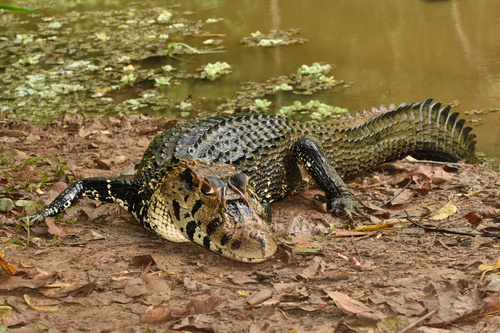
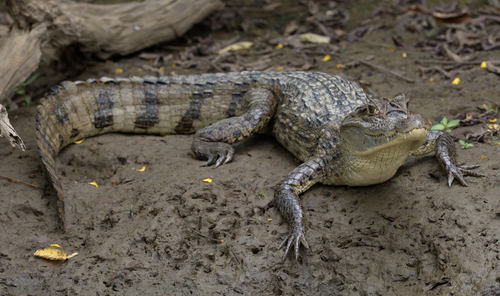
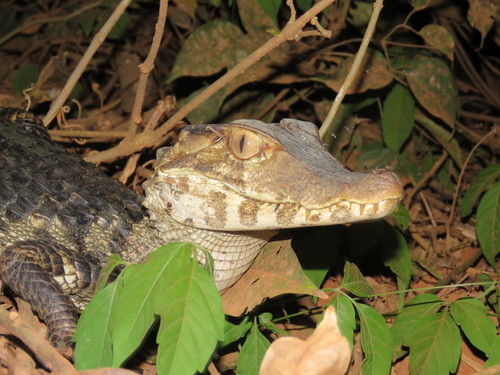
Paleosuchus trigonatus, commonly called the smooth-fronted caiman, has a head similar in appearance to that of the spectacled caiman (Caiman crocodilus), but lacks the bony ridge or "spectacle" between the eyes.
Neck and Tail Scutes
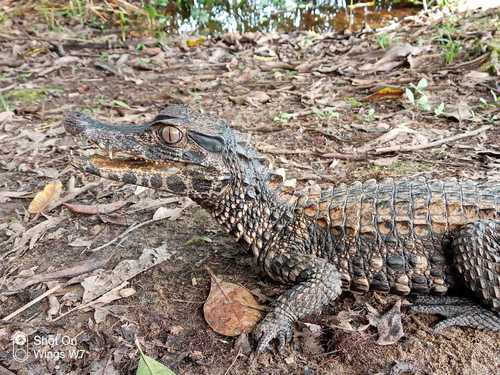
The scutes on the back of its neck and tail are large, triangular, and sharp.
Body Armor
It has heavily ossified body armor on both its dorsal and ventral surfaces.
Tail Shape
Its relatively short tail is broad at the base and flattened dorsoventrally, which contrasts with most crocodilian species that have laterally flattened tails.
Tail Armament and Flexibility
The bony scutes on the tail have sideways projections, and the tail is so heavily armored that it is relatively inflexible.
Coloration
This caiman has dark greyish-brown coloration and mid-brown eyes.
Male Size
Males grow to around 1.7 to 2.3 m (5 ft 7 in to 7 ft 7 in) long; the largest recorded specimen measured 2.6 m (8 ft 6 in).
Female Size
Females do not often exceed 1.4 m (4 ft 7 in) in length.
Body Build and Posture
It is a robust crocodilian, strong for its size, and typically carries its head high with its neck angled upwards.
Geographic Range
The smooth-fronted caiman is native to the Amazon and Orinoco Basins in South America, where it occurs in Bolivia, Brazil, Colombia, Ecuador, French Guiana, Guyana, Peru, Suriname, and Venezuela.
Habitat
It lives in small streams within forested areas, where in some cases the water may not be deep enough for it to fully submerge.
Basking Behavior
It is rarely seen in open areas and does not usually bask in the sun, even when kept in captivity.