About Alligator sinensis Fauvel, 1879
Species Overview
The Chinese alligator (Alligator sinensis Fauvel, 1879) is one of the smallest crocodilian species.
Adult Size
Adult Chinese alligators reach 1.5–2.1 metres (5–7 ft) in length and weigh 36–45 kilograms (80–100 lb), with females reaching roughly three-quarters the length of males. It is less than half the size of the American alligator, where males typically grow to 3.4 metres (11.2 ft) and females to 2.5 metres (8.2 ft).
Historical Size Claims
While historical reports note Chinese alligators reaching 3 metres (10 ft) in past centuries, these accounts are no longer considered accurate. The largest recorded female measured 2.07 metres (6 ft 9 in) and weighed 50 kilograms (110 lb), and the largest recorded male measured 2.46 metres (8 ft 1 in) and weighed 84 kilograms (185 lb).
Coloration
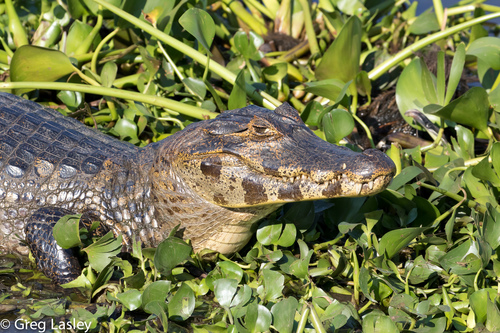
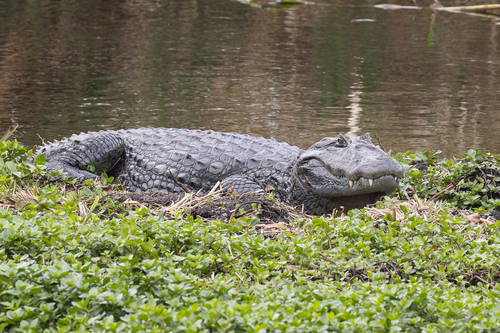
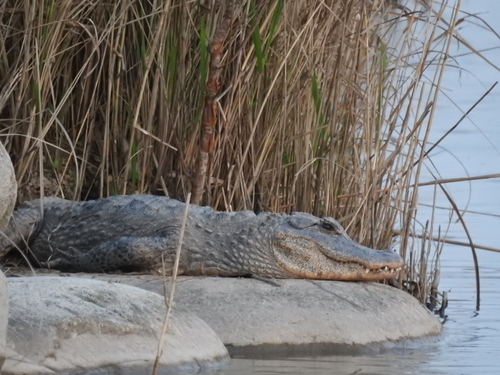
Adult Chinese alligators are almost completely black or dark gray.
Snout and Head Features
They have a short, broad snout that points slightly upward and narrows at the tip. Their head is more robust than that of the American alligator, with a bony septum dividing the nostrils.
Dentition
They have 72–76 teeth total: 13–14 maxillary, five premaxillary, and 18–19 mandibular.
Bite Force
Four specimens measuring 1.4 to 1.55 m (4 ft 7 in – 5 ft 1 in) in length and weighing 12–15 kg (26–33 lb) recorded a bite force of 894–1,357 N (201–305 lbf).
Body Armor and Scales
Unlike the American alligator, the Chinese alligator has full body armor, including on its belly. It has up to 17 rows of body scales: these are soft on the belly and sides, and rougher on the back.
Eyelid and Limb Features
Its upper eyelids have bony plates, a feature usually absent in the American alligator. Its tail is wider than that of the American alligator, and it does not have webbed feet, unlike the American alligator which has extensive webbing on its toes.
Native Range
The Chinese alligator is the only species in the family Alligatoridae native to the Eastern Hemisphere. Its modern range is extremely restricted.
Historical Distribution
Historically, it was widely distributed across the Yangtze River system. By the late 1980s, it was limited to small ponds in six counties in southeastern Anhui province.
Current Occupied Area
As of 2015, the IUCN estimates its occupied area is approximately 5 square kilometres (1.9 mi2).
Preferred Habitat
Chinese alligators live in freshwater bodies, particularly wetlands and ponds, in climate transition zones between subtropical and temperate regions. They are found at the base of mountains, in areas with common grass and shrub growth.
Habitat Loss Impacts
Habitat loss has forced the species to live at higher, colder elevations than it prefers, where soil is not suitable for digging burrows. Conservationist John Thorbjarnarson observed a female that was forced to build her nest from pine needles instead of the typical plant material; the eggs died because pine needles could not warm them properly.
Fossil Record
The oldest known record of the Chinese alligator is a late Pliocene fossil skeleton fragment, dated to 3 million years ago, found in western Japan. This fossil shows the species was larger at that time than it is today, with a total length of at least 2 metres (6.6 ft).
Former Japanese Distribution
Alligators are thought to have moved into parts of Japan either before 25 million years ago or after 10 million years ago, and were extirpated from Japan during the Plio-Pleistocene period, due to increased isolation from the continent and harsh climate.
Early Population Decline
The Chinese alligator population began declining around 5000 BC, as human civilization expanded in China, after being abundant in the lower Yangtze area. This region was one of the first places in the world to farm rice, so much of the alligator's habitat was destroyed to create rice farms.
18th-20th Century Range Reduction
In the 1700s, large-scale human settlement converted much of the alligator's remaining habitat into farmland. By the 20th century, its range had shrunk to a few small areas around the Yangtze.
1950s Distribution
In the 1950s, the species occupied three separate areas: the southern Yangtze (Chang Jiang) from Pengze to the western shore of Lake Tai (Tai Hu), mountainous regions of southern Anhui, and parts of Jiangsu and Zhejiang provinces, primarily in lakes, streams, and marshes.
1970s Population
By the 1970s, it was restricted to small parts of southern Anhui and Zhejiang, with a total population of around 1,000 individuals.
1990s Population Low
In 1998, the wild population reached its lowest recorded point; the largest remaining population patch was a small pond along the Yangtze surrounded by farmland, which held only 11 alligators. In 1999, the Wildlife Conservation Society estimated 130–150 individuals remained in the wild.
Early 2000s Population
According to The New York Times, the population was fewer than 130 individuals in 2001; at this time, alligators sometimes wandered in search of suitable habitat but failed to find it, as most former habitat had been converted to rice fields. The population remained roughly stable between 1998 and 2003, then began a gradual increase after 2003.
2005 Survey Results
A 2005 survey by the Anhui National Nature Reserve for Chinese Alligator (ANNRCA) found 92–114 adults and 66 young remained in the wild. The survey concluded the population was growing at four sites, and stable across the rest of the species' range.
2010s Population Estimates
A 2012 journal article estimated the total wild population at 120–150. A 2015 survey observed 64 individuals, 32 of which were adults, and estimated a total of 68–86 adults and a total population of 136–173.
Recent Population Status
In 2017, Wang Renping, head of the ANNRCA, stated around 300 specimens exist in the wild, including some that were born in captivity and reintroduced to the wild. As of 2018, the wild population is no longer considered to be declining.
Genetic Threat
Because the wild population is very small, high inbreeding is a major threat to the species' long-term survival.
Winter Behavior
In terms of ecology, Chinese alligators brumate in burrows during winter. After this dormant period, they often spend significant time basking in the sun before summer begins.
Summer Activity Pattern
They are nocturnal throughout summer: they feed at night and shelter during the day to avoid humans and summer heat. This behavior allows them to live in areas with high human presence.
Temperament
It is a docile species, and generally does not intentionally harm humans.
Mating Season
The Chinese alligator's breeding season occurs in early summer, with the highest mating rate in mid-June. Mating happens earlier in the year when temperatures are higher.
Mating Behavior
During mating season, males typically search ponds for mates, and both males and females are often aggressive toward each other. The species is polygamous: single males may mate with multiple females, and single females may mate with multiple males.
Multiple Paternity
A study of 50 clutches found multiple paternity in 60% of clutches, with up to three males contributing to a single clutch.
Nest Construction
Nests are usually built 2–3 weeks after mating, between July and late August. Nests are constructed by females from rotting plant material such as leaves, and are 40–70 centimetres (16–28 in) high.
Nest Site Selection
Females prefer to build nests in areas with thick tree canopy and far from human disturbance; islands often meet these criteria, so they are frequently used as nesting sites. Nests are always built near water. Individuals often return to the same nesting site each year, though intraspecific competition and environmental change can force them to move to new sites.
Clutch Characteristics
Eggs are generally laid at night; a typical mating produces 20–30 eggs, though the IUCN records clutch sizes ranging from 10 to 40 eggs. After laying eggs, females sometimes leave the nest, and sometimes stay to guard the eggs.
Egg Size
The eggs measure about 6 centimetres (2.4 in) long, 3.5 centimetres (1.38 in) in diameter, and weigh 45 grams (1.59 oz), making them smaller than the eggs of any other crocodilian.
Incubation Period
Incubation typically lasts around 70 days, with an average incubation temperature of 25–26 °C (77–79 °F) across day and night.
Incubation Temperature Effects
Incubation temperature determines the sex of hatchlings (temperature-dependent sex determination), a trait shared with many other reptiles. Higher incubation temperatures also increase hatching success.
Hatchling Emergence
Hatchlings emerge in September, with assistance from their mother. Like the eggs, newborn Chinese alligators are the smallest of any crocodilian, measuring 20–22 centimetres (7.87–8.66 in) long and weighing 25–30 grams (0.88–1.06 oz).
Hatchling Appearance and Care
Unlike adults, hatchlings have light speckles on their bodies and heads. Mothers help hatchlings leave the nest and carry them to water after hatching.
Early Growth
Hatchlings grow very little in their first year, because they can only feed for around 2 months after hatching before winter brumation. A 2002 study found that at birth, Chinese alligators are two-thirds the length and half the weight of newborn American alligators, but after one year they are half the length and one-tenth the weight of one-year-old American alligators.
Juvenile Survival
Young alligators depend on their mothers for protection during their first winter, as their small size makes them easy prey. Growth is rapid in the first few years, then slows at age five.
Sexual Maturity and Lifespan
According to the National Zoological Park, females reach sexual maturity roughly four to five years after birth, though other sources estimate maturity at six to seven years. Chinese alligators can live more than 50 years, and have been recorded reaching 70 years of age in captivity. They stop breeding after age 50.