About Oxybasis chenopodioides (L.) S.Fuentes, Uotila & Borsch
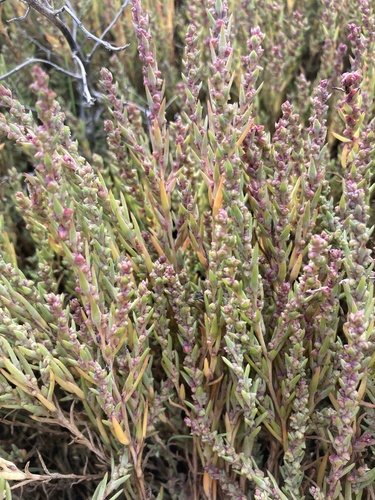
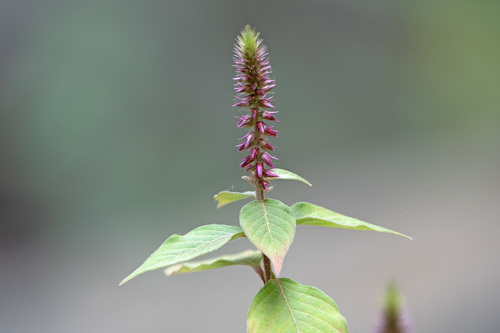
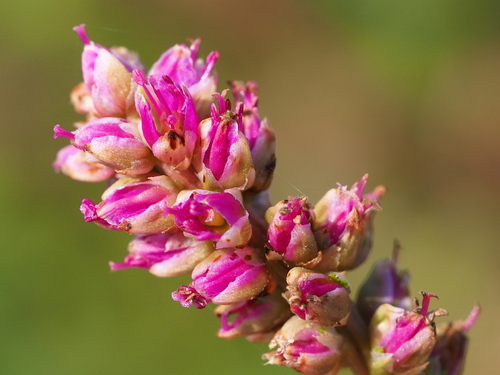
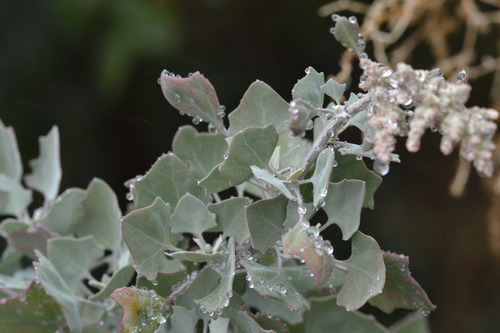
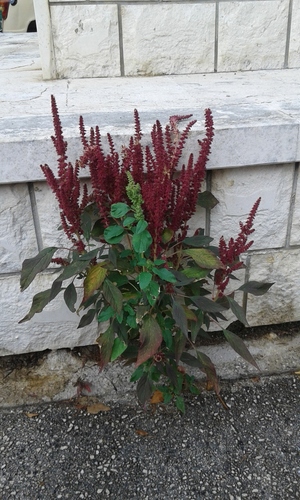
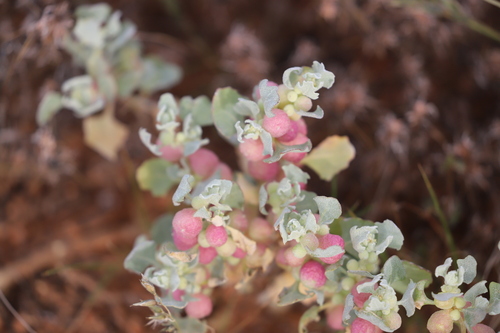
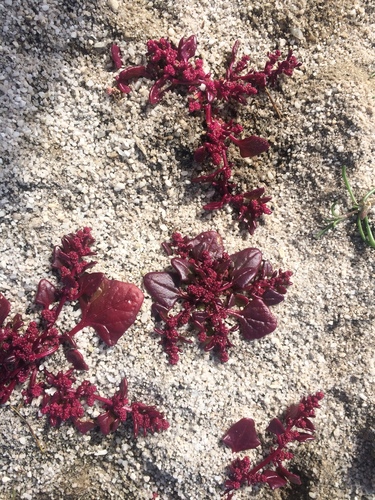
Oxybasis chenopodioides, commonly called Saltmarsh Goosefoot, is an annual herb. It grows to around 30 cm tall, sometimes reaching up to 50 cm, and often grows prostrate along the ground. It has short fibrous roots, so the entire plant can be easily lifted out of soil. Its stems are angular, often branched near the base, with branches generally growing in subopposite pairs. The whole plant is glabrous (hairless), though leaves sometimes bear mealy vesicular hairs, and the plant can be green, crimson, or a mix of both colors. Leaves are alternate, with a short petiole around 0.8 cm long and no stipules. Leaf blades can grow up to 8 cm long and 6 cm wide, but are usually much smaller, typically 2–3 cm long. The leaf blade is thick and fleshy, triangular to ovate in outline, with either entire (untoothed) margins or a few faint teeth along the edge. In northern Europe, flowering occurs from July to September. Its inflorescences are technically panicles, with a branched structure holding clusters of glomerules (groups of flowers on very short stalks), but they often resemble spikes (sessile flowers growing along a single unbranched stem). Each glomerule contains 10 to 20 small red flowers of two types: terminal flowers are bisexual, with 5 tepals, 5 stamens, and 2 stigmas; lateral flowers may be bisexual or female, with 3 to 5 tepals and 0 to 3 stamens. The fruit is an achene that detaches while still enclosed in the perianth.
Saltmarsh Goosefoot can be very difficult to distinguish from red goosefoot. Typically, Saltmarsh Goosefoot is low-growing with nearly entire leaves, while red goosefoot is larger, erect, and has clearly defined leaf lobes and teeth. However, both species are highly variable in these traits and can sometimes be almost indistinguishable. Either species can be mostly red or mostly green in colour. The reliable key difference, visible when fruits are mature, is that the tepals surrounding lateral fruits of Saltmarsh Goosefoot are fused almost to their tip, forming an almost complete ball, while tepals of red goosefoot are only fused halfway, leaving more of the seed visible.
Saltmarsh Goosefoot is native to southern Europe, Asia, and parts of North Africa, and is widely established throughout the Americas. In central to southern Africa, it has been recorded in Kenya, Burundi, Namibia, and South Africa, and was recently added to the flora of the Congo based on a 1914 collected specimen. It is thought to have been dispersed to this region by migrating birds, and is considered native here at the edge of its range. In the United States, it is generally classed as a casual introduction, presumed to have been brought by humans. It has been recorded in New York since at least 1894, but populations die out quite quickly. In western North America, it is well established in the Rocky Mountains from British Columbia to California, where it grows in sagebrush desert vegetation, usually along roadsides. Some American publications note that the form called "low goosefoot" is native to South America, where it has been known since at least 1891, when it was collected at Soriano, Uruguay. It is sometimes reported from the coast of Argentina, but there are very few records from that area. In France, where it is called Oxybaside faux chénopode, it occurs mainly around the coast. It holds a status of Least Concern (LC) in Corsica and southern départements, but is classified as Vulnerable (VU) in Nord-Pas-de-Calais, Critically Rare (CR) in Picardie, and also Vulnerable in inland Lorraine. It is considered rare in Italy, where it occurs along the coasts of mainland Italy, Sicily, and Sardinia, and is limited by a lack of suitable habitat. The first British record, published under the name Chenopodium botryodes Sm., was published by J.E. Smith in English Botany in 1811. In 1962, it was confirmed to be largely confined to coastal grasslands in southeast England (Kent and Essex), and this distribution has not changed. It is currently classified as nationally scarce but not threatened, with an IUCN status of Least Concern (LC), and is regarded as an axiophyte of conservation habitats. GBIF maps show Saltmarsh Goosefoot ranges across the central Asian steppe as far east as eastern Siberia, and just extends into China in parts of the Gobi Desert, where it grows on salt flats.
Contrary to its common name, Saltmarsh Goosefoot does not usually grow in salt marshes. Its typical habitat is grasslands with some brackish influence, often located near coasts. It is most often found in shallow depressions where winter flooding persists into spring, creating patches of bare ground. It germinates late and only flowers in autumn, so lack of competition is important for its growth. Inland, it is usually associated with natural salt deposits, or sometimes with salt-treated roadside verges. Under the EUNIS habitat classification system, Saltmarsh Goosefoot is a characteristic species of the Pannonic salt steppes of southeast Europe, specifically of the salty E6.2131 Puccinellia distans hollows found in this grassland type. In this inland vegetation, brackish conditions form from evaporation of surface water during dry summers (rather than from marine influence), and the dominant salts are carbonates and sulphates rather than chlorides. This habitat is a conservation priority, and many Natura 2000 sites are designated for its protection. The equivalent habitats in southern France are halo-nitrophile lawns on Mediterranean coasts of mainland France and Corsica (Corine code 22.343), which are also a priority conservation habitat. This vegetation occurs in grazed pastures, and hosts species including spear-leaved orache, annual beard-grass, and strapwort. Recorded vegetation communities that include Saltmarsh Goosefoot are the toad rush-Saltmarsh Goosefoot community mainly found on the Atlantic coast, and Echinochloa crus-galli-Sporobolus schoenoides and Gnaphalium uliginosum-Sporobolus schoenoides vegetation in the Mediterranean. In Italy, its typical habitat differs slightly: it grows on sandy, nearly bare soils that are inundated in winter and dry out in summer, giving it a 4-month growing season from August to November. It usually grows on the coast in association with Salicornia perennans and Suaeda maritima, but sometimes occurs inland at elevations up to 180 m. Britain lies at the northern edge of the species' natural range, and Saltmarsh Goosefoot is largely restricted to the grazing marshes of the Thames Estuary. Here it grows on the banks of cattle-poached brackish ditches, or in shallow rills in fields that dry out in summer. Its populations fluctuate dramatically with weather, and the species only flourishes after a hot summer. Due to its rarity in Britain, it has not been assigned to any vegetation community, and no insect associations are known for the species.