About Amaranthus cruentus L.
Growth Form
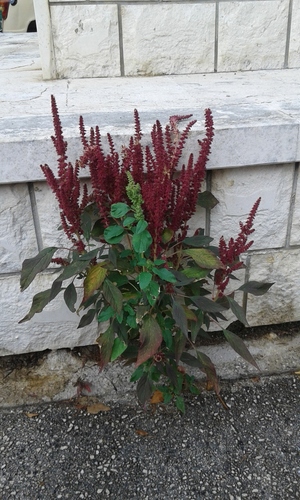
Amaranthus cruentus L. is a tall annual flowering herb.
Flower Appearance & Height
It is topped with clusters of dark pink flowers, and can grow up to 2 meters (6 feet) in height.
Bloom Period
It blooms from summer through fall.
Taxonomic Origin & Morphology
It is thought to have descended from Amaranthus hybridus, and shares many morphological features with that species.
Foliage Color Variants
The plant is most commonly green, though a purple variant was historically grown for use in Inca rituals.
Recorded Maximum Height
Individuals reaching up to 13 feet in height have been recorded in Wayanad, Kerala.
Historical Food Use Timeline
This species was used as a food source in North America and Central America as early as 4000 BC.
Seed Color Variation
Its seeds are eaten as a cereal grain: wild plants produce black seeds, while domesticated plants produce white seeds.
Seed Culinary Uses
Seeds can be ground into flour, popped like popcorn, cooked into porridge, or made into a Mexican confectionery called alegría.
Leaf & Sprout Uses
Its leaves can be cooked and eaten like spinach, and its seeds can be germinated into nutritious sprouts.
Contemporary Food Status
While A. cruentus is no longer a staple food in North and Central America, it is still grown and sold as a health food, and is an important crop for subsistence farmers in Africa.
Chhattisgarh Culinary Use
In Chhattisgarh, red amaranth is used to make Lal Bhaji, a stir-fried dish.
Maharashtra Culinary Use
In Maharashtra, a stir-fried dish of the plant with grated coconut is served during festivals in the month of Shravan.
Stem Culinary Use
Its stems are used in a curry prepared with Vaal hyacinth bean.
Zuni Ceremonial Food Use
Among the Zuni people, the feathery upper portion of the plant is ground into a fine meal to color ceremonial bread red.
Zuni Cosmetic Use
Crushed leaves and blossoms are moistened and rubbed on cheeks as rouge.
Himachal Pradesh Culinary Uses
In the Kinnaur District of Himachal Pradesh, India, the grain of A. cruentus is used to make kheer, which is served as a dessert during marriage ceremonies, and its flour is used to make deep-fried chapatis called pole.
Ornamental Cultivation Purpose
A. cruentus is also cultivated as an ornamental plant, valued for its feather-like flowering plumes.
Ornamental Propagation Method
It is typically grown from seed as a half-hardy annual: seeds are sown under glass in early spring, and seedlings are planted outdoors in summer.
Award-Winning Cultivars
Numerous cultivars have been developed, and three of these have earned the Royal Horticultural Society's Award of Garden Merit: 'Autumn Palette Group', which produces flowers in earth tones including rust, cream, and brown; 'Oeschberg', which bears crimson flowers; and 'Velvet Curtains', which has deep red to crimson growth.