About Ovophis okinavensis (Boulenger, 1892)
Adult Size
Adults of Ovophis okinavensis are typically 30 to 80 cm (11¾–31½ inches) in total length.
Common Body Coloration
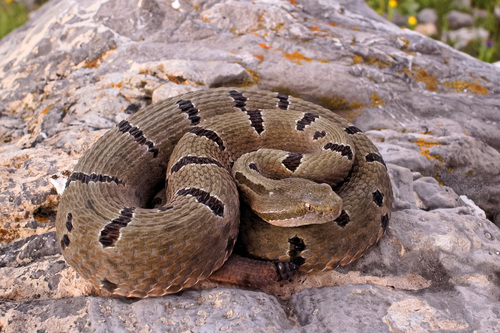
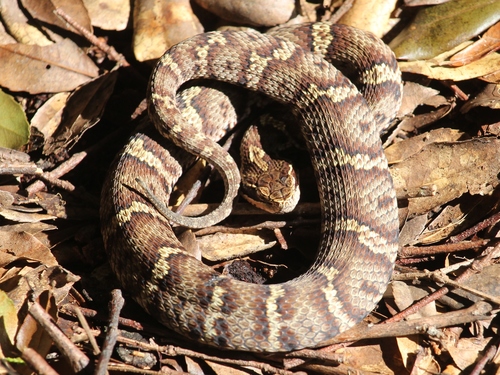
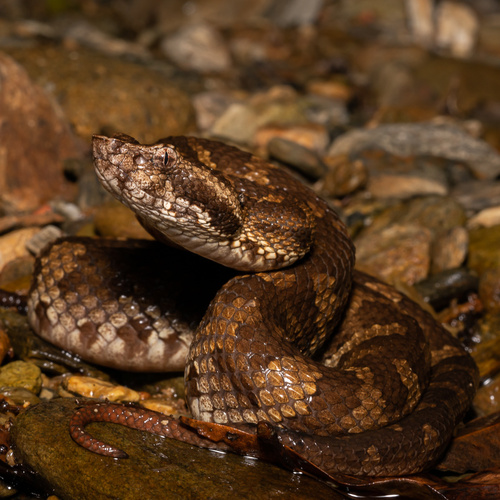
Most individuals have a pale greenish-brown or yellowish-olive body, sometimes pale brown, marked with alternating darker brownish or greenish dorsal blotches, each of which is edged with yellowish scales.
Head Morphology
The head is large, triangular, and clearly distinct from the neck, with a narrow dark postocular stripe.
Scale Arrangement
This species has a consistent scale arrangement: dorsal scales form 23 or 21 rows at midbody; there are 125–135 ventral scales, 36–55 paired subcaudal scales, and 8 supralabial scales, though 7 or 9 are seen occasionally.
Alternate Color Pattern
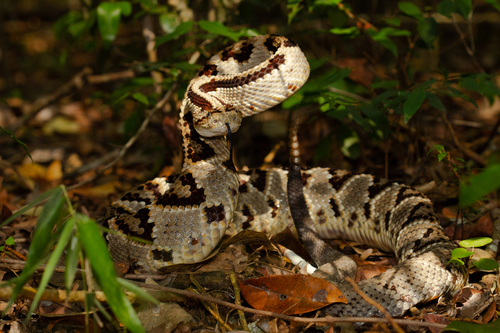
Some individuals have a different color pattern, with a gray base color covered in a series of dark gray to grayish-black crossbands, plus a ventrolateral pattern of black spots set against a gray-white background.
Native Range
This species is native to the Ryukyu Islands of Japan, including Okinawa and the Amami Islands.
Type Locality
Its type locality is officially recorded as "Okinawa".
Habitat Types
It inhabits a wide range of environments, including open woodland, closed forests, mountains, fields, and farming areas located close to streams, ponds, and other water sources.
Human Proximity Occurrence
It can also be found within human habitations.
Reproductive Modes
Ovophis okinavensis exhibits both oviparous and ovoviviparous reproduction.
Reproductive Flexibility
Based on local environmental conditions, females either lay their eggs directly, or retain the eggs to incubate them internally before giving birth to live young.