About Otocryptis wiegmanni Wagler, 1830
Taxonomy and Size
Otocyptis wiegmanni, scientifically named by Wagler in 1830, reaches an adult snout-to-vent length (SVL) of approximately 7 cm (2.8 in), with an additional tail that grows 15 cm (5.9 in) long.
Base Coloration
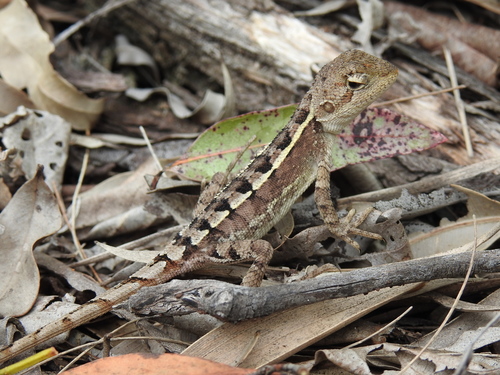
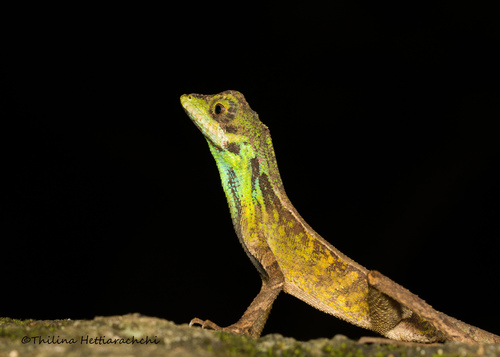
Its base coloration spans from dark reddish brown to dull brown.
Sexual Dimorphism
Males of the species are darker than females, and have a distinct maroon patch on their gular sac.
Habitat Range and Rainfall Requirement
This species prefers habitats in the wet zone forests and lower mountain forests of Sri Lanka that receive more than 2000 mm of annual rainfall, occurring up to 1,300 m (4,300 ft) in elevation.
Microhabitat
It is commonly found in the leaf litter of shady rain forests.
Male Territoriality
Males of O. wiegmanni are territorial, and defend their territory from intruders using displays and fights.
Reproductive Egg Laying
Females lay clutches of 3 to 5 eggs between July and January each year, with nesting peaking between October and January; the eggs are placed in a ground nest.
Egg Characteristics
The eggs are ellipsoidal in shape, measuring 7 mm–7.5 mm by 10 mm–17 mm (0.28 in–0.30 in by 0.39 in–0.67 in).
Incubation Period
Hatchlings emerge from the eggs between 57 and 70 days after laying.