About Orthosiphon thymiflorus (Roth) Sleesen
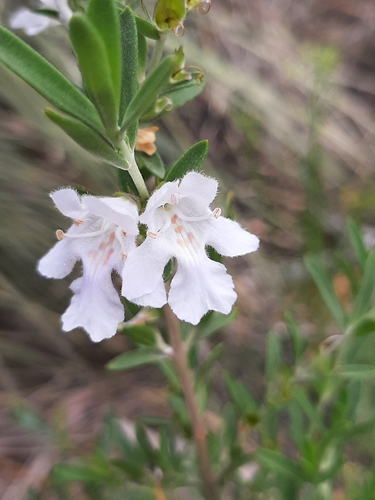
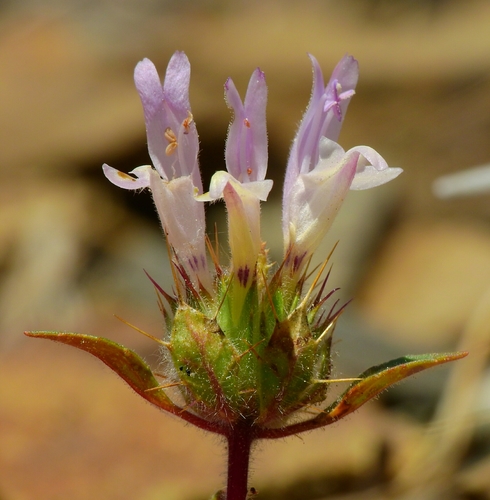
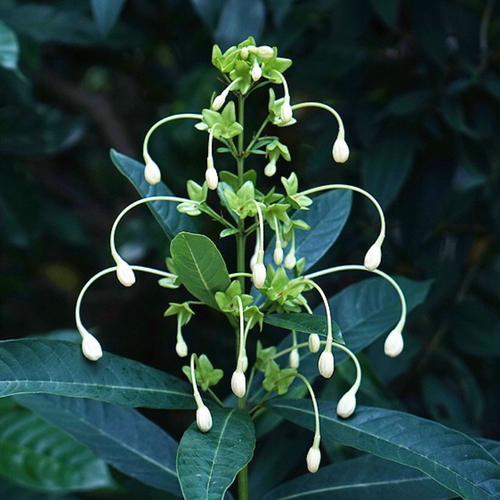
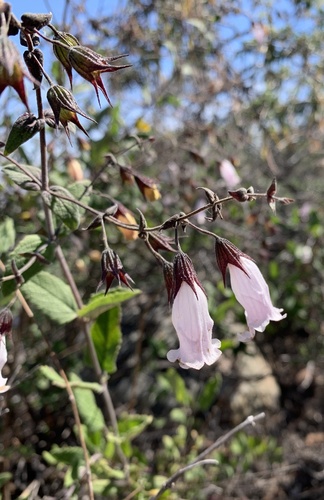
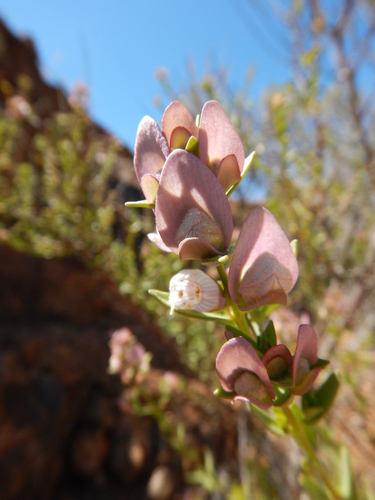
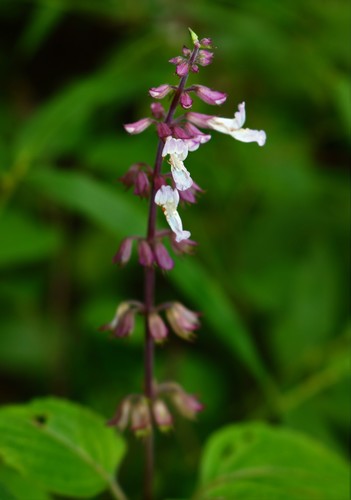
Orthosiphon thymiflorus (Roth) Sleesen is a perennial herb with a straggling growth habit, and it becomes somewhat shrubby as it ages. It flowers early in its life cycle and develops a small rootstock that produces several ascending stems, which reach 0.2–1.5 m (0.66–4.92 ft) in height. This species has little to no aromatic scent. Its stems are erect, square in cross-section, typically well-branched, and covered in hairs, with denser hairiness along the stem angles and near the stem tips. Leaves are stalked, ranging in shape from ovate to elliptic, and are mostly 1–4 cm (0.39–1.57 in) long; plants grown in shaded conditions produce larger leaves. Leaves have toothed margins, and their hairiness is variable, with the most hair found along the veins on the underside of the leaf blade. The species' inflorescence becomes lax quickly, with small clusters of flowers spaced 8–14 mm (0.31–0.55 in) apart. The calyx of this species is distinctive: it is purple on its upper side and green on its lower side. It measures around 3–4 mm (0.12–0.16 in) long when the plant is flowering, and elongates to 5–7 mm (0.20–0.28 in) once it develops fruit. The corolla is most often pink, but may occasionally be white or mauve, and is 8–10 mm (0.31–0.39 in) long. It has a straight tube and a hooded lower lip that encloses the stamens. The species produces small, brown, broadly egg-shaped nutlets that are roughly 0.9–1.2 mm (0.035–0.047 in) long, which release a small amount of mucilage when wet. Orthosiphon thymiflorus is closely related to Orthosiphon schimperi. In eastern Africa, the two species can be distinguished most notably by their calyx color: Orthosiphon thymiflorus has a purple upper calyx lip and green lower calyx lip, while Orthosiphon schimperi has a uniform purple-red calyx. This color distinction may not be valid for identifying the two species outside of eastern Africa. Some South African sources currently recognize Orthosiphon suffrutescens as a distinct separate species, but most botanical authorities treat Orthosiphon suffrutescens as a synonym of Orthosiphon thymiflorus. This species has been recorded in Angola, Benin, Botswana, Burundi, the Central African Republic, southeast China, the Democratic Republic of the Congo, the Republic of the Congo, Eritrea, Eswatini, Ethiopia, Ghana, India, Java, Kenya, Laos, Madagascar, Malawi, Mozambique, Nigeria, Rwanda, Saudi Arabia, Somalia, South Sudan, Sri Lanka, Tanzania, Togo, Uganda, Vietnam, Zambia, and Zimbabwe, as well as the South African provinces of Eastern Cape, Gauteng, KwaZulu-Natal, Limpopo, Mpumalanga, and North West. It grows in wooded grassland, bushland, and more open, drier types of forest.