About Orites excelsus R.Br.
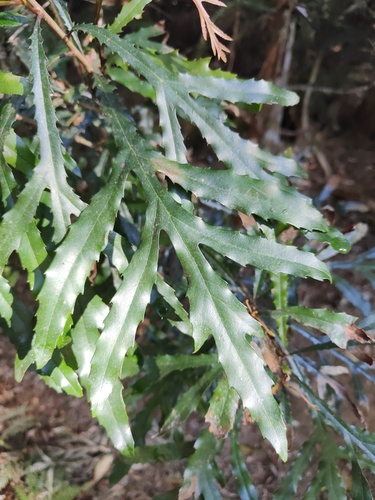
Orites excelsus R.Br. is a tree that typically grows up to 30 meters (98 feet) tall. It has mostly smooth brown or grey bark, which often bears minute scales, and new shoots are initially covered in rust-coloured hairs. Its leaves can be elliptic, lance-shaped, egg-shaped, or oblong, measuring 40–185 mm (1.6–7.3 in) long and 15–45 mm (0.59–1.77 in) wide, attached to a 10–25 mm (0.39–0.98 in) long petiole. Leaves are usually lobed, typically have regularly spaced teeth along their edges, are shiny green on the upper surface, and range from grey to whitish on the lower surface. The flowers are white or creamy-white, fragrant, and around 6 mm (0.24 in) long. They are arranged in leaf axils along a 50–110 mm (2.0–4.3 in) long rachis. Flowering takes place from winter to early spring. The fruit produced are boat-shaped follicles, 20–30 mm (0.79–1.18 in) long and 8–10 mm (0.31–0.39 in) wide. This species grows in cool mountain rainforests, ranging from Barrington Tops in New South Wales north to south-eastern Queensland, and also occurs on Mount Bellenden-Ker and Mount Bartle Frere in north Queensland. It grows at altitudes above 750 m (2,460 ft) in New South Wales, and between 1,000 and 1,500 m (3,300 and 4,900 ft) in north Queensland. It is associated with the tree species yellow carabeen (Sloanea woollsii). The timber of this tree (also called prickly ash) has been used to make shingles, casks, furniture, and joinery.