About Oreocallis grandiflora (Lam.) R.Br.
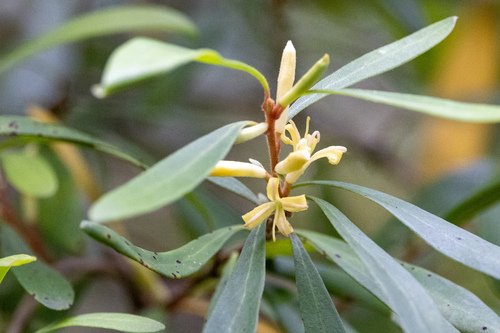
Oreocallis grandiflora (Lam.) R.Br. is a tree or shrub that grows to around 6 metres (20 ft) tall. Its leaves grow in a spiral pattern along twigs, and have simple, entire blades. Like many species in the Proteaceae family, the leaves of this species are highly variable. Leaf shape ranges from narrow and elongated lanceolate to broad and elliptical, with all intermediate shapes possible. The leaf base can be narrow or broad, and the leaf tip can be either pointed or rounded. Leaves are usually 4.8 to 12.7 centimetres (1.9 to 5.0 in) long, occasionally reaching 21.5 cm (8.5 in), and 1.6 to 3.4 cm (0.63 to 1.34 in) wide. Young leaves are often covered in dense, reddish hairs; older leaves typically have smooth surfaces, with hairs concentrated along the main veins on the leaf lower surface.
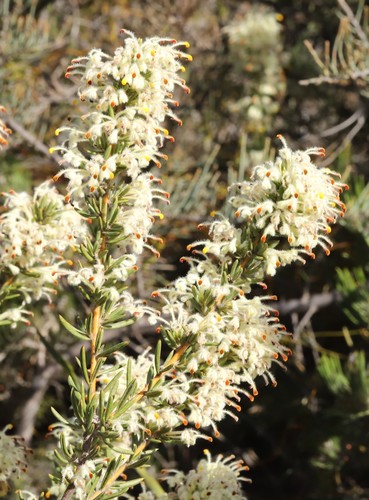
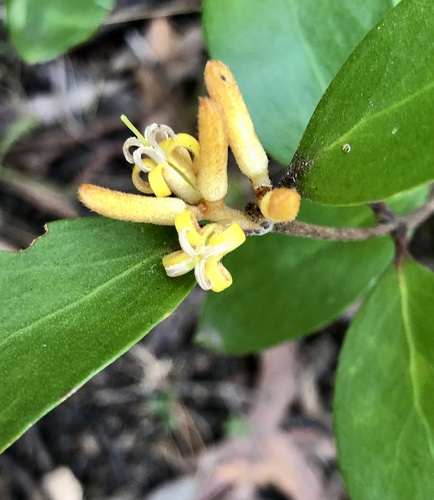
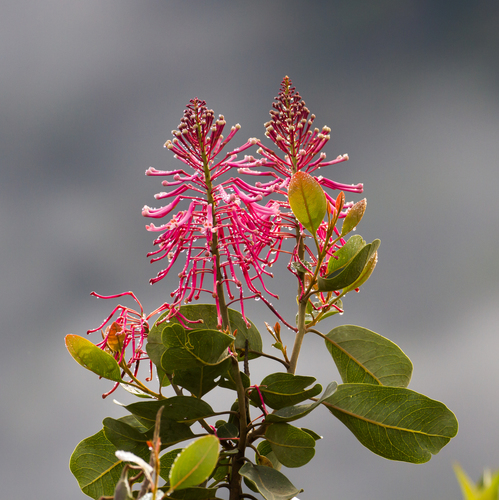
Plants produce terminal or lateral conflorescences, a type of inflorescence. Inflorescences are usually 7 to 17.5 cm (2.8 to 6.9 in) long, and may occasionally grow as long as 38 cm (15 in). They hold flowers that can be white, pink, yellow or red. The tepals, which include both sepals and petals, are mostly fused along their entire length, with only the tepal tips remaining unfused. The pollen grains of this species have three pores, a trait considered primitive within the Proteaceae.
In terms of habitat and ecology, Oreocallis grandiflora is a characteristic species of specific semi-deciduous valley forests and evergreen upper montane Andean forests in southern Ecuador, as well as evergreen sclerophyllous forests in northern Peru. It grows at elevations between 1,200 and 3,800 m (3,900 and 12,500 ft) above sea level. It tolerates habitat disturbance, and may be expanding its range in response to increased human activity. Flowering occurs continuously throughout the year. Pollinator communities vary with the species' distribution, and floral visitation happens both during the day and night; nocturnal visitation has only been reported in southern Ecuador. During the day, inflorescences are visited by birds, including at least 14 hummingbird species such as Metallura tyrianthina, Aglaeactis cupripennis and Coeligena iris. Mammals are the only nocturnal visitors: the phyllostomid bat Anoura geoffroyi, and the Andean mouse Microryzomys altissimus. The role of M. altissimus as an actual pollinator has not yet been confirmed, though samples collected from its fur show that it removes pollen.
This plant has several recorded uses. It is used for firewood and furniture or carpentry work. Its pleasantly mottled cream-white, pinkish and pale brown wood has been used for inlay work and for borders on chess boards. It also has medicinal uses, and its seeds are eaten in southern Ecuador.