About Ophrys insectifera L.
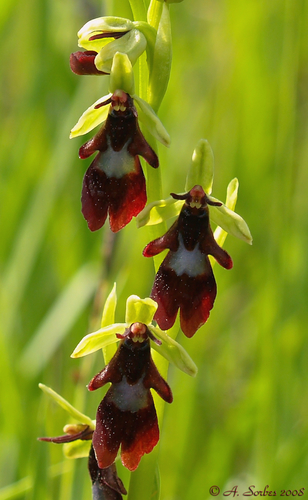
Ophrys insectifera L. is a tuberous perennial herb that grows up to 60 cm (2 ft) tall. It is a slender plant with narrow, upright leaves, and blooms from May to July across its entire range. Its flower spike can hold 1 to 10 individual flowers: these flowers have yellow-green sepals, very reduced dark brown to black petals that look like insect antennae, and a long, narrow, lobed dark labellum that ranges in color from maroon to black. The labellum has two glossy depressions called 'pseudo-eyes' and an iridescent blue-grey patch that evolved to look like the glistening wings of an insect. A rare yellow-flowered form of this species also exists. Ophrys insectifera has a chromosome count of 2n=36. This species is native to Europe, and grows further north than most other species in the genus Ophrys, ranging from Scandinavia, Finland and the Baltic states in the north down to Greece and Spain in the south. In the United Kingdom, it is a rare species with a southern distribution. It prefers sites with damp, alkaline, unimproved soil, and can be found growing in beech woodlands, on forest edges, in scrub, on limestone pavement, in limestone grassland, in chalk pits and wet meadows, on cliffs, and on disused railways. The species gets its common name because its inflorescence resembles a fly, but it actually depends on Hymenoptera for pollination. In the UK, Ophrys insectifera is only pollinated by two species of digger wasp: Argogorytes mystaceus and Argogorytes fargeii. The orchid uses scent that mimics female sexual pheromones to attract male wasps, which pollinate the flowers while attempting to mate with the flower. Both wasp species that pollinate this orchid in the UK feed on Umbellifer flowers as adults, and hunt froghopper nymphs as larvae. Argogorytes mystaceus reproduces in woodland glades, while Argogorytes fargeii reproduces in open, sparsely vegetated habitats. Like most orchids, Ophrys insectifera depends on a mycorrhizal relationship with fungi living in the soil around its roots. Experiments have found that it grows in association with fungi from the Tulasnellaceae family. Because this mycorrhizal partnership is essential, orchids are especially vulnerable to fungicide, as well as other chemicals that could affect the growth of soil fungi or cause other species of fungi or bacteria to dominate the soil they grow in.