About Ophisops leschenaultii (Milne-Edwards, 1829)
Taxonomic Naming
This species, Ophisops leschenaultii, was first described by Milne-Edwards in 1829.
Historical Description Context
Two classic historical descriptions of the species are reproduced below.
Boulenger Description Introduction
The first description, from G.A. Boulenger's 1890 work The Fauna of British India, Including Ceylon and Burma. Reptilia and Batrachia, reads: "Upper head shields strongly keeled and striated; anterior labials keeled, forming a projecting margin; canthus rostralis very strong; nostril in the horizontal suture between two large nasals which are extensively in contact with the rostral, and followed by one or two postnasals, the upper of which sometimes enters the nostril; no azygous prefrontal; frontal long and narrow; a small occipital; 4 supraoculars, first and fourth small, the two principal separated from the supraciliaries by a series of granules; subocular bordering the lip, between the fourth and fifth (or fifth and sixth) upper labials; temporal scales small, keeled; two large shields border the parietals exteriorly; a curved large shield on the supero-anterior border of the ear-opening; six large chin-shields on each side, the three anterior in contact with their fellows.
Boulenger Body Scale Description
Dorsal scales moderately large, scarcely larger on the back than on the sides; ventrals broader than long, in 6 longitudinal and 25 to 29 transverse series, the median longitudinal series narrower than the others; 42 to 48 scales round the middle of the body, ventrals included.
Boulenger Preanal and Limb Description
A large postero-median preanal plate. The hind limb reaches the ante-humeral fold or a little beyond the ear; the length of the foot equals the distance between the antehumeral fold and the nostril or the tip of the snout.
Boulenger Pores and Tail Description
12 to 16 femoral pores on each side. Tail nearly twice as long as head and body; caudal scales much larger than dorsals.
Boulenger Coloration Description
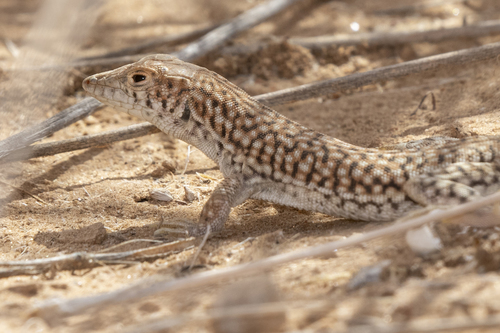
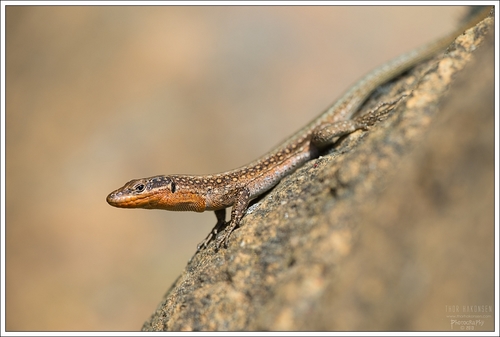
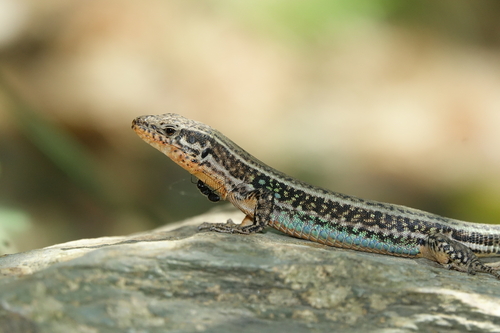
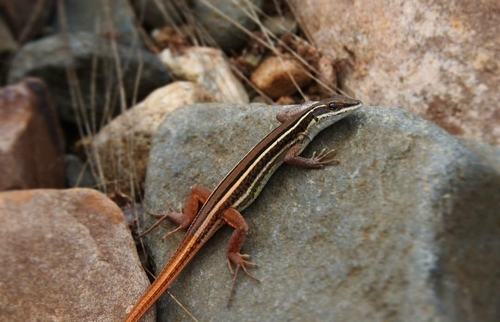
Brownish or golden above; a pale band, edged above with a black one, along each side of the body and tail, commencing from the supraciliary edge; another pale, black-edged band along the upper lip and side of the body; the space between the two light bands on each side usually black, or spotted with black; lower surfaces yellowish-white, tail and hind limbs often reddish.
Boulenger Size Description
From snout to vent 2 inches [5 cm]; tail 4 [10 cm]."
Günther Description Introduction
The second description comes from A. Günther's 1864 publication The Reptiles of British India, and reads: "Two loreals; the central occipital very small. The lower eyelid transparent; temples with small, hexagonal, keeled scales of equal size.
Günther Body Scale Description
Dorsal scales keeled, rhombic. Ventral scales in six longitudinal and twenty-five or twenty-six transverse series.
Günther Preanal and Pores Description
Vent covered with a larger central scale, surrounded by other small ones. Fifteen or sixteen femoral pores.
Günther Coloration Description
Brown, with two broad whitish bands on each side, the upper arising from the superciliary and running along the side of the back, the lower proceeding from below the eye and ear along; the middle of the side.
Günther Size Description
Total length 5 1/2 inches [14 cm], of head and trunk 2 inches [5 cm].
Historical Distribution Notes
The specimens in the Paris Museum are said to be from the coast of Coromandel. Jerdon (Journ. As. Soc. Bengal, xxii. p. 476) says that he has recognized the species: it is somewhat locally distributed.
Jerdon Range Observations
I have seen it in the Salem and Coimbatoor districts only, especially near the banks of the Cauvery. It frequents bushy ground, hedges of Euphorbia and clumps of Cactus.
Blyth Range Observations
Mr. Blyth adds that the Museum at Calcutta contains examples of what he takes to be this species, from Pind Dadun Khan, in the Punjab Salt Range; and that it formerly possessed the same from Afghanistan."
Habitat and Altitude Range
The preferred natural habitat of O. leschenaultii is rocky areas within forest or shrubland, found at altitudes ranging from sea level up to 1,500 m (4,900 ft).
Reproduction
Ophisops leschenaultii is oviparous, and its clutch size can reach up to six eggs.