About Ophioblennius steindachneri Jordan & Evermann, 1898
Juvenile Coloration
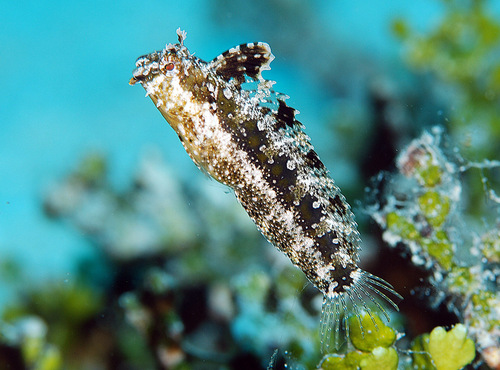
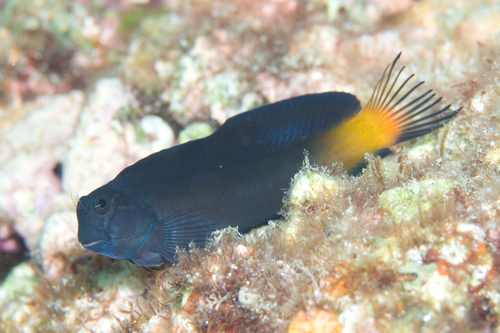
Ophioblennius steindachneri, commonly called the large-banded blenny, is darkly colored as a juvenile.
Adult Coloration
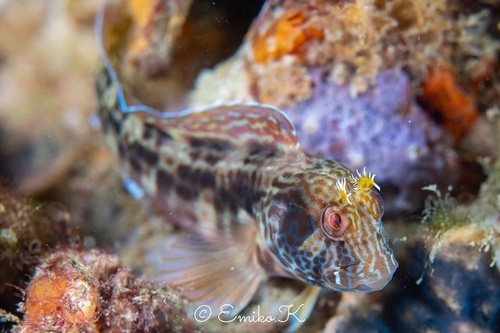
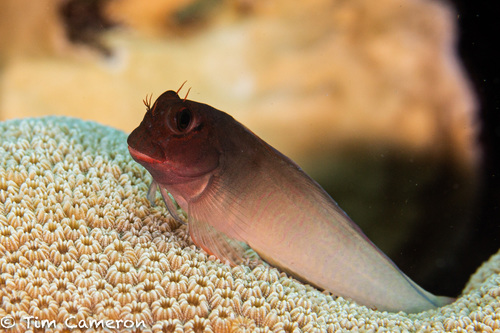
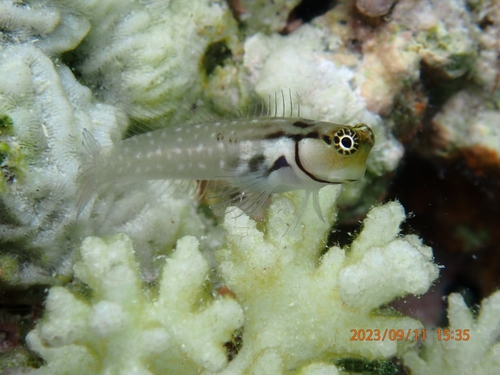
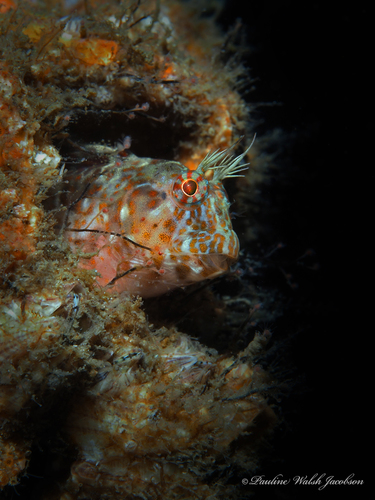
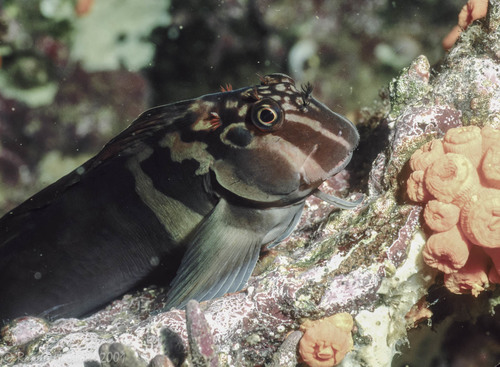
As it matures, it develops brownish to olive coloration with lighter markings, plus a dark spot behind the eye.
Body Markings
It also has several broad bands that start at the head and fade out behind the pectoral fins.
Geographic Range
This species is distributed in the eastern Pacific Ocean, ranging from the Gulf of California to Peru.
Distribution Islands
Its distribution includes the Revillagigedo Islands, Cocos Island, Malpelo Island, and the Galápagos Islands.
Adult Habitat
Adult large-banded blennies live primarily in the surge zone of exposed rocky headlands with steep slopes.
Shelter Behavior
They wedge themselves into crevices close to the shore in shallow water.
Territoriality
This species is territorial, and individuals will dart out of their hiding spots to defend their territory.
Feeding Period
They feed during the day, grazing on algae and preying on sessile invertebrates.
Feeding Adaptation
They use their comb-shaped incisor teeth to scrape food off rock surfaces.
Reproductive Mode
Like all blennies, Ophioblennius steindachneri is oviparous.
Egg Characteristics
It lays demersal eggs that stick to the substrate via a filamentous adhesive pad or pedestal.
Larval Traits
The species' larvae are planktonic, and are often recorded from shallow coastal waters.