About Ophidion marginatum DeKay, 1842
Etymology and Lateral Line
The striped cusk-eel, scientifically named Ophidion marginatum DeKay, 1842, gets its common name from its lateral line. This lateral line stops before the base of the tail, and has a noticeably different shade from the rest of the fish’s gray-green body.
Body Shape
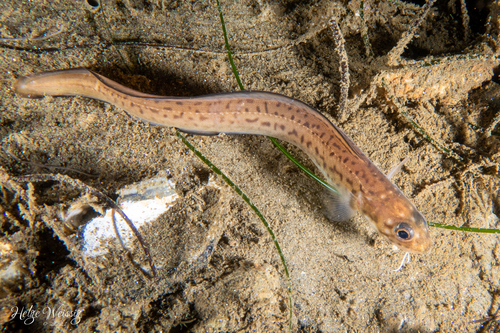
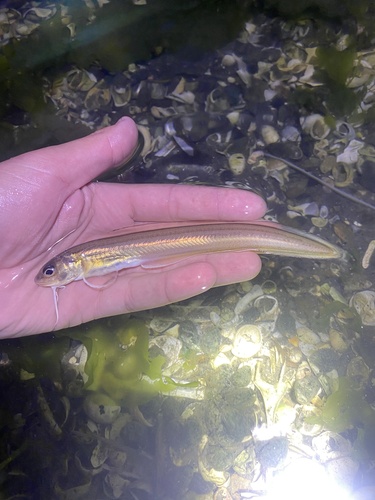
This species has an elongated body that is laterally compressed. The profile of its head is almost straight, running from the tip of its moderately pointed snout to a point behind its eye.
Snout Morphology
The snout extends just past the mouth, and has a spine that projects downward near its tip. Males of this species have a prominent crest on the nape.
Fin Fusion
The dorsal, anal, and caudal fins are joined together.
Dorsal and Anal Fin Rays
The dorsal fin has 147 to 158 rays, while the anal fin has 118 to 124 rays.
Pelvic Fin Structure
Each pelvic fin has two rays of unequal length, and is inserted under the eye.
Scale Characteristics
The scales are smooth and elongated, do not overlap, and are completely absent from the head.
Body Coloration
The striped cusk-eel is gray-green on its upper body, golden on its flanks, and white on its underside. It has 2 to 3 dark stripes running along the full length of its body, with one stripe positioned along the lateral line.
Head and Fin Markings
The side of the head has brown spots. The dorsal fin is pale green with a black margin, and the anal fin also has a black margin.
Maximum Length
This fish can reach a maximum length of 25 centimetres, or 9.8 inches.
Geographic Range
The striped cusk-eel is found in northern Atlantic waters off the coast of the United States, with a range extending from New England to northeastern Florida.
Larval Habitat
Larvae of the species live on the United States continental shelf.
Juvenile Habitat
A mix of larvae and juveniles has been recorded in estuaries between Barnegat and Chesapeake Bay.