About Ononis spinosa L.
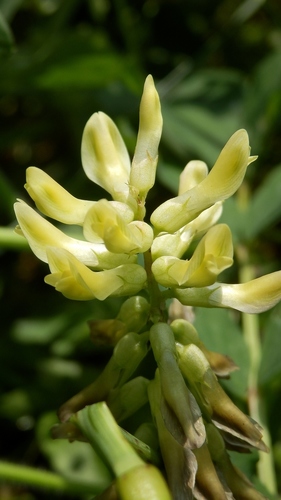
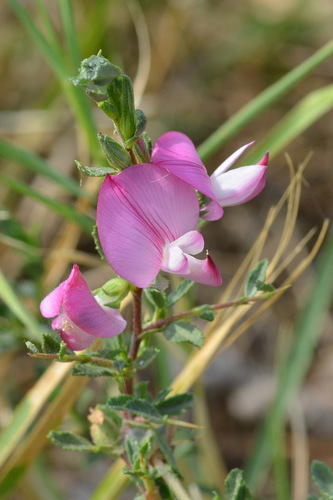
Ononis spinosa L., commonly known as spiny restharrow, is an upright, bushy perennial. Its wiry, branched stem is downy, almost always spiny, and grows to a height of 60 cm (24 in). This species has small, dark green leaves that can be oval or trifoliate, with toothed leaf-like stipules at their base. Its flowers are deep pink and white; the wing (side) petals are shorter than the hooked keel petal, a feature that distinguishes it from Ononis repens, where the wings are the same length as the keel. For Ononis spinosa, the calyx is usually shorter than the pod.
Spiny restharrow is distributed across southern temperate areas of Europe and Siberia. In Great Britain, it has a more southeastern distribution than O. repens. It occurs widely across central and southeastern England, is scarce in Wales, southwestern England, and northern England, and is only found at a very small number of sites in southern Scotland. It is not native to Ireland, where it only occurs as a rare introduced plant. Its typical habitat is lime-rich, nutrient-poor grassland growing on chalk and heavy, calcareous soils.
In medieval Russia, spiny restharrow was used in the production of bulat steel. All details of the original manufacturing process have been lost. The process is known to have involved dipping finished weapons into a vat holding a special liquid that contained spiny restharrow extract; the plant's Russian name, stalnik, reflects this historical role. After dipping, swords were held aloft while galloping on horseback, to allow the treatment to dry and harden in the wind. In traditional Russian herbal medicine, the species was used as an anodyne, antiphlogistic, aperient, coagulant, and diuretic. A decoction of restharrow was used to treat eczema and other skin problems, hemorrhoids, chronic constipation, and anal infections.