About Oenothera suffrutescens (Ser.) W.L.Wagner & Hoch
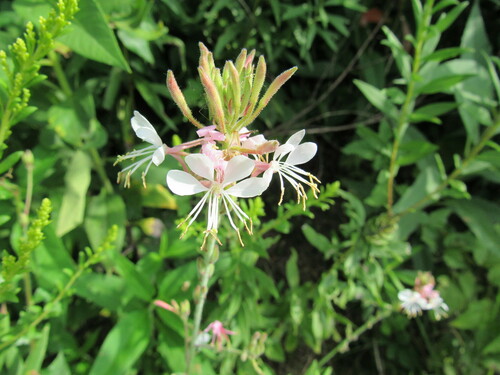
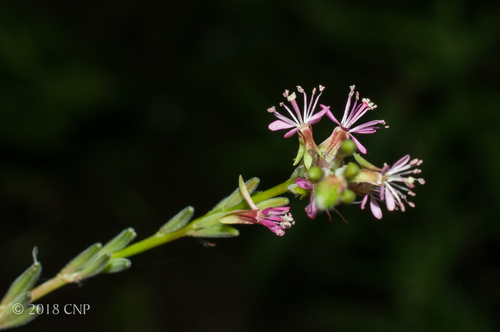
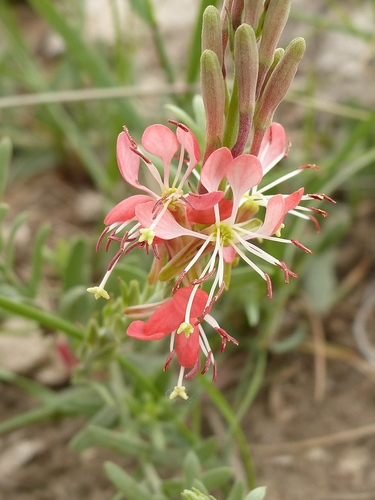
Scarlet beeblossom, with the scientific name Oenothera suffrutescens (Ser.) W.L.Wagner & Hoch, is a perennial herb that grows from a woody base and heavy roots. Stems can range from 10 centimeters tall to over one meter tall, grow in a sprawling form, and are often covered in small, stiff hairs. Plants form thin to thick clumps of stems covered with linear to somewhat oval-shaped leaves that measure one to seven centimeters long. The tops of stems hold spike inflorescences, each holding several flowers. Each flower has four long, stiff sepals that open, fall away from the flower, and lie reflexed toward the stem. It has four spoon-shaped petals that are white to yellowish and may turn pink as they age. Each flower contains eight long stamens with large red, pink, or yellowish anthers arranged around a long stigma. The flowers have a strong, noticeable scent. The fruit produced is a woody capsule less than one centimeter long. This plant is native to a large portion of North America, particularly the western and central parts of the continent. It grows in many different habitat types, and is occasionally found in urban areas. In 2016, NatureServe assessed this species under its former name Gaura coccinea and ranked it as globally secure (G5). This species is occasionally grown in wildflower gardens, valued because its flowers resemble butterflies and produce a pleasant scent when blooming. However, some gardeners including author Claude A. Barr find the plant difficult to control in garden settings, as it spreads via deep rhizomes.