About Oenanthe fistulosa L.
Tubular water-dropwort (Oenanthe fistulosa L.) is a hairless, stoloniferous perennial herb that grows up to 80 cm tall. Its stems are brittle, hollow, inflated and cylindrical, 0.5 cm in diameter, and constricted at the nodes – this trait gives the species its specific epithet fistulosa. Unlike some other water-dropworts, it has no swollen tubers among its roots, but can reproduce vegetatively via its long stolons.
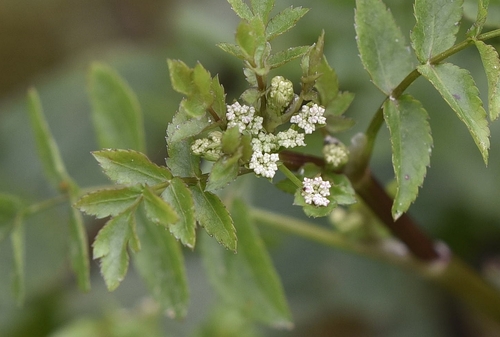
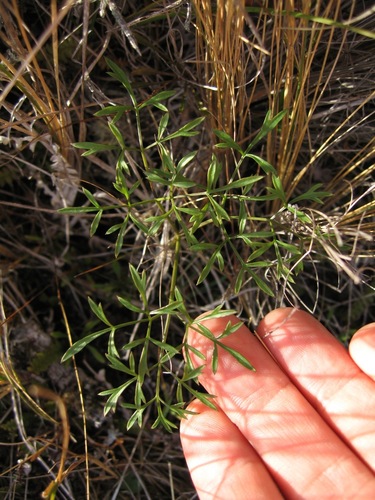
Leaf shape varies widely across the plant. Upper leaves are typically pinnate, with narrow, almost linear segments. Lower leaves can be 2- or even 3-times pinnate, with broader, flat leaflets that more closely resemble those of other umbellifers. The leaf stalks of upper leaves are hollow like the stem, and longer than the pinnate leaf blade.
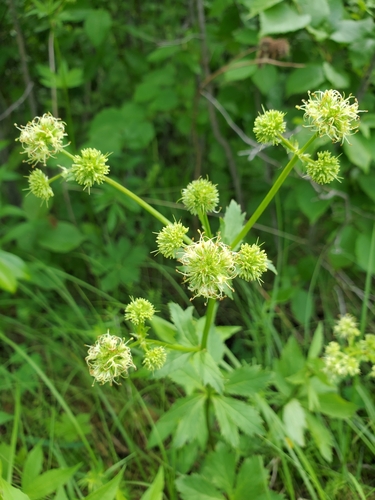
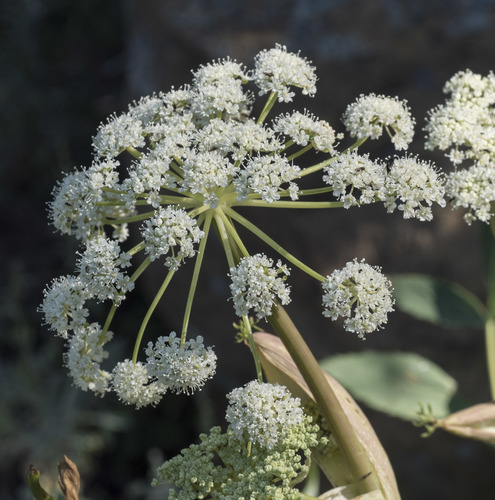
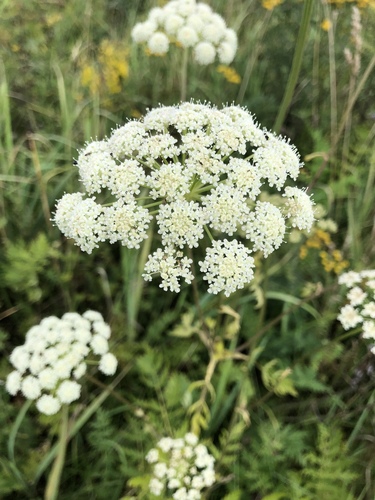
In northern Europe, it flowers between July and September. It produces clusters of 2-4 umbels, each around 1 cm in diameter and holding numerous white to pinkish flowers. A key distinguishing feature is that unlike many other umbellifers, it has no bracts, and only small bracteoles on the individual umbels. The rays (stalks supporting the umbels) are 10–30 mm long and thicken after flowering.
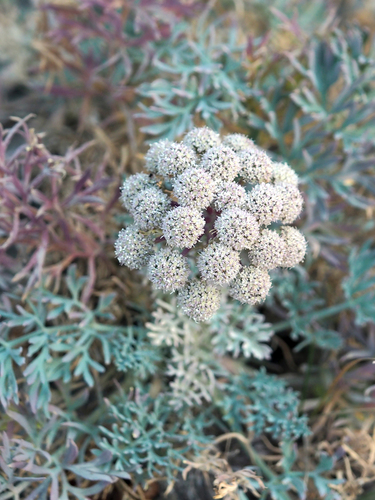
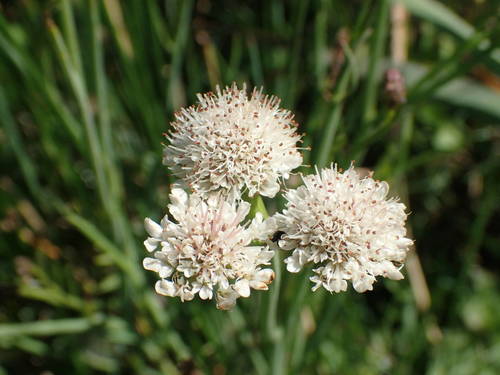
Plants are monoecious: terminal umbels bear both hermaphroditic and male flowers, while lateral umbels only produce male flowers. Each flower has 5 unequal petals, with the larger outer petals radiating outwards, 5 stamens, and 2 prominent styles growing from a swollen base (stylopodium) at the top of the ovary. After flowering, flower stalks and fruits expand to form distinctive pink balls, with the remains of the styles projecting in pairs from the surfaces of the cone-shaped fruits.
For identification in the United Kingdom, it can be told apart from other native British Oenanthe species by several traits: its inflated hollow stems (stems of O. lachenalii and O. pimpinelloides are solid); the complete absence of bracts (bracts are present in O. crocata, O. lachenalii and O. pimpinelloides); its globose fruits that are all sessile (this is not true for O. crocata, O. silaifolia, O. pimpinelloides or O. lachenalii); and fruits that are less than 4 mm long (fruits are longer in O. crocata and O. fluviatilis).
The global natural range of tubular water-dropwort extends from Europe through the northern half of Africa to western Asia. It does not grow naturally further north than southern Scandinavia, and it is rare as an introduced species beyond its natural range. In Britain and Ireland, it occurs mainly in lowland eastern counties, and becomes increasingly rare moving towards the uplands of the north and west. In France, its distribution follows a similar pattern: main populations are in the southern lowlands, and it becomes rarer in upland regions around the Alps.
Its IUCN global and European threat status, assessed in 2013, is Least Concern (LC). In France, it is considered unthreatened at the national level, but it is declining in some regions: it is listed as Critically Rare (CR) in Limousin and Endangered (EN) in Midi-Pyrénées. It is also declining in other European countries, including Slovenia, where it is classed as EN. In Britain it is classified as Vulnerable (VU), and in England its area of occupancy is estimated to have declined by 35% between the 1960s and the 1990s. This decline has continued in some English counties: in Kent, the number of sites holding the species shrank by 60% between the 1970s and 2005, even though it is a designated Biodiversity Action Plan species.
Tubular water-dropwort is a wetland plant, that occurs naturally in swamps and marshes along valleys and in river deltas, including the Camargue in France and Doñana National Park in Spain. In well-drained agricultural landscapes, it is now most often found in drainage ditches, farm ponds and grazed wet meadows. In some locations it grows as a halophyte in coastal dune slacks or brackish grazing marshes, such as at Aiguamolls de l'Empordà in Spain or on the Sefton Coast in Britain.
It favours clean, mesotrophic water, slightly base-rich conditions, and moderately high light levels, which makes it an axiophyte in most British counties. In France, it is an indicator species for the Gratiola officinalis-O. fistulosa community in restored wetlands along the Saône river. In Italy, it is the dominant species in a community of flooded creeping bent meadows on clay, classified as the Ranunculus ophioglossifolius-O. fistulosa community.
Where the species has declined noticeably, habitat restoration attempts have been made. Wet meadows were sown in the Meuse valley in northeast France, but the species did not colonise the site after three years. However, after a species-poor ditch in arable farmland on Romney Marsh was cleared and planted with O. fistulosa, the species thrived for at least some time, indicating it is less sensitive to nutrient enrichment than many other wetland species. Its Ellenberg values in Britain are L = 7, F = 9, R = 7, N = 6, and S = 0.
Like other umbellifers, tubular water-dropwort has unspecialised flowers pollinated by a wide variety of beetles, flies and other invertebrates. Only a small number of insects have been recorded feeding on it: larvae of the beetle Lixus paraplecticus are phytophagous and develop inside the stems; common swallowtail caterpillars eat the leaves in France; and larvae of the moth Depressaria daucella create leaf mines or feed directly on the foliage and flowers. Two fungi cause galls in tubular water-dropwort in Britain: Protomyces macrosporus causes distortion and swelling of leaves, petioles and stems, while Uromyces lineolatus produces yellowish spots on the lower surface of leaves and on petioles.
Tubular water-dropwort roots contain small quantities of Oenanthotoxin, the toxic compound that makes hemlock water-dropwort so dangerous. Oenanthotoxin levels here are 10 times lower than in hemlock water-dropwort, and the species is generally considered safe, and even palatable. It is freely grazed by livestock.
It is used in traditional medicine in Algeria. Research on its essential oil has identified constituents that may have medical benefits, as well as the chemical Heneicosane, which attracts mosquitoes that transmit Dengue fever. It is documented as part of traditional cuisine in parts of southern Italy and Turkey, where it is known as Gazyak or Kazayağı (a general name for multiple water-dropwort species), and its basal leaves are cooked and eaten. Irish botanist D.E. Allen suggests that O. fistulosa may be the plant reported to treat rheumatism in County Wicklow, Ireland.