About Ocyceros griseus (Latham, 1790)
Scientific Nomenclature and Size
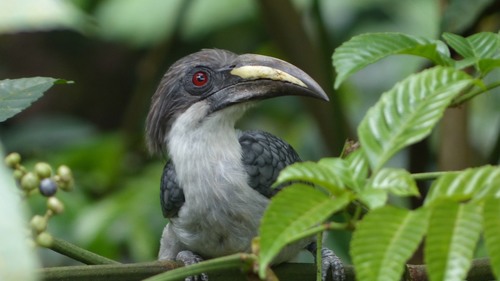
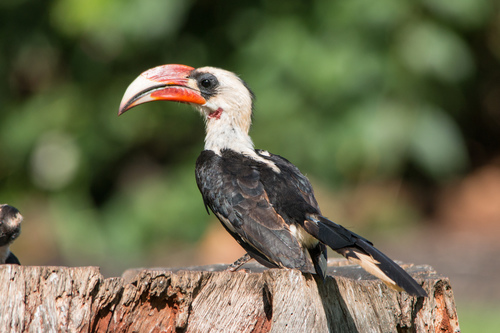
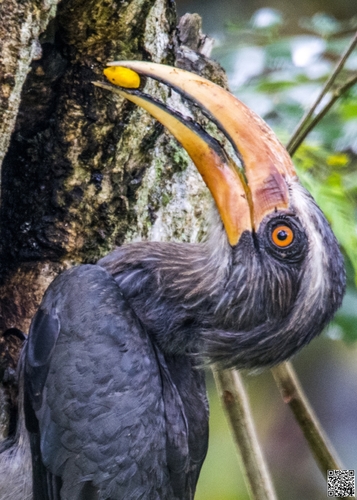
The Malabar grey hornbill (scientific name: Ocyceros griseus (Latham, 1790)) is a large bird, measuring 45 to 58 cm (18 to 23 in) in length, making it the smallest of all Asian hornbills. It has a 23 cm (9.1 in) long tail and a pale, yellowish, or orange bill.
Bill Sexual Dimorphism
Males have a reddish bill with a yellow tip, while females have a plain yellow bill with black at the base of the lower mandible and a black stripe running along the culmen. This species has a broad whitish superciliary band above the eye that extends down to the neck.
Movement Patterns
It flies with a strong flapping and gliding flight pattern, and hops heavily across the outer branches of large fruiting trees. Its wings are brown-grey, it has a white carpal patch, and its black primary flight feathers have white tips.
Distinction from Indian Grey Hornbill
It can be easily distinguished from the Indian grey hornbill, which mainly lives on the adjoining plains: the Indian grey hornbill has a prominent casque, and a white trailing edge across its entire wing visible in flight. The Malabar grey hornbill has a grey back and a cinnamon vent.
Plumage Details
Its long tail is blackish with a white tip, and its grey underparts are marked with white streaks. Its long, curved bill has no casque.
Immature Bird Features
Immature birds have browner upperparts and a yellow bill, while young birds have a dull white or yellow iris. Its loud calls are distinctive, including cackling described as hysterical, laughing, and screeching calls.
Geographic Range
This species is endemic to the Western Ghats mountain range of India, ranging from around Nashik in the north to the southernmost hills of the region. Its elevational distribution spans from about 50 m near the coast, for example at Phansad Wildlife Sanctuary in Maharashtra, up to around 1,500 m in the mountains.
Southern Western Ghats Elevational Records
In the southern Western Ghats, Malabar grey hornbills have been reported in evergreen forests between 500 m and 900 m in elevation (and sporadically up to 1,100 m) in Kalakad–Mundanthurai Tiger Reserve, but are found frequently up to 1,200 m in the Anamalai Hills further north. At both of these sites, estimated population density of the Malabar grey hornbill decreases as elevation increases.
Anamalai Hills Population Factors
In rainforest fragments of the Anamalai Hills, population density is also positively related to the species richness of food trees. This species occurs mainly in dense forest habitats; the thinner dry forest of the plains is typically occupied by the Indian grey hornbill.
Taxonomic Distinction
The Sri Lanka grey hornbill was previously grouped with this species, but is now recognized as a separate distinct species. Malabar grey hornbills are typically found in small groups, mostly in habitats with ample tree cover.
Ecological Role
As large frugivores, they act as important seed dispersal agents for many species of fruit-bearing forest trees. They also feed on small vertebrates, and will readily eat meat when kept in captivity.