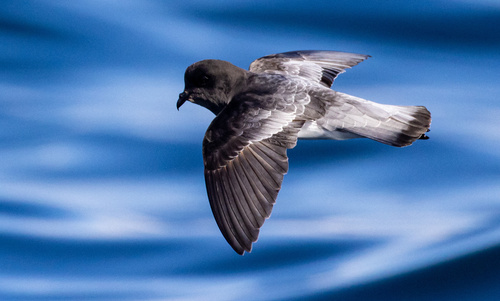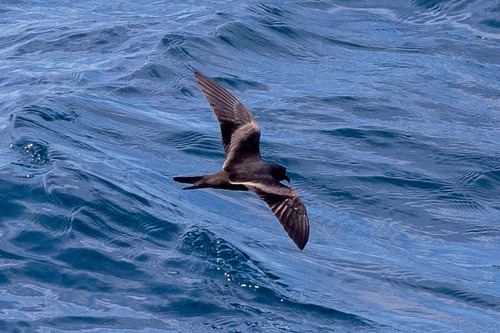
About Oceanodroma markhami (Salvin, 1883)
Taxonomic Identity
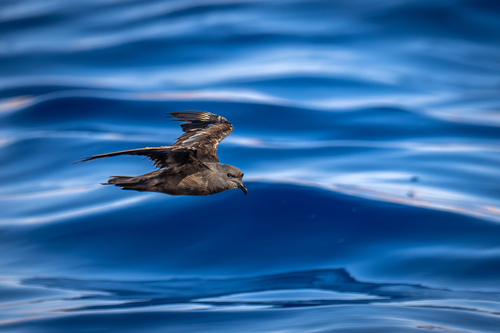
Markham's storm petrel (scientific name Oceanodroma markhami (Salvin, 1883)) is a large, slender species of storm petrel.
Body and Wing Structure
Like other members of its genus, it has slender wings with tapered tips and a clear bend at the carpal wrist, and a deeply forked tail.
Plumage Coloration
Fresh plumage ranges from black to sooty brown, with a dull lead-gray gloss on the head, neck, and mantle; worn plumage becomes overall browner. A distinct, crescent-shaped grayish bar runs diagonally across the upper side of the inner wing. Covert feathers above this bar are often brownish, while the primaries below it are often blackish, creating a characteristic three-colored wing pattern.
Soft Part Morphology
This species has a brown iris, and black bill, legs, and feet. Its bill is shorter than that of most closely related species, while the nasal tube on top of the bill is long, extending to the midpoint of the beak.
Size Measurements
Adult individuals have a wingspan of 49 to 54 cm (19 to 21 in), a total length (from bill tip to tail tip) of 21 to 23 cm (8.3 to 9.1 in), and an average body weight of 53 g (1.9 oz). There are no morphological differences between sexes.
Similar Sympatric Species
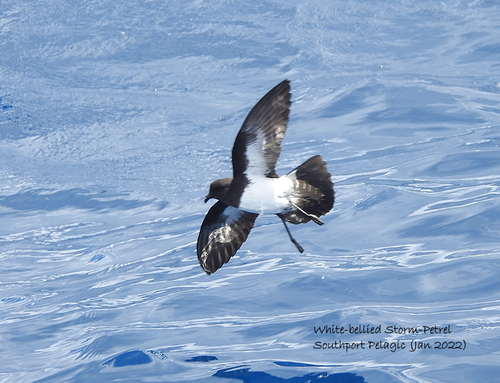
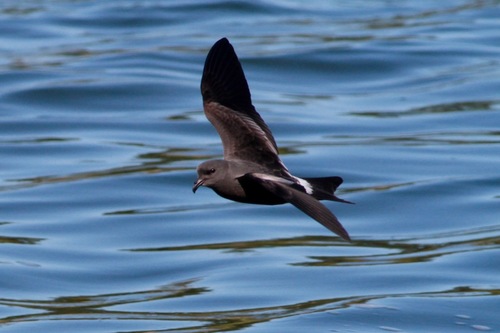
Similar species that overlap with Markham's storm petrel in range include black storm petrel (Hydrobates melania) and the dark morph of Leach's storm petrel (Hydrobates leucorhous).
Distinction from Black Storm Petrel
It is especially hard to tell apart from the similar-sized black storm petrel: Markham's storm petrel differs by having a tarsus much shorter than its foot, a more distinct gray upper wing bar that extends closer to the wing's leading edge, a shorter neck, more angular head, and more deeply forked tail.
Distinction from Leach's Storm Petrel
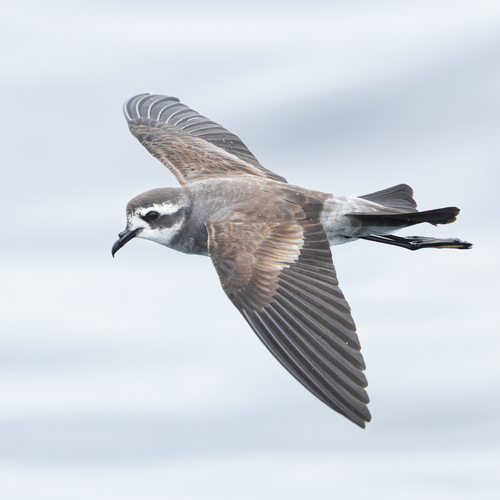
Compared to Leach's storm petrel, Markham's storm petrel has deeper tail fork, longer wings, and a larger overall size. Flight pattern differences also help separate these species.
Flight Characteristics
Markham's storm petrel typically flies slowly, often gliding with occasional shallow wingbeats, and usually flies more than 1 m (3.3 ft) above the ocean surface. By contrast, black storm petrel glides less often, uses deep wingbeats, and usually flies lower than 1 m above the surface. Leach's storm petrel generally uses deeper wingbeats and has a more bouncing flight.
Vocalizations
The calls of Markham's storm petrel are described as series of "purrs", "wheezes", and "chatters"; adult nesting individuals will vocalize when recordings of the species' vocalizations are played at their nest cavity entrance.
Core Marine Range
Markham's storm petrel lives in Humboldt Current waters of the Pacific Ocean off Ecuador, Peru, and northern Chile, and is considered endemic to the Humboldt Current, as individuals spend most of their lives at sea.
Maximum Range Extent
The species can range as far north as southern Mexico (18°N), as far south as central Chile (30°S), and as far west as 118°W. There have been unconfirmed sightings further north off Baja California, but these may be misidentifications of black storm petrel.
Non-breeding Distribution
A 2007-published survey found that during the non-breeding austral autumn, the largest concentration of Markham's storm petrel is located just off the coast of Peru between Guayaquil and Lima. In spring, this concentration splits into two groups: one off southern Peru and northern Chile, and a second around 1,700 km (1,100 mi) further west.
Age-based Distribution
Adults are most common within 200 km (120 mi) of the coast, while subadults are most common more than 500 km (310 mi) offshore.
Habitat Preferences
The species is more common in relatively shallow waters over the continental shelf (continental crust) than in deeper waters over oceanic crust, and more common in areas with cooler, saltier surface water. As a highly pelagic species, it is only rarely seen from shore.
Breeding Habitat
Despite its wide marine range, Markham's storm petrel only breeds in the Atacama Desert of Peru and Chile, nesting in natural cavities within saltpeter (nitrate-rich salt crusts).
Colony Characteristics
Known breeding colonies range in area from 33 to 6,100 ha (82 to 15,073 acres), with nest densities between 0.5 and 248 nests per hectare. Colonies are typically located within 25 km (16 mi) of the sea, at elevations up to 1,080 m (3,540 ft), and are usually on flat, vegetation-free ground. In 2021, a colony at Punta Patache was discovered near a lomas (fog oasis), marking the first known colony associated with abundant vegetation.
Colony Site Selection
Colony location is likely dependent on favorable wind corridors that allow birds to use onshore sea-land winds to return to nests after nightfall, and offshore land-sea winds to return to the sea before dawn.
Colony Detection Challenges
Because Markham's storm petrel only returns to nesting colonies after dark and departs for the sea before dawn, breeding colonies are very hard to detect, and their locations were unknown for a long time.
First Documented Colony
The first documented colony, on Peru's Paracas Peninsula, was reported in 1993 and is estimated to hold 2,300 breeding pairs.
Subsequent Colony Discoveries
Five additional colonies, all in northern Chile, were discovered between 2013 and 2021. Two separate discoveries were made in Chile in 2013: one of nesting sites south of Acha valley in Arica Province, and one of a recorded singing bird.
2013 Colony Survey Results
A 2019 study reported that follow-up exploration in November 2013 (based on the recording) found 34,684 nests in Arica, 20,000 nests in Salar Grande, and 624 nests in Pampa de la Perdiz in northern Chile's Atacama Desert, which made up approximately 95% of the known breeding population at that time. The study authors noted that two other areas in Chile could hold colonies based on grounded fledgling sightings; these would be the southernmost known colonies for the species.
Most Recent Colony Discovery
The first confirmed breeding site in southern Peru was reported at Pampa Pie de Candela in 2023.
Mating System
Like other storm petrels, Markham's storm petrel is thought to be monogamous.
Breeding Cycle Length
The full reproductive cycle, from colony arrival to fledgling departure, lasts approximately five months.
Breeding Timing Variation
Some pairs start breeding much earlier than others: for example, in the Paracas, Arica, and Salar de Quiña colonies, some females lay eggs in April, while others lay eggs as late as August. This can result in an overall 10-month breeding season for the entire colony, unlike most other colony-forming bird species which have much more synchronized breeding.
Inter-colony Breeding Timing Differences
There are also large timing differences between colonies: in the Caleta Buena, Salar Grande, and Salar de Navidad colonies, egg laying occurs much later, between November and likely February. The reasons for these timing discrepancies are unknown.
Nest Cavity Dimensions
Nest cavity entrances average 9.33 cm (3.67 in) in diameter, ranging from 5.5 to 18 cm (2.2 to 7.1 in), and nest cavities are typically more than 40 cm (16 in) deep. Active storm petrel nests have a characteristic strong smell that helps researchers confirm they are in use.
Egg Characteristics
Each breeding pair produces one egg per season, laid on bare ground inside the cavity with no nesting lining. Eggs are plain white with no gloss, and average 32.2 by 24.2 mm (1.27 by 0.95 in) in size.
Incubation Behavior
Both parents incubate the egg in shifts of up to three days, while the off-shift partner feeds at sea. The average incubation period at the Paracas colony is 47 days.
Chick Provisioning
After the chick hatches, parents return to feed it every two to three days. At the Punta Patache colony, Markham's storm petrels typically return to their nests after nightfall between 23:00 and 01:00, and leave between 04:00 and 06:00.
Breeding Social Behavior
Pairs within a colony do not cooperate on breeding. After hatching, once they complete the chick phase, Chilean fledglings travel toward the sea.
Fledgling Disorientation
Fledglings are either attracted to or disoriented by artificial lights, a common issue for burrow-nesting petrels.
Molt Timing
Adult molt likely occurs between December and May, while juvenile molt likely happens several months earlier.
At-sea Social Behavior
At sea, Markham's storm petrel is usually encountered alone or in small flocks, sometimes mixed with other storm petrel species. It does not usually follow ships.
2007 Diet Study Results
A 2007 study of 15 sampled individuals found that Markham's storm petrel consumed the fish Diogenichthys laternatus and Vinciguerria lucetia, among other prey items. The species was found to have lower dietary diversity than other small petrels, though small petrels as a group generally had higher dietary diversity than other bird groups included in the analysis.
2002 Diet Study Results
A 2002 study found that by mass, the main diet components are fish (specifically Peruvian anchovy, Engraulis ringens), cephalopods (specifically the octopus Japetella sp.), and crustaceans (specifically the pelagic squat lobster, Pleuroncodes monodon). Around ten percent of analyzed stomach contents showed evidence of scavenging.
Foraging Behavior
Based on the large variation in consumed food types and its scavenging behavior, Markham's storm petrel appears to forage opportunistically near the ocean surface. The 2007 study found that the proportion of birds feeding or resting (compared to those in flying transit) was significantly higher in austral autumn than in spring.
Adult Predators
Adult Markham's storm petrels are likely preyed on by larger birds such as skuas and large gulls.
Nest Predators
Two fox species, the Sechura fox and the South American gray fox, are important nest predators. Chicks are also known to be preyed on by birds of prey, dogs, and the ant Pheidole chilensis.
Ectoparasites
A 2018 study found the ectoparasitic stick-tight flea (Hectopsylla psittaci) on two out of ten birds captured in Pampa de Chaca, Arica y Parinacota Region. Both flea specimens were found on the lorum, the region between the eyes and nostrils, of their hosts.
Parasite Host Transition
The turkey vulture (Cathartes aura) is a possible source of host transition for the fleas, as both vultures and Markham's storm petrel have been observed nesting in the same colony.