About Nyctomys sumichrasti (Saussure, 1860)
Species Identification
Sumichrast's vesper rat, Nyctomys sumichrasti, is a relatively small rat.
Body Length
Adult body length (not including the tail) measures 10 to 13 cm (3.9 to 5.1 in), and the tail is only slightly shorter than the body.
Weight
Males and females are similar in size, with both sexes weighing between 220 and 245 g (7.8 to 8.6 oz).
Pelage Coloration
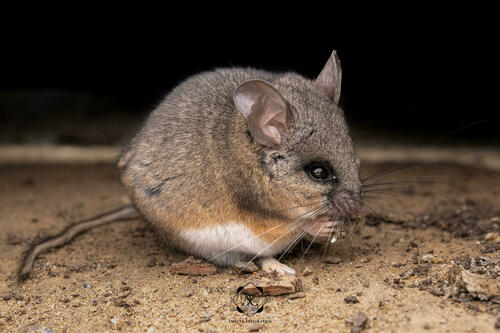
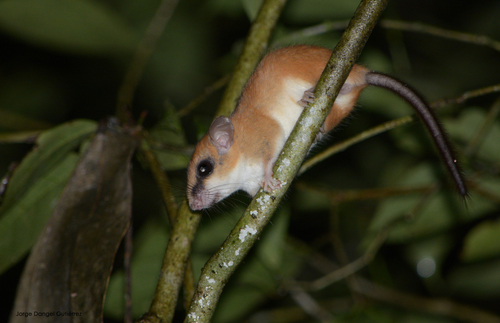
It is one of the more brightly colored rat species, with a reddish or orange back and creamy to white underparts.
Fur Distribution
It has a thick pelt of soft fur that covers the full length of its tail, and is only absent on the soles of the feet.
Head Features
Its eyes are relatively large and surrounded by a narrow ring of black hair, while its whiskers are long and its ears are small.
Climbing Adaptations
To help with climbing, its claws are compressed and curved, and the first toe on each foot is shaped like a thumb.
Geographic Range
Sumichrast's vesper rat ranges from southern Jalisco and Veracruz in Mexico through most of Central America (excluding the Yucatan Peninsula) as far east as central Panama.
Habitat and Elevation
Across this range, it lives in evergreen and semi-deciduous forests at elevations from sea level up to 1,600 m (5,250 ft).
Subspecies
Nine subspecies are currently recognized: N. s. sumichrasti from southern Veracruz, Mexico; N. s. colimensis from Jalisco to Oaxaca, Mexico; N. s. costaricensis from southern Costa Rica; N. s. decolorus from southern Belize and eastern Guatemala to Honduras; N. s. florencei from southern Honduras and western Nicaragua; N. s. nitellinus from eastern Costa Rica to central Panama; N. s. pallidulus from southern Tabasco and western Chiapas, Mexico; N. s. salvini from eastern Chiapas, Mexico and southern Guatemala; and N. s. venustulus from eastern Nicaragua.
Mating Period
Mating takes place throughout the year.
Gestation and Litter Size
Gestation lasts from 30 to 38 days, after which one to three young are born.
Nesting Behavior
Both parents build the nest where the young are reared, though the male usually stays outside the nest for the first seven days after birth.
Newborn Size
Newborn young are about 8 cm (3.1 in) long and weigh 4.5 g (0.16 oz).
Juvenile Development
They are born blind, only partially covered in fur, and remain attached to the mother's teats for most of their first two weeks, but are able to crawl starting from two days of age.
Weaning and Eye Opening
They are weaned at around three weeks old, and their eyes open between fifteen and eighteen days after birth.
Sexual Maturity and Lifespan
They reach sexual maturity at around 75 days of age, and have been recorded living up to five years in captivity.