About Nyctereutes procyonoides (Gray, 1834)
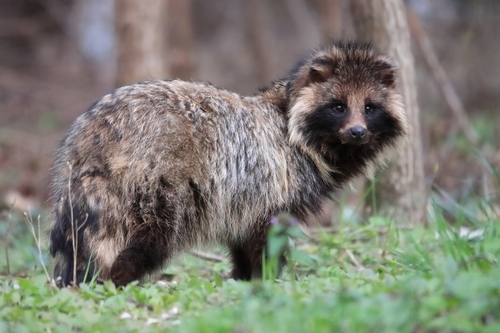
The scientific name of the common raccoon dog is Nyctereutes procyonoides (Gray, 1834). The skulls of common raccoon dogs strongly resemble those of South American foxes, especially crab-eating foxes, though genetic studies confirm the two groups are not closely related. Common raccoon dog skulls are small but sturdily built and moderately elongated, with narrow zygomatic arches. Skull projections are well-developed, with the sagittal crest being particularly prominent in older animals. Matching their omnivorous diet, common raccoon dogs have small, weak canines and carnassials, flat molars, and relatively long intestines that are 1.5 to 2.0 times longer than those of other canids. They have long torsos and short legs. Total body length ranges from 45 to 71 cm (18 to 28 in). Their tail is 12 to 18 cm (4.7 to 7.1 in) long, short, making up less than a third of their total body length. The tail hangs below the tarsal joints without touching the ground. Their ears are short and protrude only slightly from the fur. Body weight fluctuates by season: in March, individuals weigh 3 kg (6.6 lb), while from August to early September males average 6.5–7 kg (14–15 lb), with some reaching a maximum weight of 9–10 kg (20–22 lb). On average, specimens measured in Japanese and Russian studies are larger than those measured in Chinese studies. The common raccoon dog's winter fur is long and thick, with dense underfur and coarse guard hairs that reach 120 millimetres (4.7 in) in length. This winter fur protects the animals from low temperatures as cold as −20 to −25 °C (−4 to −13 °F). Winter fur is a dirty earth-brown or brownish-grey color with black guard hairs. The tail is darker than the torso. A dark stripe runs across the back, broadening over the shoulders to form a cross shape. The abdomen is yellowish-brown, while the chest is dark brown or blackish. The muzzle is covered in short hair, which grows longer and thicker behind the eyes. The cheeks are covered in long, whiskery hairs. Summer fur is brighter and reddish straw-colored. A rare white color variant occurs in China, and yellow-colored individuals also exist. Between 1928 and 1958, 10,000 individuals of the N. p. ussuriensis subspecies were introduced to 76 districts, territories, and republics of the Soviet Union in an effort to improve fur production quality. Primorye in the Russian Far East was the first region colonized, with individuals transplanted from islands in the Sea of Japan. By 1934, common raccoon dogs had been introduced to Altai, the Northern Caucasus, Armenia, Kyrgyzstan (then called Kirgizia), Tatarstan, Kalinin (now Tver Oblast), Penza, and Orenburg regions. The following year, they were introduced further to Leningradsky District (Krasnodar Krai), Murmansk, Novosibirsk, and Bashkortostan. Common raccoon dogs did not survive well in Irkutsk, Novosibirsk, Trans-Baikaliya, and Altai, due to harsh winters and scarce food. They also fared poorly in the mountainous regions of the Caucasus, Central Asia, and Moldova. However, introductions were successful in the Baltic states, European Russia (particularly in then-Kalinin, now Tver Oblast; Novgorod, Pskov, and Smolensk regions), central Russia (Moscow, Yaroslavl, Vologda, Gorkiy (now Nizhny Novgorod), Vladimir, Ryazan Oblasts, etc.), the Chernozem belt of Voronezh, Tambov, and Kursk, the lower Volga Region, and the low-elevation parts of Northern Caucasus and Dagestan. In Ukraine, the largest populations became established in Poltava, Kherson, and Lugansk. In 1948, 35 common raccoon dogs were introduced to Latvia. The population grew rapidly, and in 1960 Latvia officially reported that 4,210 common raccoon dogs were hunted that year. The common raccoon dog is now abundant across Finland, Estonia, Latvia, and Lithuania, and has been recorded as far away as Denmark, Norway, Sweden, Belarus, Poland, Germany, Netherlands, Belgium, Luxembourg, France, Switzerland, Czech Republic, Hungary, Romania, Bulgaria, Serbia, and Moldova. In response to its spread, Denmark set a goal of zero breeding for common raccoon dogs by 2015. By 2018, however, the species had become fully established in Jutland (the Danish mainland directly connected to Germany), with further projects focused on limiting or preventing its spread to the Danish islands. In June 2021, a study commissioned by the United Kingdom's Department for Environment, Food and Rural Affairs identified the common raccoon dog as one of 20 invasive species likely to spread to the UK. The common raccoon dog's mating season runs from early February to late April, depending on location. Common raccoon dogs are monogamous, with pair bonds usually forming in autumn. Captive males have been recorded mating with four or five females. Males fight briefly (but not fatally) to compete for mates. Copulation happens during the night or at dawn, and typically lasts 6–9 minutes. Estrus lasts from a few hours to six days, during which females may mate up to five times. Females enter estrus again 20–24 days after their first estrus, even if they are already pregnant. The gestation period lasts 61–70 days, with pups born in April–May. Litter sizes are typically 6–8 pups, though 15–16 pups may be born in exceptional cases. First-time mothers usually give birth to fewer pups than older females. Males play an active role in raising pups. This male contribution is extremely important: early 1928 releases of pregnant females without males resulted in very limited introduction success, while later releases of breeding pairs from 1929 through the 1960s led to the common raccoon dog's current extensive introduced range in Europe. At birth, pups weigh 60–110 g (2.1–3.9 oz), are blind, and are covered in short, dense, soft wool with no guard hairs. Their eyes open after 9–10 days, and teeth erupt after 14–16 days. Guard hairs begin growing after 10 days, first appearing on the hips and shoulders. After two weeks, their fur lightens in color, with black tones remaining only around the eyes. Lactation lasts 45–60 days, though pups start eating food brought to them as early as three weeks to one month of age. They reach full adult size at 4.5 months old. Pups leave their parents in late August–September. By October, the pups, which by this point resemble adults, form pairs. Sexual maturity is reached at 8–10 months. Their maximum lifespan is not well documented: 6–7 year-old individuals have been found in the wild, while captive specimens have been recorded living up to 11 years. When used for clothing, common raccoon dog fur is often called "murmansky" or "tanuki" fur. In the United States, it is marketed as "Asiatic raccoon", and in Northern Europe as "Finn raccoon". Generally, pelt quality is based on the silkiness of the fur, since the attractive look of the pelt depends on guard hairs staying erect, which only happens with silkier furs. Small common raccoon dog pelts with silky fur sell for higher prices than large pelts with coarse fur. Due to their long coarse guard hairs and woolly fur fiber that tends to felt or mat, common raccoon dog pelts are used almost exclusively for fur trimmings. Japanese common raccoon dog pelts, while smaller than other geographic variants, are the most valued variety, with pelts from Amur and Heilongjiang coming close behind. Pelts from Korea and southern China are the least valued. When raised in captivity, common raccoon dogs can produce 100 g (3.5 oz) of wool of slightly lower quality than goat wool. Russian trade in common raccoon dogs was well developed in the Primorye and Ussuri areas in the 1880s. World trade of common raccoon dog pelts between 1907 and 1910 totaled 260,000–300,000 pelts, with an estimated 20,000 (5–8%) coming from Russia, though more recent estimates put the number lower at 5,000–6,000. 12,000 common raccoon dogs were caught in the 1930s. In their introduced range, licensed trade of common raccoon dogs began in 1948–1950, with trade restrictions removed in 1953–1955. After trade opened up, the number of animals caught rose sharply. From 1953 to 1961, the number of catches fluctuated between 30,000 and 70,000. In 1961, about 10,000 were taken from their natural range in the Far East, while 56,000 were taken from their introduced range. Of the 56,000, 6,500 came from Belarus, 5,000 from Ukraine, 4,000 each from Latvia, Lithuania, and Krasnodar, 3,700 from Kalinin, 2,700 from Pskov, and 2,300 from Astrakhan. 1,000–2,000 pelts each were produced in Vologod, Moscow, Leningrad, Novogrod, Smolensk, Yaroslavl, Azerbaijan, Estonia, and Dagestan. Fewer than 1,000 pelts were produced in all remaining republics and districts. Successful introductions in Kalinin produced animals with denser and softer fur: the length of guard and top hairs increased by 7.96%, the length of underfur increased by 5.3%, the thickness of guard and top hairs decreased by 3.41%, and fur density increased by 11.3%. The introduced population also became darker in color, with black-brown pelts occurring in 8% of specimens, compared to 3% in the species' native range. Captive breeding of common raccoon dogs started in 1928 in the Far East, with 15 state farms keeping the animals by 1934. Common raccoon dogs were the main farmed furbearer in the early years of collective farms, particularly in Ukraine. By the 1940s, this practice became less popular, since common raccoon dogs required almost the same food as silver foxes, which are more valuable. An investigation by three animal protection groups into the Chinese fur trade in 2004 and early 2005 states that approximately 1.5 million common raccoon dogs are raised for fur in China. The common raccoon dog makes up 11% of all animals hunted in Japan. Twenty percent of domestically produced fur in Russia comes from the common raccoon dog.