About Nonnula frontalis (P.L.Sclater, 1854)
Taxonomy and Basic Measurements
Grey-cheeked nunlet (scientific name Nonnula frontalis (P.L.Sclater, 1854)) measures 14 to 15 cm (5.5 to 5.9 in) long and weighs 14.5 to 19.5 g (0.51 to 0.69 oz).
Nominate Subspecies Plumage (Head and Upperparts)
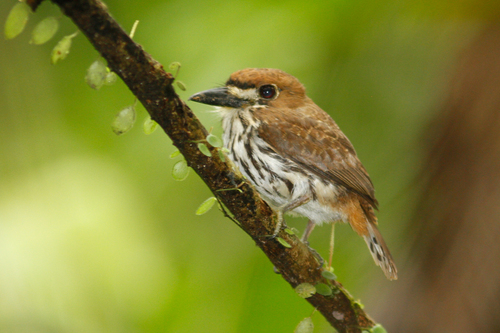
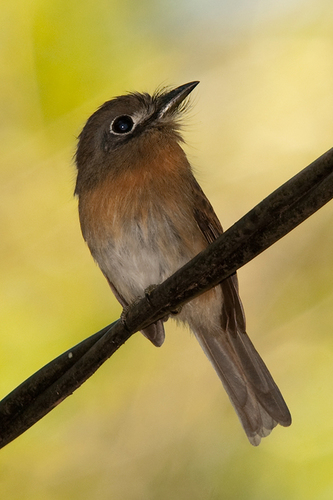
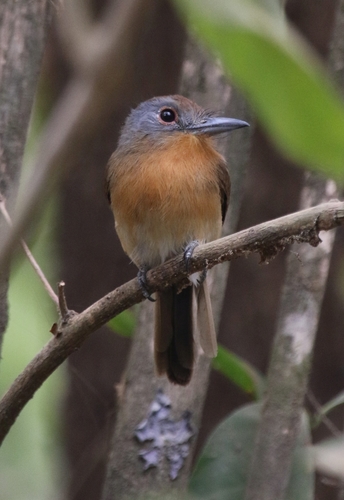
The nominate subspecies has a very dark chestnut crown, plain brown upperparts that are lighter on the rump, a dark brown tail that is almost black near the tip. Most of the face is gray, with a ring of bare red skin around the dark brown eye.
Nominate Subspecies Plumage (Underparts)
Its chin, throat, breast, and flanks are rufous, and the belly is buffy.
Nominate Subspecies Soft Parts
The bill is mostly blue-gray, and the feet are dull brown or greenish gray.
Subspecies N. f. stulta Morphology
Subspecies N. f. stulta has a very dark crown, with a blacker tail and a drabber rump than the nominate subspecies.
Subspecies N. f. pallescens Morphology
Subspecies N. f. pallescens has much paler upperparts than the nominate, and its throat and breast are buff.
Overall Species Range
This species has a somewhat restricted range that extends from central Panama to north-central Colombia.
Subspecies N. f. stulta Distribution
N. f. stulta, the northernmost subspecies, occurs from central Panama into extreme northwestern Colombia.
Subspecies N. f. pallescens Distribution
N. f. pallescens is found in the Caribbean lowlands of northern Colombia.
Nominate Subspecies Distribution
The nominate subspecies occurs in the interior of northern Colombia.
Habitat Preferences
The grey-cheeked nunlet inhabits a variety of landscapes: moist to humid primary and secondary forest, gallery forest, and thickets, and it especially favors river-side woodlands.
Vertical Forest Occurrence
It usually lives in the lower levels of the forest, but can also be found up to the subcanopy.
Elevation Range
It occurs at elevations ranging from sea level to 1,000 m (3,300 ft).