About Bucco tamatia J.F.Gmelin, 1788
Size and Weight
The spotted puffbird (Bucco tamatia J.F.Gmelin, 1788) is approximately 18 cm (7.1 in) long and weighs 31 to 42 g (1.1 to 1.5 oz).
Nominate Subspecies Head Markings
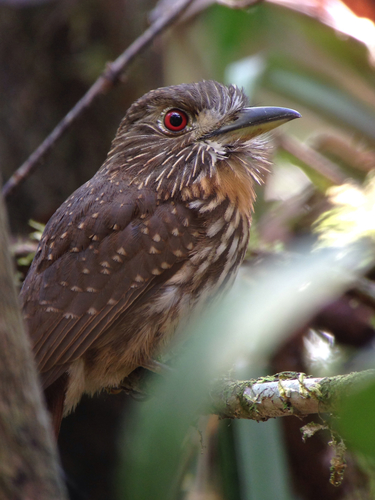
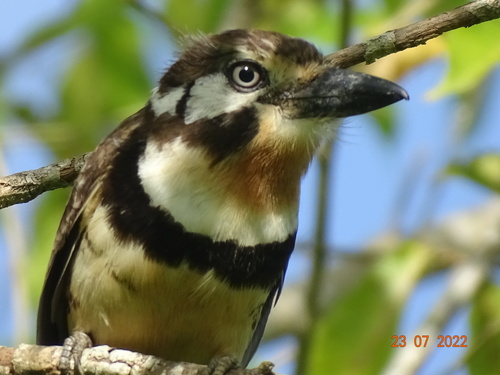
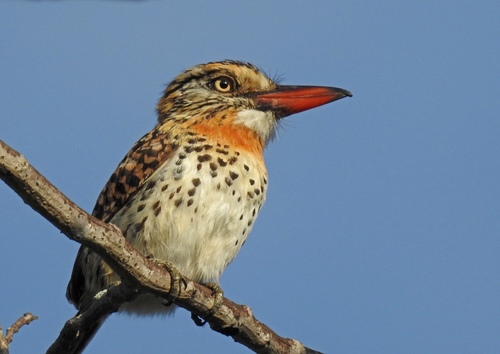
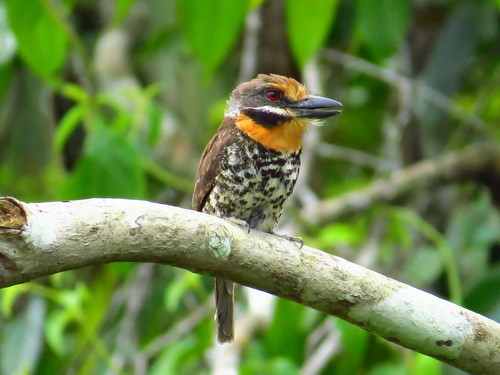
The nominate subspecies has a pale rufous forehead, with rufous spots on a dark brown background on the crown. Below the crown, there is a blackish band running through the eye, a white stripe below this band, and a black patch below the stripe.
Head Stripe Details
The white stripe extends all the way around the nape.
Upperparts and Tail Appearance
The upperparts and wings are dark brown with light buffy scalloped markings, and the tail is dark brown with buffy edges on its feathers.
Underparts Appearance
The chin is white, the throat is rufous, the breast and flanks are whitish marked with black spots and scaled patterns, and the belly and vent area are white with small black spots.
Bare Part Coloration
The bill is black, the iris is bright red, and the feet are dark gray or greenish.
B. t. pulmentum Features
B. t. pulmentum has a much paler throat than the nominate subspecies, a brighter forehead, and heavier black spotting across its body.
B. t. hypnaleus Features
B. t. hypnaleus is larger than the nominate subspecies but has a smaller bill, and has heavier spotting on its underside, especially on the breast.
Primary Song Structure
The spotted puffbird's song is a series of 10–20 soft, whistled 'chyoi' or 'puwéep' notes at approximately 2 notes per second. It starts weak and hesitant, then a few notes are given at lower pitch and slower speed, ending with around 4 inflected 'pchooii, pchooii, pchooii, peejowee' whistles.
Song Performance Context
This song is most often sung at dawn, and is sometimes performed as a duet.
Dispute Vocalization
The species also produces faint wheezy whistles during disputes.
Nominate Subspecies Distribution
The nominate subspecies is distributed from eastern Colombia eastward through Venezuela and the Guianas into Brazil, ranging south within Brazil to the north (left) bank of the Amazon River.
B. t. pulmentum Distribution
B. t. pulmentum is found from southeastern Colombia south through eastern Ecuador, northeastern Peru, and western Brazil into northeastern Bolivia.
B. t. hypnaleus Distribution
B. t. hypnaleus occurs in Amazonian Brazil east of the Tapajós River.
Habitat Types
The species lives in a range of somewhat open landscapes, including várzea and igapó forests, mature secondary forest, savanna woodland, and gallery forest. It is rarely found in the interior of dense closed forest.
Elevation Range
In terms of elevation, its range generally extends from sea level up to 1,400 m (4,600 ft), though in Venezuela it is most commonly found below 700 m (2,300 ft).