About Nitrosalsola vermiculata (L.) Theodorova
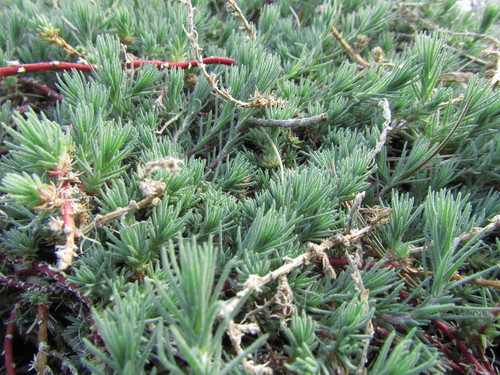
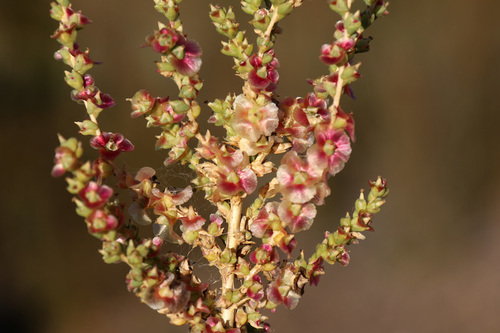
This species, currently accepted under the scientific name Nitrosalsola vermiculata (L.) Theodorova, is also referred to as Caroxylon vermiculatum in the text below. It is a small, greyish, heavily branched shrub that grows 25 to 100 cm (10 to 40 in) tall. Its branches branch repeatedly, and are wiry and woody at the base. The leaves are very small and scale-like, they clasp the stem and are covered with minute hairs. The inflorescence is a leafy spike, with solitary flowers growing in the leaf axils. The flowers have persistent, pinkish, winged sepals, no petals, and measure about 10 mm (0.4 in) in diameter. This plant is native to Syria, Lebanon, Israel, Jordan, Saudi Arabia, Egypt, Morocco, and southern Europe including Italy, Spain and Portugal. Its natural habitat is semi-arid and arid grassland. It has been introduced to Pakistan and California to provide forage in arid locations. In California, it has become a weed and is classified as an invasive species. Caroxylon vermiculatum is a member of the climax community in the Syrian steppe, where it grows alongside Artemisia herba-alba, Atriplex leucoclada and Stipa barbata. It also grows on the Jordanian steppe together with Artemisia herba-alba and Achillea fragrantissima, but all three of these useful fodder species are growing increasingly rare due to overgrazing. Excluding livestock from an area leads to a large increase in the biomass of these species. Caroxylon vermiculatum has a high protein content and is highly valuable as a forage crop in arid areas. It is planted in the Middle East for grazing by cattle, sheep, goats and camels. Natural regeneration happens in both spring and autumn, but plants that germinate in autumn are more drought tolerant and more likely to become established. Rainwater harvesting done as contouring furrows that prevent run-off improves the successful establishment and growth of this species. Planting this species and other native species such as Atriplex halimus has shown high potential for improving the Badia rangelands in Syria. Prolonged drought can sometimes cause the plants to shed their leaves. In California, Caroxylon vermiculatum has been found to act as an alternate host for the plant viruses that cause curly top, a disease affecting sugar beets, tomatoes and cucurbits.