About Neustanthus phaseoloides (Roxb.) Benth.
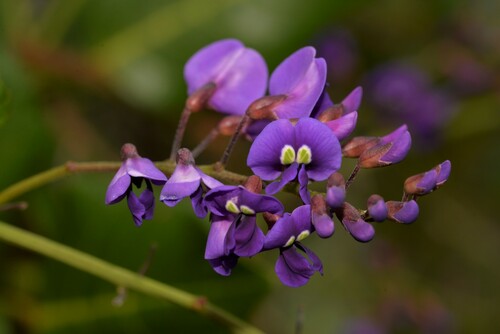
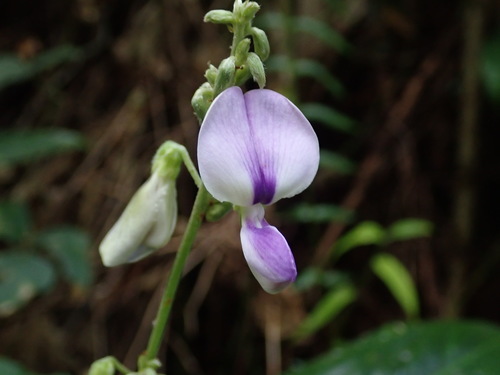
Neustanthus phaseoloides is a deep-rooted perennial herb that forms a subtuberous structure, which allows it to survive in waterlogged soils and withstand short periods of drought. Above-ground growth can reach up to 30 cm per day, and its stems often elongate to 20 meters in total length. N. phaseoloides is a twining vine that climbs over other plants or human-made structures. Its leaves are large and trifoliate, which is characteristic of the legume family. Individual leaflets may be oval or triangular in shape, and their size ranges from 2 × 2 cm to 20 × 15 cm. In subtropical regions, its growing season runs from early spring to late fall; it grows year-round in tropical regions. Its flowers follow the typical structure of the Fabales order. The flowers are small, colored mauve to purple, and grow in scattered pairs along a raceme. Mature pods of N. phaseoloides are black and covered in fine hairs. They are straight or slightly curved, and measure 4 to 11 cm in length. Each pod holds 10 to 20 seeds. The seeds have a distinct squarish shape with rounded corners, measure 3 × 2 mm, and are black or brown in color. N. phaseoloides is native to East and Southeast Asia. It has since been introduced and naturalized across many other wet tropical regions, including Africa, the Americas, and Australia. It grows best in ruderal sites such as cocoa or banana plantations, at low altitudes most often below 600 meters above sea level, in wet evergreen or monsoon forests. It can grow in a wide range of soil types, tolerates acidic soils, and withstands pH levels between 4.3 and 8. N. phaseoloides is cultivated as a cover crop, often grown alongside centro and calopo, in oil palm, rubber, and coconut plantations. The main benefits of using N. phaseoloides as a cover crop are its relatively high nitrogen accumulation and the improvement of soil structure from its deep rooting system. It can be used as a grazed forage crop, as green manure in crop rotations, and to prevent soil erosion on sloped land. In Africa, it is primarily used as a cover crop in plantations, while in tropical America and Southeast Asia it is used as a mixed forage crop and as a cover crop. In Malaysia, extracts of this plant are used in medicine.