About Neogobius melanostomus (Pallas, 1814)
Characteristics
Physical Features
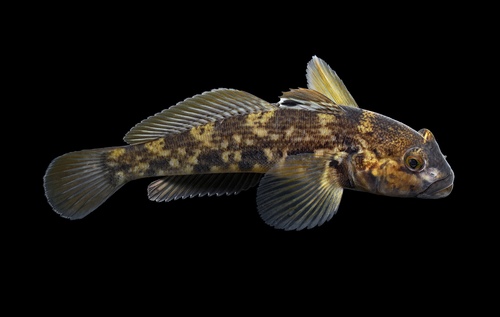
Round gobies are small, soft-bodied fish, identifiable by a distinct black spot on the first dorsal fin. Their eyes are large and protrude slightly from the top of the head, and like most gobies, their pelvic fins are fused together to form a single suction cup-shaped disc on the belly.
Size
Round gobies measure between 10 to 25 centimetres (4 to 10 inches) in length, with a recorded maximum size of 24.6 cm (9.7 in). They weigh between 5.0 and 79.8 grams (0.176 and 2.816 ounces), and their weight increases as they age. Males grow larger than females.
Coloration
Juvenile round gobies (individuals less than one year old) are solid grey. When they reach maturation, round gobies develop mottled markings in shades of grey, black, brown, and olive green. During the spawning season, adult male round gobies turn inky black and develop swollen cheeks.
Sex Differences
Males and females can be easily distinguished by the shape of their urogenital papilla: in males this structure is white to grey, long, and pointed, while in females it is brown, short, and blunt-tipped.
Distribution and habitat
Native Range
Round gobies are widespread in the Sea of Marmara and the rivers of its basin. They are also found in the Black Sea and the Sea of Azov, along all coasts and fresh waters of these basins, and in the region's coastal lakes and lagoons. Additional populations exist in the rivers of Crimea, the Caucasus (including the Mezib, Pshada, Vulan, Kodori, and Çoruh rivers), and the Caspian Sea, where the subspecies Neogobius melanostomus affinis occurs.
North American Introduction
Since 1990, the round goby has been recorded as an introduced invasive species in the North American Great Lakes, parts of Europe, and the Baltic Sea. The first documented catch of round goby in North America was made by an angler fishing in the St. Clair River at Sarnia, Ontario on June 28, 1990; this record was published by Jude et al. 1992 and Crossman et al. 1992. Studies by Jude, Crossman, and Jude et al. 1995 found round gobies in the St. Clair ranging in size from 29 to 180 millimetres (1+1⁄8 to 7+1⁄8 inches).
Expansion
Round gobies are rapidly expanding into tributaries of the North American Great Lakes, and have recently been discovered in at least one of New York State's Finger Lakes: Cayuga Lake. The first round goby recorded in the Hudson River was discovered by the state of New York in 2021. Round gobies are euryhaline (salt-tolerant), and can live in both freshwater and marine ecosystems, with tolerance for water mineralization up to 18–24%.
Habitat
They are most commonly found on continental shelves with sandy or rocky bottoms and low silting, at depths ranging from 1–2 m (3.3–6.6 ft) to 10–17 m (33–56 ft).
Reproduction
Maturity
Female round gobies reach sexual maturity at one to two years old, while males reach maturity at three to four years old. Round gobies living in the Laurentian Great Lakes typically mature up to one year earlier than populations in their native European habitat.
Courtship
Females can spawn up to six times per spawning season, which runs from April to September in most regions. At the start of the mating season, males migrate from deeper water, where they spend the winter, to shallower breeding grounds. They then release a steroid sex pheromone that attracts females to their territory. Males also use visual courtship displays, including posturing and changing color from beige to black, and can produce sounds during courtship.
Nesting
Females deposit their eggs in crevices between rocks that are guarded by males. Individual eggs measure 4 by 2.2 mm (0.16 by 0.087 in), and a single clutch can hold up to five thousand eggs.
Parental Care
Males are territorial, and defend the eggs from predators while continuously fanning them to supply oxygenated water to developing embryos. This parental care results in successful hatch rates of up to 95%.