About Myotis thysanodes Miller, 1897
Name and Size
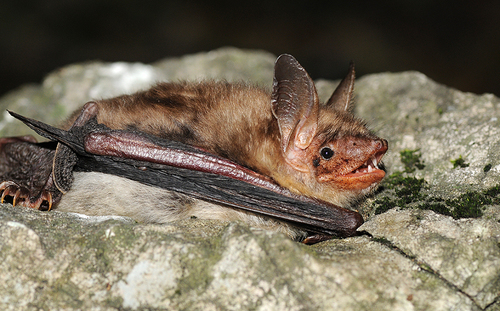
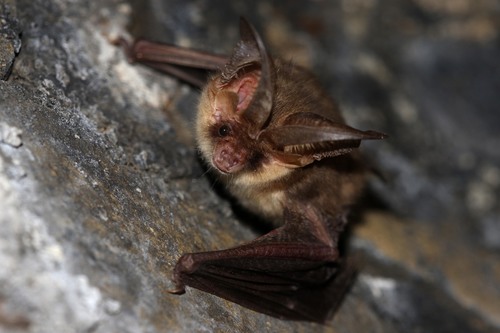
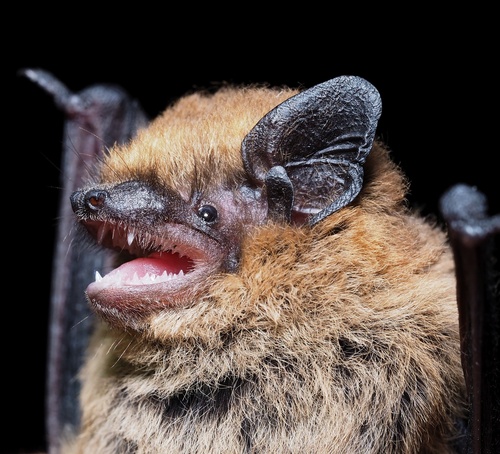
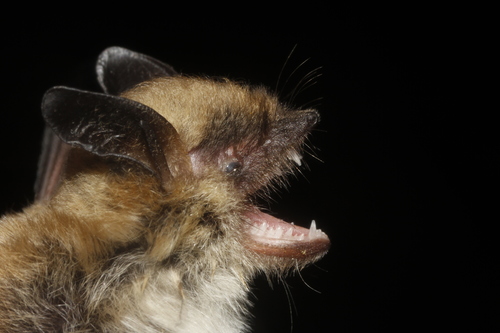
Myotis thysanodes, commonly called the fringed myotis, has the shortest ears among the long-eared myotis group. It gets its common name from a distinct fringe of short, wire-like hairs on the membrane between its hind legs. This species can live up to 18 years or more, with an average total body length of roughly 85 millimetres (3.3 in) and an average weight of 8.8 grams (0.31 oz).
Measurements
Its ears are about 16.5 millimetres (0.65 in) long, and extend roughly 5 millimetres (0.20 in) beyond the snout. The hind foot measures 8–9 millimetres (0.31–0.35 in), and the tail measures 37–40 millimetres (1.5–1.6 in). Sexual dimorphism occurs in this species, with males being much smaller than females.
Coloration and Dentition
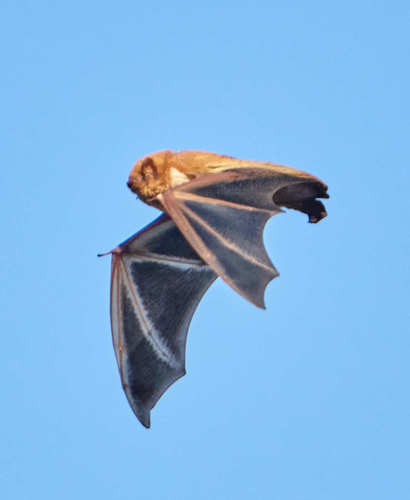
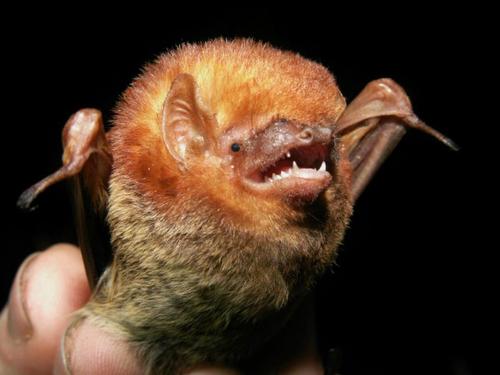
It has a full pelage that is typically light yellow-brown or olive on the back and off-white on the underside. Northern populations of this species tend to have darker coloration. The dental formula of Myotis thysanodes is 2.1.3.3 / 3.1.3.3.
Range
Fringed myotis live mainly in the western United States, ranging as far north as British Columbia and as far south as Mexico.
Habitat
They are primarily found in desert shrublands, sagebrush-grassland, and woodlands dominated by Douglas fir, oak, and pine trees. They typically inhabit elevations between 1,200 and 2,100 m, but have been observed as high as 2,850 m in New Mexico and as low as 150 m in California.
Reproduction
Most mating for this species occurs in autumn, while ovulation, fertilization, and implantation take place between late April and mid-May. Gestation typically lasts 50 to 60 days, so young are born between late June and mid-July. Each litter produces only one unusually large pup.
Early Development
A newborn can weigh up to 22% of its mother’s weight, and measure up to 54% of its mother’s length. For the first few weeks of life, young remain in specialized "maternity roosts". Several females stay in these roosts to nurse the young, while other females leave each night to forage. While not fully precocial, the pups are able to fly just a little over two weeks after birth.