About Myoporum insulare R.Br.
Common Name and Growth Form
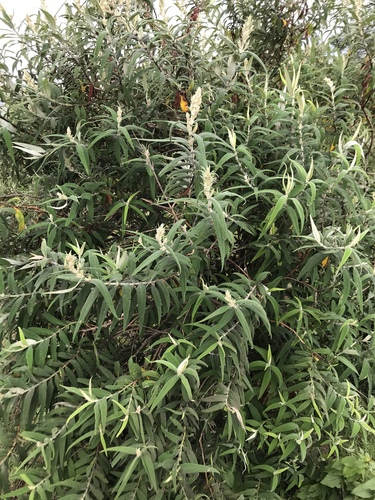
Commonly called boobialla, Myoporum insulare R.Br. varies in growth form from a prostrate shrub to a small, erect tree reaching 6 metres (20 feet) in height.
Leaf Size
It produces thick, smooth green leaves that measure 30–90 mm (1.2–3.5 in) long and 7–22 mm (0.28–0.87 in) wide.
Leaf Margin
Leaf edges are either untoothed, or toothed toward the tip of the leaf.
Leaf Shape and Color
Leaves are egg-shaped, and both the upper and lower leaf surfaces are the same dull green colour.
Flower Arrangement and Size
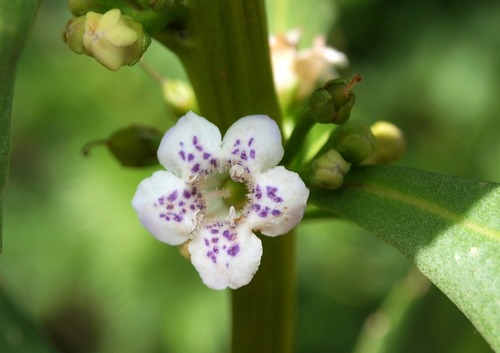
White flowers with purple spots grow in clusters of three to eight in leaf axils, and are 6–8 mm (0.24–0.31 in) in diameter.
Sepal Characteristics
This species has five glabrous, smooth sepals.
Petal Tube Structure
The tube formed by the petals is 2.3–3.6 mm (0.091–0.142 in) long, with the lobes of the tube about the same length as the tube.
Stamen Characteristics
The four stamens usually extend slightly beyond the petal tube.
Flowering Period
Peak flowering occurs from July to February in Western Australia, and from October to December in south-eastern Australia.
Fruit Characteristics
After flowering, the plant produces a smooth, rounded purple to black drupe that is 4.5–9 mm (0.18–0.35 in) in diameter.
Native Distribution Range
Myoporum insulare occurs naturally in coastal areas of New South Wales, Victoria, South Australia, Western Australia and Tasmania.
New South Wales Distribution
In New South Wales, it occurs from Eden southward, though an isolated occurrence was recorded much further north on Brush Island.
Lord Howe Island Distribution
It is also found on Lord Howe Island.
Victoria Distribution
In Victoria, it grows in coastal areas and also grows inland in the west of the state.
South Australia and Western Australia Distribution
Boobialla is common along the coast of South Australia, and in Western Australia it occurs south from Shark Bay to the South Australian border.
Habitat and Substrate
It grows in sandy soils, often between rocks or near sandstone.
Invasive Range
Myoporum insulare is invasive in several African countries and in the western coastal areas of the United States.
Invasive Population Taxonomy Note
Invasive populations recorded as this species may actually include some other species of the same genus.
South African Common Name
In South Africa this species is known by the common name manatoka.