About Mycteroperca tigris (Valenciennes, 1833)
Body Shape
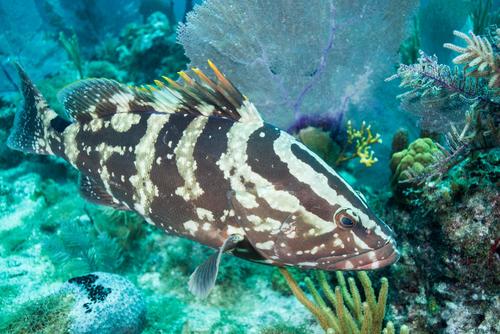
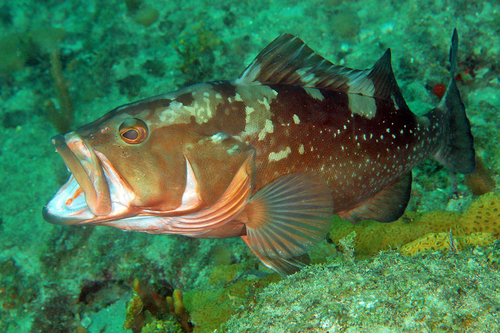
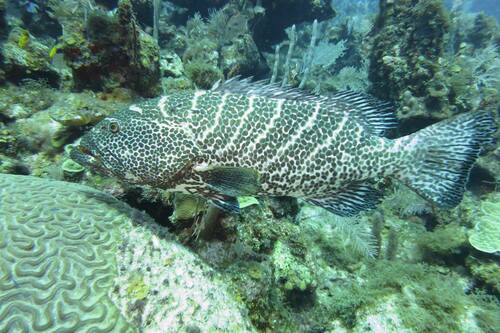
The tiger grouper, Mycteroperca tigris, has an elongate, robust, compressed body. Its body depth at the origin of the dorsal fin is no greater than its depth at the origin of the anal fin, and the species has a large mouth.
Body Proportion
The standard length of this fish is between 3.1 and 3.6 times its body depth. Its preopercle is rounded, with no lobe at its angle.
Fin Structure
The dorsal fin holds 11 spines and 15 to 17 soft rays, while the anal fin holds 3 spines and 11 soft rays. The membranes between the dorsal fin spines are distinctly notched.
Caudal Fin Shape
The caudal fin is straight in juvenile tiger groupers and slightly concave in adults.
Adult Coloration
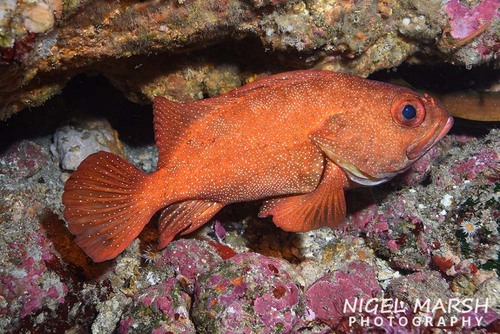
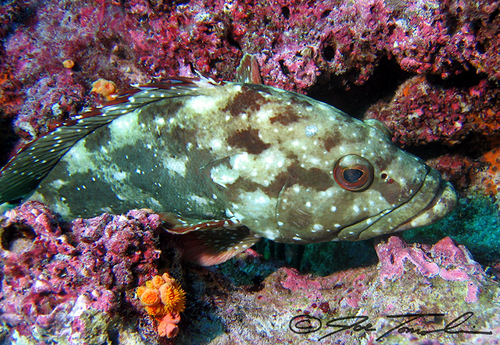
The upper body of adults is dark, marked with 9 to 11 thin, pale oblique lines. This species can change its colour dramatically, and can lighten or darken its overall colour; it can occasionally appear bright red, particularly when it is being attended to by cleaner fish.
Juvenile Coloration
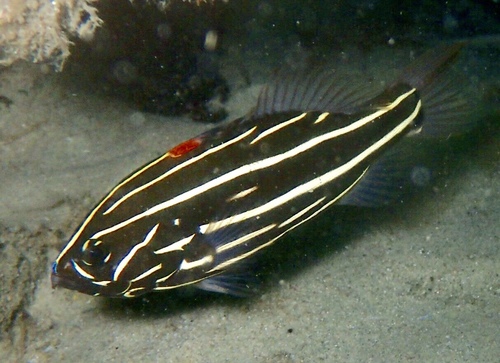
Juvenile tiger groupers are yellow, with a dusky line running along their flanks.
Size and Weight
This species reaches a maximum total length of 101 centimetres (40 in), though individuals are commonly around 40 centimetres (16 in); the maximum published weight for the species is 10 kilograms (22 lb).
Distribution Range
Tiger grouper is distributed in the western Atlantic Ocean. Its range extends in the north from southeastern Florida, Bermuda, the Bahamas, and the Flower Garden Banks, south through the Caribbean Sea to the Maroni River in French Guiana.
Disjunct Population
There is a separate disjunct population in Brazil, found from Ceara State to Rio de Janeiro State.
Habitat
This is a solitary species that lives on coral reefs and in rocky areas. It is an ambush predator that hunts smaller fishes, and hides among coral and sponges, attempting to stay concealed even when approached.
Cleaning Behavior
It visits the cleaning stations of cleaner fish.
Reproductive Biology
The size distribution and sex ratio of the population around Bermuda suggests that tiger groupers are protogynous hermaphrodites: all individuals with a total length less than 37 centimetres (15 in) are female, and all individuals with a total length greater than 45 centimetres (18 in) are male.
Depth Range
Tiger groupers occur at depths ranging from 3 to 112 metres (9.8 to 367.5 ft).
Spawning Behavior
They are known to form spawning aggregations in the northern part of their range, though no such aggregations have been recorded off the coast of Brazil.