About Mycteroperca olfax (Jenyns, 1840)
Common Name & Body Shape
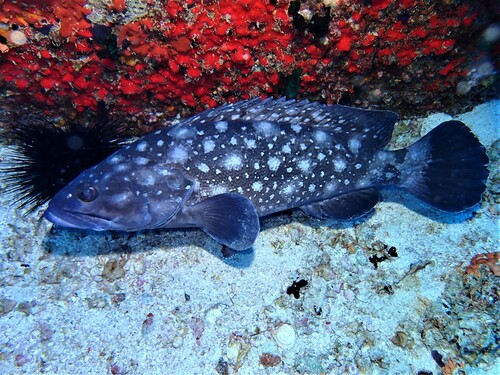
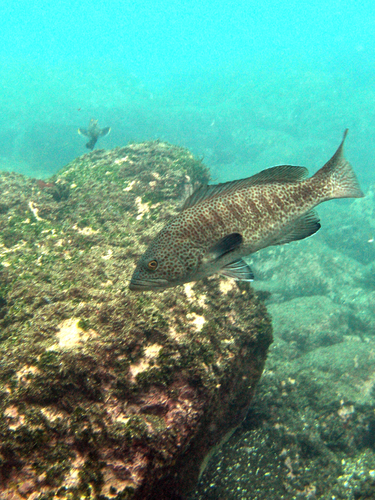
Mycteroperca olfax, commonly called the sailfin grouper, has an elongated, robust, laterally compressed body.
Body Depth Proportion
Its body depth is equal at the origin of both the dorsal fin and the anal fin, and its standard length measures 2.9 to 3.1 times its body depth.
Preopercle Structure
The preopercle is angular, with a serrated lobe at its angle.
Fin Ray Counts
The dorsal fin has 11 spines and 16 to 17 soft rays, while the anal fin has 3 spines and 11 soft rays.
Dorsal Fin Morphology
The membranes between the dorsal fin spines are not deeply notched, and the soft-rayed portion of the dorsal fin has a rounded shape.
Caudal Fin Variation
Adult sailfin groupers have an emarginate caudal fin, and juveniles have a truncate caudal fin.
Base Color & Body Markings
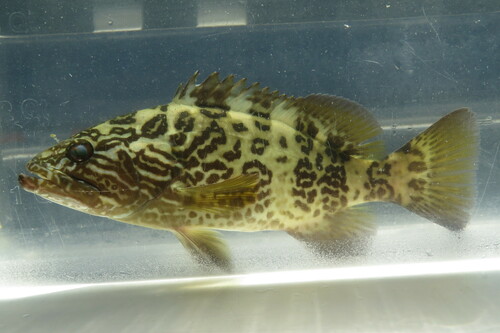
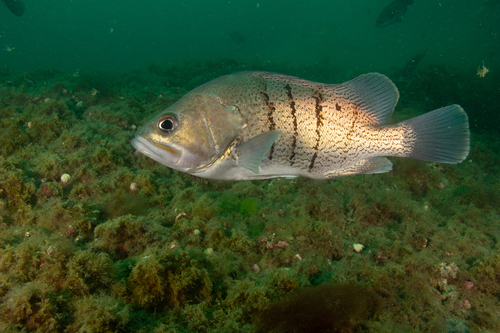
The head and body are typically pale grey-brown, covered in numerous closely spaced brown spots, and sometimes feature 10 to 12 thin, potentially broken dark bars across the upper body.
Fin Margin Coloration
The fin margins are dark and marked with narrow white borders.
Rare Color Morph
Rarely, individual sailfin groupers may be entirely bright yellow.
Maximum Total Length
This species reaches a maximum total length of 120 centimetres (47 in).
Core Distribution Range
The sailfin grouper is native to the eastern Pacific Ocean, where it is found in waters around Ecuador’s Galapagos Islands, Costa Rica’s Cocos Island, and Colombia’s Malpelo Island.
Vagrant Occurrence
Sporadic vagrant individuals have been recorded along the mainland coast between Costa Rica and Peru.
Adult Habitat
Adult sailfin groupers live along rock walls, rocky reef drop-offs, underwater lava ridges, and other vertical rock formations.
Juvenile Habitat
Juveniles are found in shallow sandy lagoons, seagrass beds, mangrove lagoons, shallow lava reefs, and even inland lava ponds.
Adult Diet
Adults are piscivorous, and the main prey of large adult sailfin groupers is the Pacific creolefish (Paranthias colonus).
Female Sexual Maturity
Female sailfin groupers reach sexual maturity at 4 years of age, when they reach a total length of around 47.5 centimetres (18.7 in).
Sex Transition Age & Size
They transition to male at around 12 years of age, when they reach a total length of 83.7 centimetres (33.0 in).
Hermaphroditism Status
The species’ skewed sex ratio and lack of small males suggest it is a monandric protogynous hermaphrodite, though this has not been confirmed through histological analysis.
Spawning Period & Aggregations
Spawning occurs from October to April, peaking in October and December, and spawning aggregations have been observed.
Non-Spawning Sexual Segregation
Outside of the spawning season, males and females appear to be ecologically separated, with males occurring further offshore than females.