About Morethia obscura Storr, 1972
General Skink Classification
Skinks are small reptiles in the family Scincidae, one of the most diverse known lizard families.
General Skink Morphology
Most skinks have relatively small legs out of proportion to their body size, lack a pronounced neck, and are bilaterally symmetrical.
Common Name and Similar Species
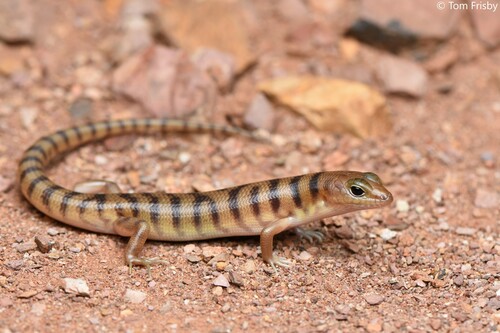
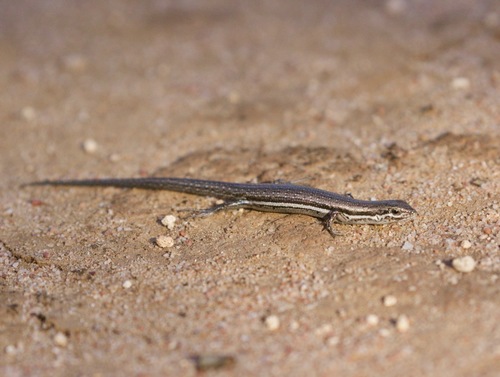
Morethia obscura, commonly called the shrubland Morethia skink, is often mistaken for the ragged snake eyed skink (C. pannosus).
Adult Body Weight
M. obscura is a small terrestrial lizard with an average adult body weight of approximately 1.9 grams.
Dorsal Surface Coloration
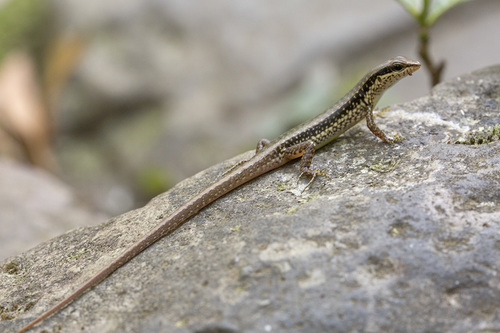
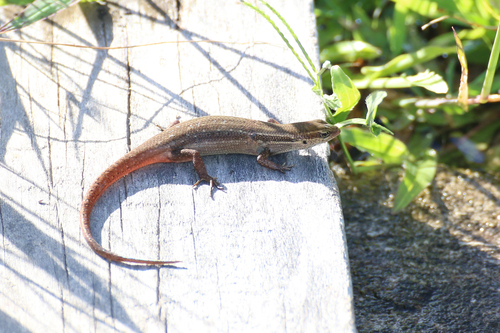
Its dorsal surface ranges from olive brown to olive gray.
Body Striping
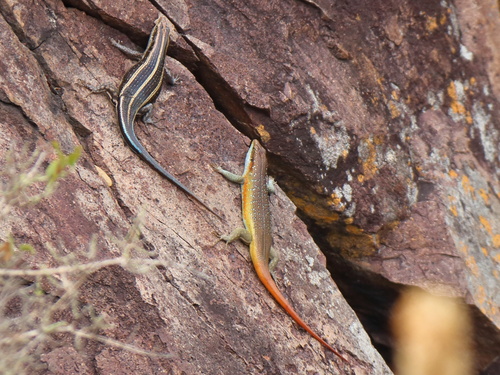
This species sometimes has a pale dorsolateral stripe and a broad, irregular black lateral stripe.
Body Length Measurements
Intact-tailed adults measure roughly 107 mm to 129 mm in total length, with a snout-vent length ranging from 18 mm to 56 mm.
Nuchal Plate Morphology
M. obscura has one pair of nuchals, which are plates that cover the dorsal portion of the neck.
Ear Structure and Hearing
It has between one and four ear openings, a tympanic middle ear system, and an inner ear structure called an otolith that detects acceleration and acoustic sounds, with a hearing range of up to 40 dB.
Mid-body Scale Arrangement
Mid-body scales are usually arranged in 26 to 28 rows.
Fourth Toe Lamellae Morphology
Lamellae, which are thin plates, under the fourth toe are smooth or keeled, and unicarinate.
Geographic Distribution
The shrubland Morethia skink occurs in woodlands, heaths, and shrublands, often associated with mallee and spinifex, in arid and semi-arid areas of southwest New South Wales, southern South Australia and some of its offshore islands, northwest Victoria, and southern Western Australia.
Preferred Habitat Openness
It is abundant in open areas with little vegetation, such as forest edges.
Heliothermic Habitat Requirements
This allows the species to access food resources from within forests while still obtaining the ambient light and temperature levels it requires as a heliotherm.
Vegetation Density Association
Studies have found M. obscura is less abundant, and almost non-existent, in heavily vegetated areas.
Habitat Rainfall Range
The areas it inhabits generally receive less than 500 mm of rainfall per year.
Habitat Degradation Susceptibility
Because M. obscura is most abundant around the edges of forest fragments, it is less susceptible to harm from habitat degradation.
Sexual System
M. obscura reproduces sexually through a dioecious sexual system, with distinct male and female individual organisms.
Reproductive Mode
It is an oviparous species, meaning it lays eggs.
Clutch Size
Clutch size generally ranges from 3 to 5 eggs.
Breeding Season Timing
The breeding season starts between October and early November.
Egg Retention and Laying
Fertilized eggs are retained in the female's reproductive system until late January each year, when the eggs are laid with the embryo already in an advanced state of development.