About Monardella odoratissima subsp. villosa (Benth.) Brunell
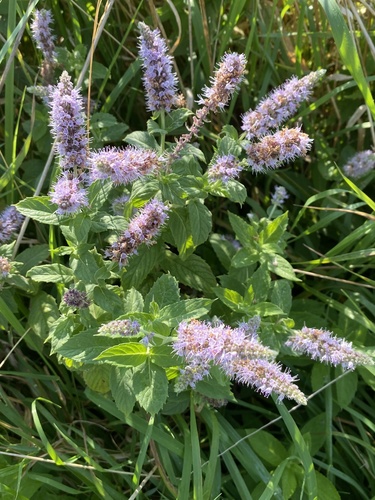
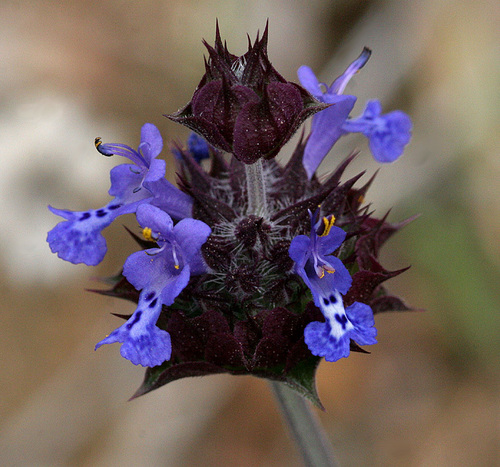
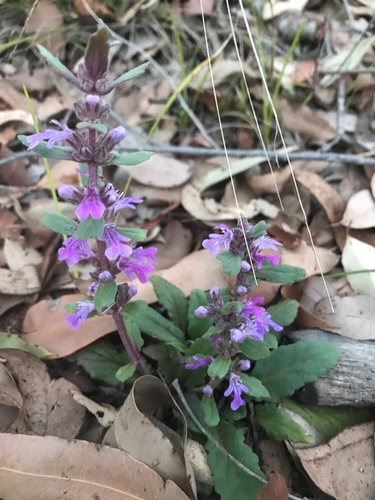
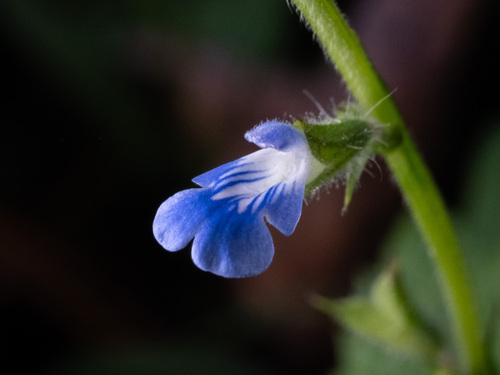
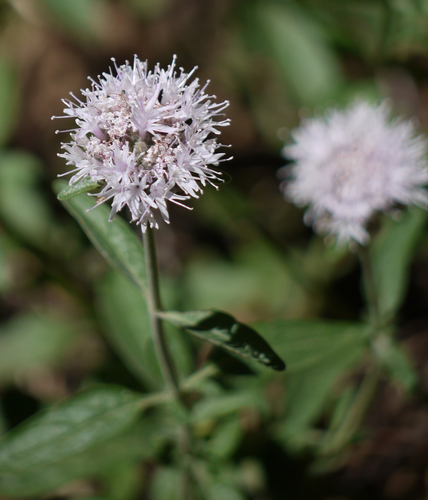
When distinguished from Monardella villosa, Monardella odoratissima subsp. villosa is a subshrub that reaches 10–45 cm (4 in – 1 ft 6 in) in height. It is generally sparsely hairy, and occasionally bears sparse stalked, cone-shaped glandular hairs. Its untoothed leaves are 15–50 mm (0.6–2.0 in) long and 5–18 mm (0.2–0.7 in) wide, ranging in color from green to ashy gray, and are often tinged with purple. Leaves may be either sparsely or densely hairy, and glandular hairs on the underside of the leaf grow in pits. The inflorescence is a flower cluster that is usually 12–28 mm (0.5–1.1 in) across, though it may grow up to 37 mm (1.5 in) across. Each main stem can bear one or several inflorescences. The inflorescence has erect bracts that form a cup-like structure; the bracts are pale greenish, or tinged purple to rose. Each flower has sepals 6–11 mm (0.2–0.4 in) long that are densely hairy or woolly. The petals are white, lavender, or purple, and measure 10–20 mm (0.4–0.8 in) long. When defined broadly to include Monardella villosa, the species occurs in western North America, ranging from British Columbia in the north, through Colorado, Idaho, Montana, Oregon, Utah, and Washington, to Arizona, California, and New Mexico in the south. It is found in many Northern California mountain ranges, including the Klamath Mountains, the Northern California Coast Ranges, the Cascade Range, the Sierra Nevada, the Modoc Plateau, the White Mountains, and the Inyo Mountains. Monardella odoratissima is easy to grow as a garden plant. Although Monardella belongs to the mint family, most species do not grow from runners, but can still be propagated easily from cuttings. The plant is very attractive to butterflies, which are its main pollinator. It will grow in full sun to medium shade. It can be pruned lightly in late fall or early winter to create a bushier plant, as it can grow sprawling if left unpruned. It blooms profusely at any time from April through August. Because the plants produce many flowers, they look best when spent blooms are deadheaded.