About Mixophyes fleayi Corben & Ingram, 1987
Size
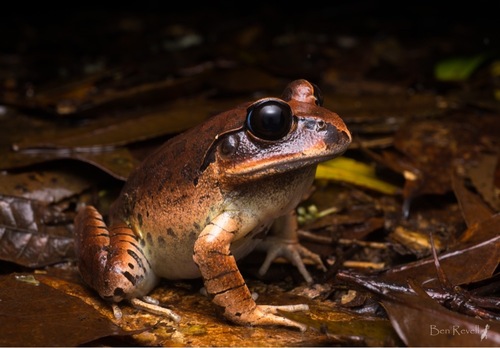
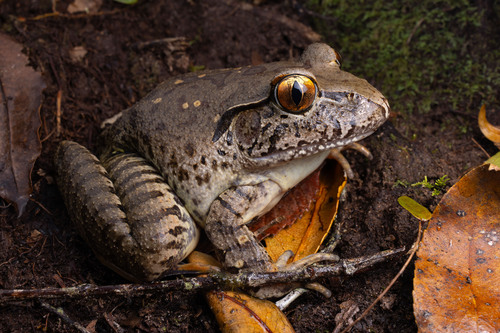
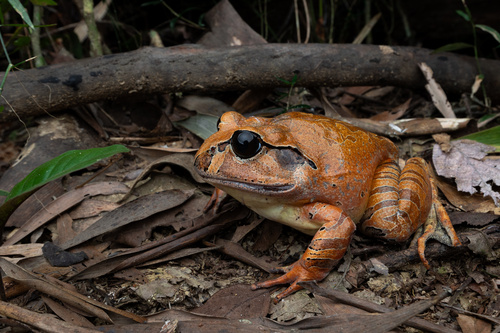
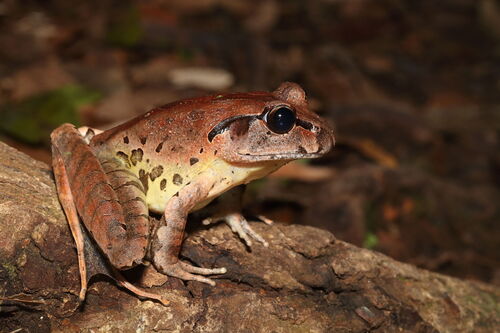
Fleay's barred frog, scientifically named Mixophyes fleayi Corben & Ingram, 1987, is a moderately large frog species that reaches up to 90 millimeters in length.
Dorsal Appearance
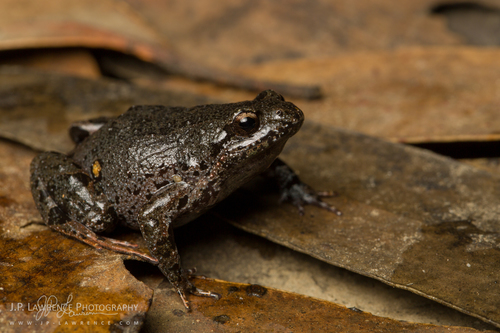
Its dorsal surface is finely granular, and its base color is light brown marked with darker blotches. An irregular darker brown band runs from behind the eyes down along the back, and a dark stripe on the head extends from in front of the nostril through the eye to the tympanum.
Limb and Head Markings
The arms and legs have 7 to 8 narrow dark bars, the flanks bear scattered dark spots and blotches, the upper lip is spotted with brown, and the iris is silvery to pale blue in its top third and brown in the bottom two thirds.
Ventral and Limb Features
The ventral surface is smooth, and colored pale yellow or white. The toes are three-quarters webbed.
Etymology
This species was named after David Fleay, an Australian naturalist.
Distribution Range
This frog has a fragmented distribution across wet forests, ranging from the Conondale Range in Queensland in the north to Yabbra Scrub in northern New South Wales in the south. The majority of its population lives in rainforests above 400 meters, though it is also found in some lowland rainforest sites.
Population Decline
The species has declined across many Queensland sites since the 1970s. It is currently known to occur in Conondale and Main Range, Springbrook and Lamington Plateaux, and Mount Barney in Queensland, and in Border Ranges, Mount Warning, Nightcap Range, and Yabbra and Tooloom Scrub in New South Wales.
Historical Range
Its historical area of occurrence is approximately 7000 square kilometers, and it has disappeared entirely from Bunya Mountains and Mount Tamborine in Queensland.
Habitat
Mixophyes fleayi lives alongside flowing streams and creeks in rainforest, as well as adjacent wet sclerophyll forest and Antarctic Beech forest.
Mating Call
During spring and summer, after rain, males call from stream-side leaf litter with a call sounding like "ok-ok-ok-ok-ok" or "arrrrk".
Reproduction
Eggs are laid in a dug-out nest in gravel and leaf litter located in shallow flowing water.
Tadpole Characteristics
Tadpoles of this species are large, reaching up to 65 millimeters in length.
Metamorphosis
Metamorphosis takes around 200 days to complete; newly metamorphosed frogs measure about 20 millimeters, and resemble adults except that their iris is copper-red.
Population Assessment Difficulty
It has been difficult to measure the full extent of this species' population decline due to the absence of historical records of occupied sites and population abundance.