About Mimetes saxatilis E.Phillips
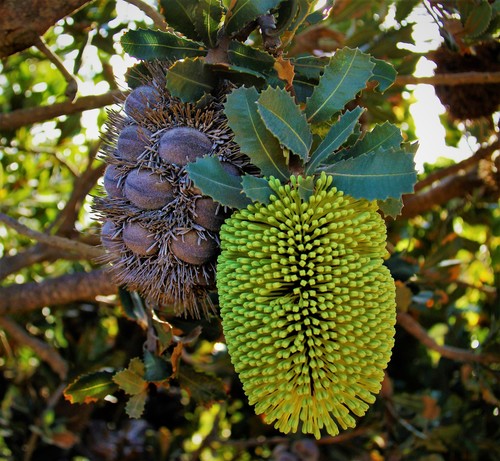
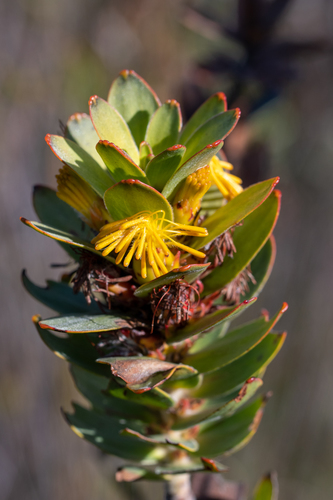
Mimetes saxatilis (E.Phillips) is an evergreen, upright, rarely branching shrub that reaches 1–2¼ m (3⅓–7¼ ft) in height. Its branches are ½–1 cm (0.2–0.4 in) thick; they are initially densely felty, and become hairless as they age, leaving conspicuous marks after leaves are shed. The leathery leaves are arranged alternately, held at a slight upward angle and somewhat overlapping, and lack both stipules and leaf stalks. Leaves are elliptic to broadly oval, 3½–5 cm (1.4–2.0 in) long and 1½–3 cm (0.6–1.2 in) wide, with an entire margin and a blunt thickened tip, or sometimes three crowded teeth. They have a row of hairs along the edge, and a surface that is initially felty before becoming hairless. Inflorescences at the tip of shoots are cylinder-shaped, 5–10 cm (2–4 in) long and 5–6 cm (2.0–2.4 in) in diameter, positioned below a crest of green, oval or elliptic, more or less upright leaves. Each flower head contains 14 to 22 individual flowers, and is subtended by an ordinary, flat, green leaf. The outer whorl of bracts surrounding the flower head is loosely arranged, oval to broadly lance-shaped with a pointed tip, 1–2½ cm (0.4–1.0 in) long and 6–8 mm (¼–⅓ in) wide, with a hairless surface apart from a row of hairs along the edge. Bracts on the inside of the flower head are narrowly lance-shaped, 1¼–2½ cm (½–1 in) long and ¼–½ cm (0.1–0.2 in) wide. The bract subtending each individual flower is lance-shaped, 1¼–2¼ cm (0.5–0.9 in) long and 1–2 mm (0.04–0.08 in) wide, with very densely silky margins. The yellow 4-merous perianth is 3–3½ cm (1.2–1.4 in) long. Its lower merged section, called the tube, which remains connected when the flower opens, is about 2 mm (0.08 in) long, slightly inflated, and hairless. The four segments of the middle section (claws) are thread-shaped and carry some felty hairs. The upper segments (limbs), which enclose the pollen presenter while in bud, are boat-shaped and linear with a pointed tip in outline, about 5 mm long, with a few scattered hairs. The four anthers are about 2 mm (0.08 in) long, lack filaments, and are directly attached to the limbs. A slender style 3–5 cm (1.2–2.0 in) long emerges from the center of the perianth, and is pale yellow near its thickened tip, the pollen presenter. The pollen presenter has a ring at its base, a squared cylinder shape in its middle section, and a pointed egg-shaped tip. The ovary, approximately 1 mm (0.04 in) long, is egg-shaped, covered in fine silky hairs, and is subtended by four pointed, awl- to line-shaped scales around 2 mm (0.08 in) long. After fertilization, the ovary develops into a cylinder-shaped fruit 6–8 mm (¼–⅓ in) long and 3–4 mm in diameter. Mimetes saxatilis occurs in an approximately 100 km (63 mi) long, narrow 3 km (2 mi) wide strip along the South African south coast, extending from Franskraal in the west to Struisbay, several kilometers east of Cape Agulhas, and stretches inland in a narrow strip to around Bredasdorp. It grows at elevations from sea level up to a maximum of 180 m (590 ft). It only grows on limestone from the Alexandria Formation and the alkaline soils derived from this rock, and appears to thrive best in bare rock sinkholes and crevices. It grows alongside other limestone-loving protea species, including Leucospermum patersonii, Protea obtusifolia and Leucadendron meridianum. Flowering can occur any time between July and December, and appears to depend on the availability of sufficient moisture. Across most of its distribution range, average annual precipitation is about 400 mm (16 in). Fruits ripen approximately 9 months after flowering.