About Microseris troximoides A.Gray
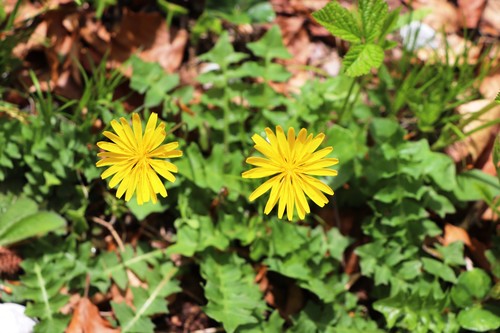
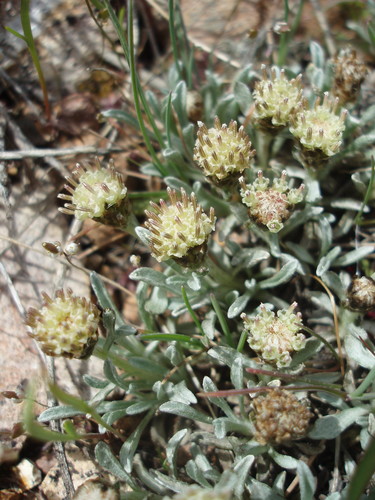
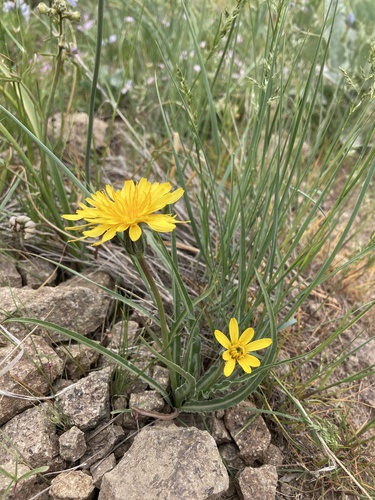
This species, currently accepted under the scientific name Microseris troximoides A.Gray, is also referenced as Nothocalais troximoides in botanical literature. It is a perennial herb that grows from a stout root and thick caudex, producing a woolly flower stem reaching up to approximately 25 centimeters (10 inches) tall. Its leaves grow in a basal cluster around the base of the stem. Individual leaves are linear, up to 30 centimeters (12 inches) long, and typically have a paler, prominent midrib. Leaf edges are often crinkled and wavy; leaves sometimes bear a thin coat of small hairs, with a thicker fringe of hairs along the leaf margin. Each flower stem produces exactly one flower head. The flower head is lined with green phyllaries that are sometimes speckled with purple. It contains many yellow ray florets and no disc florets. The fruit is a cylindrical achene that reaches up to 1.3 centimeters (1/2 inch) long, not counting its large pappus. The pappus consists of up to 30 silvery white bristles that can add an additional 2 centimeters (3/4 inch) to the total length of the fruit. This plant is native to British Columbia, Canada, and the northwestern United States, where it occurs in Washington, Oregon, northern California, Idaho, and Montana. It grows in sagebrush and other plateau and mountain habitats, most often in rocky soil.