About Ambrosia salsola (Torr. & A.Gray) Strother & B.G.Baldwin
Common Names and Taxonomy
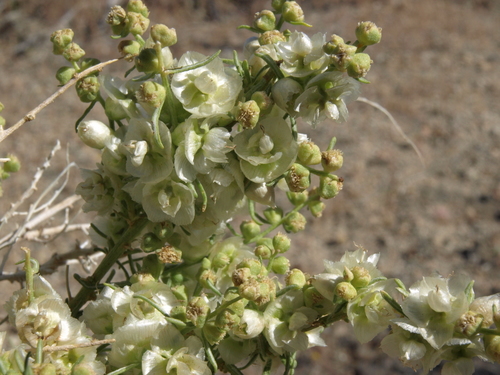
Ambrosia salsola (Torr. & A.Gray) Strother & B.G.Baldwin is commonly known by multiple common names: cheesebush, winged ragweed, burrobush, white burrobrush, and desert pearl. It is a perennial shrub species in the Asteraceae family, native to the deserts of the southwestern United States and northwestern Mexico.
Distinctive Traits and Hybridization
This species is notable for its foul smell, and it easily hybridizes with white bur-sage (Ambrosia dumosa).
Habitat Types
It is common in sandy desert flats and desert dry washes, and grows as a weed in disturbed sites within creosote bush scrub, shadscale scrub, Joshua tree woodland, and Pinyon juniper woodland.
Geographic Range
Its range extends from Inyo County, California, to northwestern Mexico.
Soil and Elevation Preferences
It grows in sandy and gravelly soil, and sometimes occurs on lava formations, at elevations between 200 and 1,800 m (660 and 5,910 ft).
Native Distribution
It is native to Arizona, California, Nevada, and Utah in the southwestern United States, and Sonora, Baja California, and Baja California Sur in northwestern Mexico.
Environmental Adaptations
In this region, it is a common desert plant that thrives in sandy soil, alkaline environments, and disturbed sites.