About Micrastur semitorquatus (Vieillot, 1817)
Plumage and Morphs
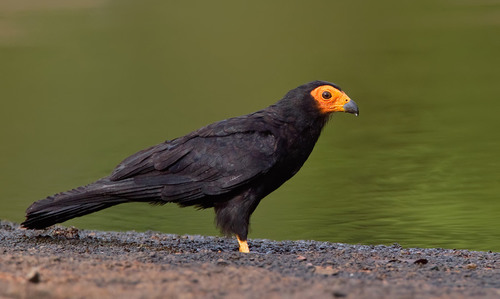
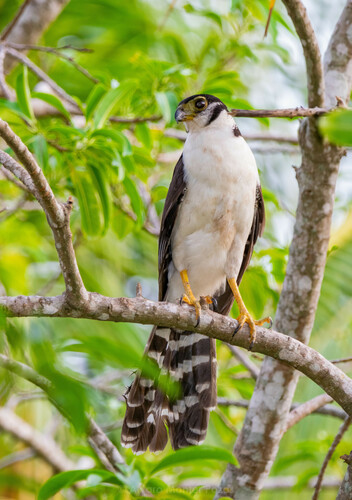
The collared forest falcon (Micrastur semitorquatus) has a dark-colored back, with a white neck and breast. This species has three distinct morphological variants, or morphs: pale, tawny, and dark. The first two morphs have a light-colored collar on the back of their neck, which gives the species its common name.
Size Measurements
It is the largest species in the forest falcon genus, with a total length of 46 to 58 cm (18 to 23 in), and a wingspan of 72 to 86 cm (28 to 34 in). Males weigh 467 to 646 g (1.030 to 1.424 lb), with an average weight of 523 g (1.153 lb), while females weigh 649–940 g (1.431–2.072 lb), with an average weight of 740 g (1.63 lb).
Morphological Comparisons
This species is nearly the size of a peregrine falcon, but it has a longer tail and much shorter wings. Although its forest-dwelling lifestyle, rounded short wings, long tail, and lack of the characteristic falcon beak tooth suggest a relationship to hawks, several morphological features link it to the Falconidae family, where it is currently classified. These linking features include its moult pattern and skull morphology.
Sexual Dimorphism
M. semitorquatus exhibits sexual size dimorphism: females are much larger than males across many measurements, including mass, beak size, tail length, and wing chord. The species has an average dimorphism index value of 9.5, which is considered moderately large, and this value was calculated from observations collected at Tikal National Park in Guatemala.
Newly Hatched Traits
Newly hatched nestlings are covered in natal down, with white nails, light yellow legs, and short, deep, laterally compressed yellowish-white beaks. Nestlings can hold their heads up and open their eyes after a few days after hatching.
Nestling Development
At hatching, pupils have a blue background tint and irises are black; after four weeks, the irises change to a darker chocolate brown. Young falcons are able to defend themselves when disturbed within a few weeks of hatching.
Fledgling Transition
Natal down is completely replaced by juvenile feathers by the sixth week after hatching, but fledging occurs before wing and tail feathers are fully grown. In the weeks after fledging, young falcons continue to move further away from the nesting site as they grow larger and gain more confidence.
Geographic Range
This species is commonly found across many countries in Central and South America: Argentina, Belize, Bolivia, Brazil, Colombia, Costa Rica, Ecuador, El Salvador, French Guiana, Guatemala, Guyana, Honduras, Mexico, Nicaragua, Panama, Paraguay, Peru, Suriname, and Venezuela. It is extremely widespread, with a total estimated population between 500,000 and 5 million individuals.
Residency Status
These falcons are year-round permanent residents throughout their range in Latin America.
Habitat Preferences
Their distinct body shape allows them to live in a wide variety of habitats, ranging from moister areas like mangroves, tropical forests, and rainforests, to gallery forest and tall second growth. They tend to prefer areas with relatively dense undergrowth, which makes it easier for them to move and hunt.
Elevation and Density
Their range extends from sea level up to 2500 m in elevation. It has been estimated that around ten territorial pairs occupy a 100 km2 area, though this estimate comes from radio telemetry data collected during the breeding season, so the density may differ in other contexts.
Courtship Period
Courtship behaviors, which include vocalizations, searching for and guarding nest sites, prey exchanges, and copulation, take place during the dry season from January to March. Egg laying occurs over a 30-day period, peaking in March.
Incubation Process
The incubation period lasts around 46–48 days, and only the female incubates the eggs. During incubation, the male provides all of the food for the pair.
Post-Hatching Care
On average, young falcons fledge at 50 days after hatching. After fledging, young remain dependent on their parents for an additional 6–11 weeks.
Parental Hunting Roles
The female only begins leaving the nest to hunt late in the nestling period, and before that point the male is the sole provider of food for the family.
Alloparental Behavior
There have been recorded observations of collared forest falcons feeding fledglings that are not their own offspring. Little is currently known about why this behavior happens or how frequently it occurs.