About Mesembryanthemum cordifolium L.fil.
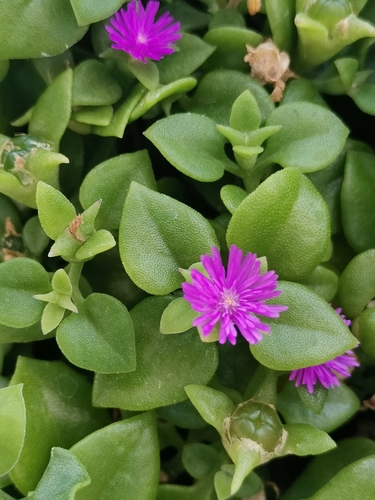
Mesembryanthemum cordifolium L.fil. is a succulent, creeping, short-lived, mat-forming perennial herb. It grows in flat clumps on the ground from a woody base, reaching only around 10 centimetres (3.9 in) in height, while its prostrate stems can grow up to 60 centimetres (24 in) long. Stems are green and cylindrical, and it bears small, fleshy opposite leaves that are ovate to cordate, around 2.5 centimetres (0.98 in) long and covered in fine papillae.
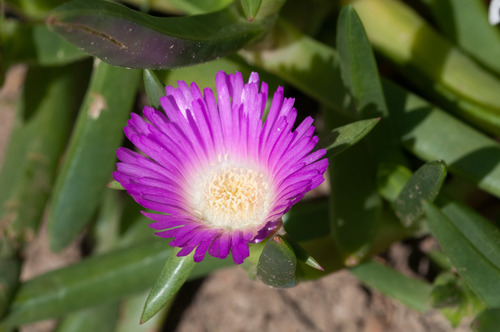
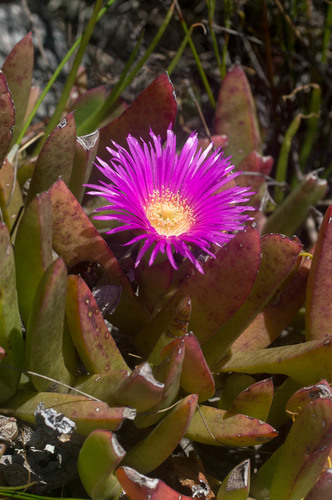
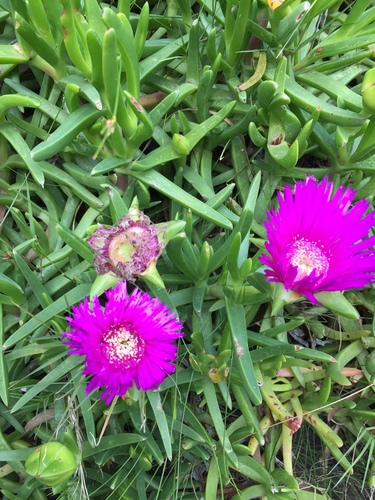
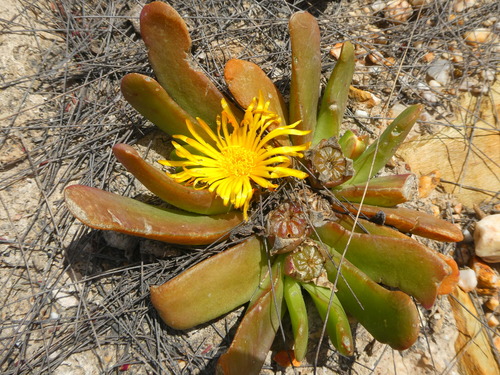
Bright pink to purplish solitary flowers grow in leaf axils. These flowers open during the day, close at night, and stay closed on cloudy days. The colored whorls on these flowers are not true petals, they are non-functional modified stamens. Functional, normal stamens are yellow. Flowering occurs primarily from spring through fall. The fruit is a capsule just over one centimeter long, which contains 1-millimeter-sized brown tuberose seeds. A variegated cultivated form of this species exists.
This species is native to Eastern Cape Province, South Africa, and is widely cultivated as an ornamental plant. It has escaped cultivation and become naturalized in many regions beyond its native range, including Australia, parts of California, Oregon, and Florida, the Mediterranean region of Europe, and central Mexico. It has recently been confirmed to be invasive in California, and is listed there as a wildland weed red alert.
The primary use of Mesembryanthemum cordifolium is ornamental. Local people in its native region use it for its anti-inflammatory properties. This species contains the alkaloids mesembrine (a serotonin reuptake inhibitor and monoamine releasing agent) and demethylmesembrenol. In an analysis of 21 different plant species, this species was found to have the second highest level of mesembrine. These alkaloids also occur in Kanna (Sceletium tortuosum), and mesembrine is thought to play a dominant role in the antidepressant effects of Sceletium tortuosum.
In cultivation, Mesembryanthemum cordifolium is a fast-growing non-hardy groundcover, suitable for planting in flower boxes, around traffic lights, to cover walls and rockeries, and to fill in bare grassless areas. Its quick growth makes it useful for suppressing weed growth in areas where it is planted. It grows well in containers, including hanging baskets, where its long trailing branches can hang down with well-spaced leaves. It requires a sunny location and well-drained soil. For overwintering, it must be kept in a frost-free sunny spot at a temperature between approximately 5 to 8 °C (41 to 46 °F). No serious insect or disease problems have been recorded for this species. In addition to the pure species and the hybrid 'Red Apple', the cultivar A. x 'Mezoo' is commonly encountered; this is a mutant of 'Red Apple' with variegated leaves that have creamy white edges. A rare white-flowering form also exists.