About Mentha spicata L.
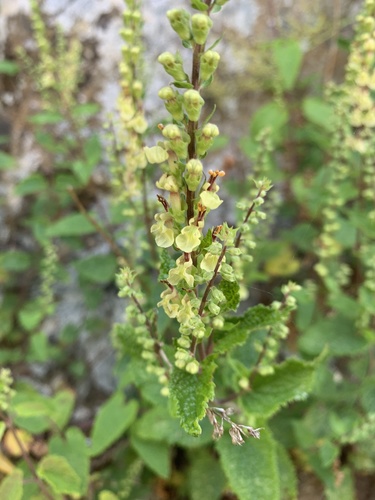
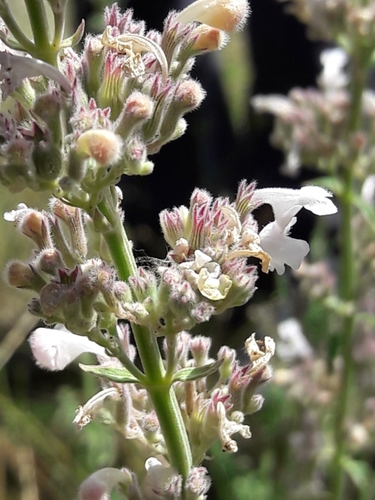
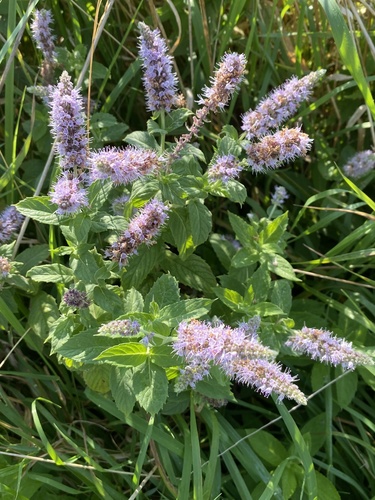
Mentha spicata L., commonly called spearmint, is a perennial herbaceous plant. It grows 30–100 cm (12–39 in) tall from a wide-spreading fleshy underground rhizome, and its stems and foliage range from mostly hairless to fully hairy. Its leaves are 5–9 cm (2–3+1⁄2 in) long and 1.5–3 cm (1⁄2–1+1⁄4 in) broad, with serrated margins and pointed tips; the name "spearmint" comes from these pointed leaf tips. Like other members of the mint family, spearmint has a characteristic square-shaped stem. Spearmint produces small pink or white flowers arranged in slender spikes; each individual flower measures 2.5–3 mm (0.098–0.118 in) long and wide. In the northern hemisphere, spearmint flowers between July and September, during the summer. It produces relatively large seeds that are 0.62–0.90 mm (0.024–0.035 in) in size. The species varies considerably in leaf blade dimensions, how prominent its leaf veins are, and the amount of hairiness (pubescence) on its tissues. Spearmint can easily adapt to grow in many different soil types. It tends to grow best in locations with full sun to partial shade, where soil contains plenty of organic material. It is naturally found in moist habitats such as swamps or creeks, growing in sandy or clay soils. Its ideal growing conditions are deep, well-drained, moist soils that are rich in nutrients and organic matter with a crumbly texture, and a soil pH between 6.0 and 7.5. Spearmint grows well in nearly all temperate climates. Gardeners most often grow it in pots or planters, because its spreading rhizomes make the plant invasive in open ground. Spearmint leaves can be used fresh, dried, or frozen. Leaves lose their desirable aromatic quality after the plant flowers, so harvesting for drying is done just before or right as flowers open at peak bloom. Harvesters typically cut the stalk halfway to three-quarters of the way down, to leave room for smaller new shoots to grow. There is ongoing disagreement over which drying method works best, with different growers favoring different wrapping materials (such as plastic or cloth) and different lighting conditions (such as darkness or sunlight). Leaves can also be preserved in salt, sugar, sugar syrup, alcohol, or oil. Spearmint is grown for its aromatic oil, known as oil of spearmint. The most abundant compound in this oil is R-(–)-carvone, which gives spearmint its distinctive scent. Spearmint oil also contains significant amounts of limonene, dihydrocarvone, and 1,8-cineol. Unlike peppermint oil, spearmint oil contains only minimal amounts of menthol and menthone. Oil of spearmint is used as a flavoring in toothpaste and confectionery, and is sometimes added to shampoos and soaps. Spearmint has a history of use in traditional medicine.